


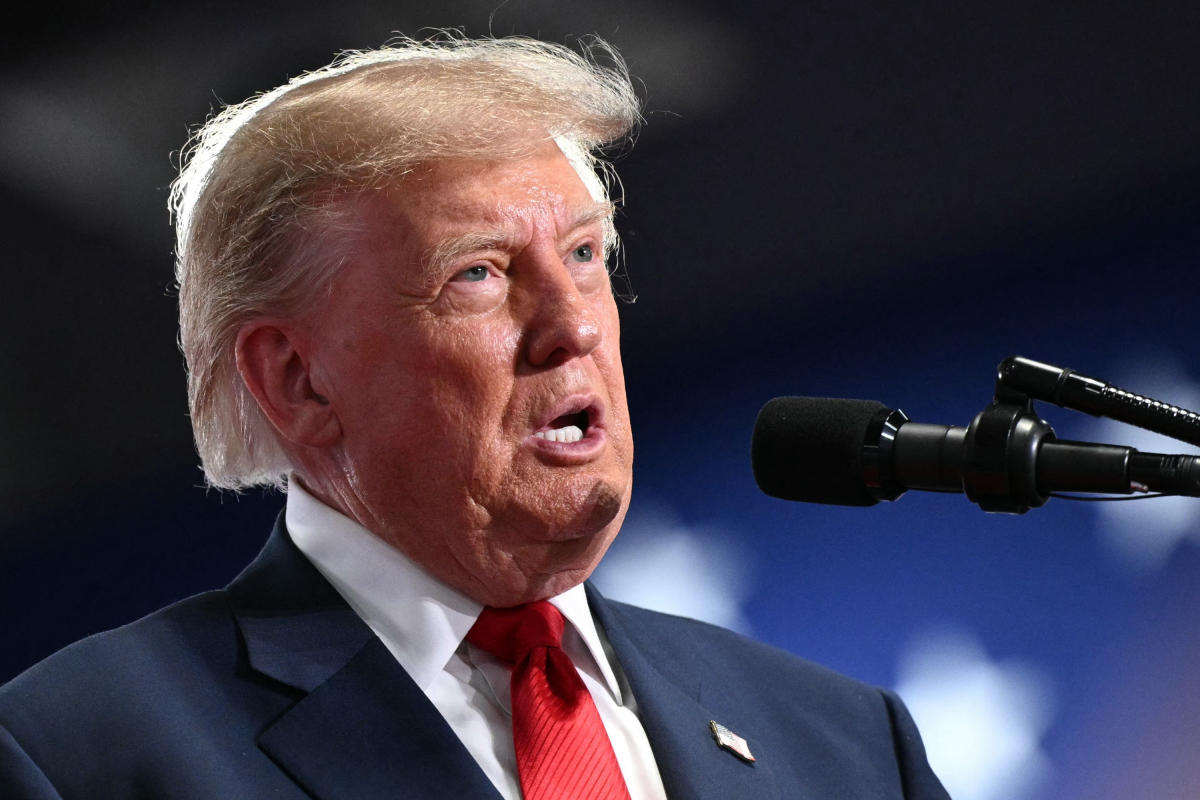
The Oncenter in Syracuse was buzzing with the kind of energy that only a presidential visit can bring. Several thousand supporters packed the venue on Friday, waving signs and cheering as the familiar strains of a campaign rally filled the air. President Donald Trump took the stage with the swagger of a man who knew exactly what his audience wanted to hear. At one point, he was joined by former heavyweight boxing champion Mike Tyson, who stepped up to the microphone, grinned, and told the crowd he was happy to be there with “my president.” It was a moment of pure spectacle, the kind of blend of sports, celebrity, and politics that has become a signature of Trump-era rallies. But the main event was not just about nostalgia or star power. Trump had come to Syracuse to campaign for Republican gubernatorial nominee Bruce Blakeman, and he wasted no time in turning the crowd’s attention to a piece of New York legislation that he believed would fire them up. With a theatrical pause, he began mocking the bill, a measure passed by state lawmakers that revises some of the language surrounding surrogacy and parentage. “You can no longer say ‘mother, hi mom!’ It’s ‘hi gestating,’” he said, drawing immediate laughter. He continued, raising his voice to a comic falsetto, “‘Hi gestating, I love you so much gestating.’” The room erupted. For Trump and his supporters, this was not just a joke about awkward wording; it was a way to paint New York Democrats as out of touch, overly bureaucratic, and hostile to the most basic family relationships.
To understand why the president’s jab landed so hard with the crowd, it helps to look at what the legislation actually does. The bill, which was passed by state lawmakers, is focused on updating terminology used in certain legal proceedings connected to surrogacy and parentage. In parts of state law, the traditional terms “mother” and “father” would be replaced with more clinical or inclusive language, including “gestating parent” and “non-gestating parent.” The measure would also swap the old-fashioned phrase “paternity” hearings for “parentage” hearings. On the surface, this might seem like a dry, technical adjustment, the kind of thing that gets lost in the fine print of legislative calendars. But in the heated atmosphere of a gubernatorial campaign, it became something far bigger. Supporters of the bill argue that the new wording is necessary to address the real-world complexity of modern family-building. In a surrogacy arrangement, for example, a child may be carried by one woman while being raised by another, or by two fathers, or by a single father. The traditional legal framework, which assumes a mother and a father are always present, simply does not fit those situations. The change to “gestating parent” and “non-gestating parent” is meant to ensure that legal parentage can be established without forcing families into categories that do not reflect their lives. To critics, however, the bill is something else entirely: an ideological project that erases the words “mother” and “father” from the law, diminishes the special role of moms and dads, and gives the state government more authority over deeply personal parental matters. It is a perfect political flashpoint, because it combines legal jargon with cultural anxiety, and it gives Republicans a way to argue that Albany Democrats have lost touch with the values of ordinary New Yorkers.
Trump, of course, did not stop at mocking the bill’s language. He quickly broadened his attack into a full-throated campaign argument against Governor Kathy Hochul, the Democratic incumbent who is seeking a full term in office. The president linked the surrogacy terminology measure to Hochul’s positions on transgender health care for children and on transgender participation in women’s sports, weaving them together into a single narrative of radical overreach. For Trump, the bill was not an isolated technicality but a symptom of a broader ideological agenda that he said was being pushed by the Democratic Party in New York. “New York needs to throw out this radical left lunatic and elect Bruce Blakeman,” he declared, tying the local race to the national culture wars that have dominated political discourse in recent years. The crowd roared its approval. The strategy was clear: make Hochul synonymous with every controversial cultural issue on the Republican playbook, from gender identity to parental rights to the language of family itself. Later, a spokesperson for Hochul’s office pushed back on the characterization, saying that no legislation changes the governor’s view that “mothers are mothers and fathers are fathers.” The statement was an attempt to walk a careful line, acknowledging the emotional resonance of the traditional terms while still defending the legal necessity of the bill. The spokesperson added that the legislation, which the governor would review, appeared to address technical legal issues related to surrogacy and parentage. And in a sharp rebuke aimed at the Republican campaign, the spokesperson said that anyone making bad-faith arguments about the bill was “deliberately misleading New Yorkers for political gain.”
Blakeman, who serves as the Nassau County executive, was more than happy to pick up where Trump left off. Earlier in the evening, he had already offered his own interpretation of the measure, calling it “insane” and using it to frame the broader stakes of the race. “They want to take control away from parents,” he told the assembled crowd. “They’re denigrating moms and dads. They’re letting Albany make the decisions that should be up to parents.” It was a powerful message, and one that clearly resonated with the Republican base in the room. For them, the surrogacy bill was not a minor procedural update but a window into the mindset of the state’s Democratic leadership. The phrase “gestating parent” sounded cold and bureaucratic, the opposite of the warmth and intimacy that the word “mother” evokes. The idea that a child might grow up hearing a legal term instead of “mom” felt like a loss, a sign that the government was inserting itself into the most personal corners of life. The governor’s office, for its part, rejected that interpretation entirely. According to The New York Post, a spokesperson for Hochul said the legislation appeared to be about technical legal issues related to surrogacy and parentage, not about denigrating traditional family roles. The response highlighted the central disagreement of this late-stage election issue. Are the new terms a necessary update to accommodate the reality of surrogacy, or are they a step toward a world where the state defines our most intimate relationships? For Republicans, the answer is obvious. For Democrats, the criticism is a cynical distortion designed to win votes by stoking fear.
The enthusiasm at the Oncenter, however, stands in stark contrast to the polling numbers in the race. Blakeman continues to trail Hochul across every recent statewide survey, and the margins are not insignificant. An Emerson College Polling/PIX11 News survey, conducted from October 3 to 5 among 900 likely voters, put Hochul ahead by 12 points, with 52 percent of the vote to Blakeman’s 40 percent, and a margin of error of plus or minus 3.3 percentage points. A Marist Poll, conducted from October 1 to 4 among 1,361 registered voters, found an 11-point advantage for the governor, with Hochul at 53 percent and Blakeman at 42 percent, and a margin of error of plus or minus 3.6 percentage points. The earlier September surveys showed an even wider spread. Quinnipiac University, which questioned 1,026 likely voters from September 17 to 20, recorded a 19-point lead for Hochul, 58 percent to 39 percent, with a margin of error of plus or minus 4.1 percentage points. A Siena University Poll, conducted from September 11 to 17 among 1,144 likely voters, placed the governor nine points ahead, 50 percent to 41 percent, with a margin of error of plus or minus 3.9 percentage points. While the margins varied from nine to nineteen points, the direction was consistent: Hochul was ahead, and sometimes comfortably. Pollsters caution that direct comparisons between these surveys require care, because Marist sampled registered voters while the other three polled likely voters. But for a Republican challenger, the overall picture is sobering. Despite the energy of a Trump rally and the visceral appeal of attacking a bill that replaces “mother” with “gestating parent,” Blakeman has a steep hill to climb in a state where registered Democrats outnumber Republicans by a significant margin.
So why does this controversy matter? Because it has become a lens through which both sides are trying to define the soul of New York politics. For Republicans, the surrogacy bill is a perfect campaign prop. It is tangible, easy to explain, and emotionally resonant. You do not need a law degree to understand why “hi gestating” sounds absurd. It allows Trump and Blakeman to argue that the Democratic Party has moved so far to the left that it can no longer even acknowledge the existence of mothers and fathers. It taps into a broader unease about the pace of social change, about the shifting language around gender and family, and about the feeling among many voters that the institutions of government are no longer on their side. For Democrats, the bill is a reminder of how easily complex policy can be twisted into a culture-war weapon. They see the new terminology as a reasonable attempt to make the law work for all families, including those built through surrogacy, and they view the Republican attacks as a cynical exercise in misinformation. The governor’s office was careful to emphasize that Hochul’s administration has not even fully assessed the legislation yet, and that the review is ongoing. But in the heat of a campaign, nuance often loses to narrative. The rally in Syracuse was not really about the legal fine points of parentage proceedings. It was about telling a story: a story of a state government that has lost its way, of a Democratic governor who is out of step with the values of everyday families, and of a Republican challenger who wants to give power back to parents. Whether that story will change the outcome of the election remains uncertain. The polls suggest it may not be enough. But the scene at the Oncenter showed that the message still has the power to move a crowd, to draw laughter, and to make a room full of supporters feel that they are on the right side of a cultural fight. In the final stretch of the campaign, both sides will keep telling their stories, and the voters of New York will decide which one feels more true.