


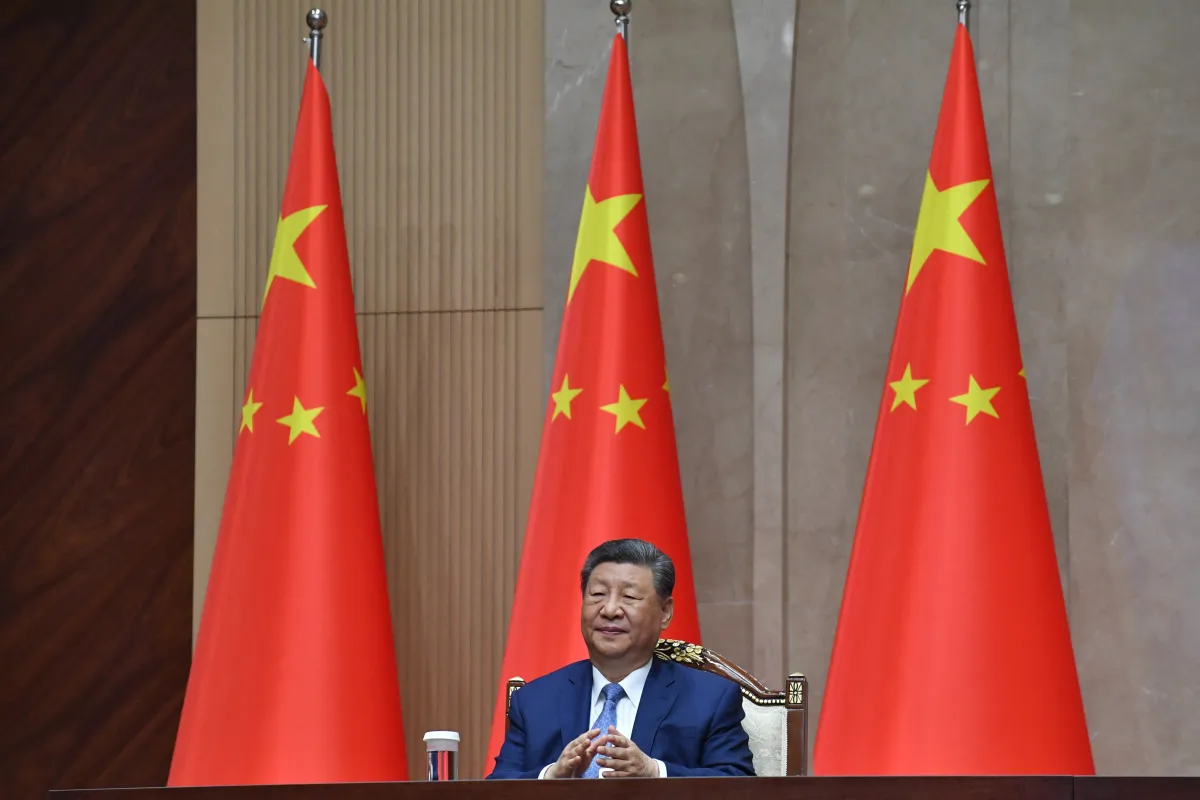
At the roof of the world, where the Nepal-Tibet border cuts through valleys and villages that cling to impossible mountainsides, a humanitarian emergency is unfolding on a scale that would occupy every hour of a leader’s calendar. In any other country, there would be rescue helicopters, emergency aid pledges, visits to shelters, a face on television promising that no one would be left behind. But Xi Jinping is not there. He has flown west, across the vast steppes of Central Asia, to Bishkek, the capital of Kyrgyzstan, to preside over the 25th anniversary summit of the Shanghai Cooperation Organization. The choice is a statement in itself: China does not behave like an ordinary state when calamity strikes. It behaves like a historical project. The SCO is not a humanitarian body, and Xi did not go to Central Asia to pass out blankets or to mourn with the victims. He came to stamp his authority on the only institution that gathers the great and aspiring powers of the non-Western world under a shared banner of suspicion toward American-led order. In Bishkek, he will meet Vladimir Putin, Narendra Modi and Masoud Pezeshkian, each encounter carefully timed, photographed and choreographed. But this is not just a regional summit. It is the prelude to a much larger journey. After a year spent hosting foreign dignitaries in Beijing, including the leaders of major Western powers and Donald Trump himself, Xi is emerging from his shell. In late September he will make a high-profile state visit to the United States. Everything he does in the Kyrgyz mountains is meant to send Washington a single message: China is not knocking on the door. China is already in the room.
The Shanghai Cooperation Organization began modestly enough. It grew out of what was once the Shanghai Five, a mechanism created after the Cold War to manage the wide and nervous borders of a disintegrating Soviet world. China and Russia were not trying to build an empire; they were trying to control the aftershocks of ideology. By 2008, at least on paper, Moscow and Beijing had settled their territorial disputes, leaving the young organization to search for a larger purpose. It found one in a common, if unstated, adversary: American dominance. For its bigger members, particularly China, the SCO has become a philosophical stage. Xi uses it to promote his Global Security Initiative, a vision of security in which great powers do not lecture one another about human rights, but instead speak the language of sovereignty, stability and controlled change. He also uses it to push the Chinese yuan outward, nudging trade agreements and central banks toward a currency that might one day compete with the dollar. But the club is not just a theatre for rhetoric. For smaller states such as Kyrgyzstan, a former Soviet republic still sensitive to Moscow’s gravitational pull, the SCO is a strategic hedge. By inviting in Chinese investment and Chinese political presence, Bishkek can balance against a Russia that has long regarded Central Asia as its own backyard. That subplot is not lost on Putin, and some Kremlin watchers worry about China’s slow-motion encroachment into a region Russia once ruled without question. Yet Putin is too entangled elsewhere to do much about it. The war in Ukraine has consumed his energy, his diplomacy and his sense of entitlement at the top table. He now attends summits where he can only share a stage with leaders who are neither his enemies nor quite his friends. The old Putin, who once sat with the advanced economies of the G8, discussing global governance over white-tablecloth dinners, is now a man of the East, leaning on a younger and more disciplined partner in Beijing.
India is perhaps the SCO’s biggest enigma. A nuclear-armed democracy of more than a billion people, courted by Washington, Tokyo and Berlin as a counterweight to China, New Delhi nevertheless sits inside the SCO and works alongside Beijing at summit after summit. The two rivals share a long and dangerous Himalayan border, the site of deadly clashes, unresolved disputes and sleepless nights in both capitals. The recent meeting between India’s national security adviser and China’s foreign minister, aimed at cooling the border temperature, was not a sign of friendship. It was a sign of necessity. Neither New Delhi nor Beijing can afford a high-altitude distraction while the world is redrawing itself into blocs. India’s strategic autonomy—that much-admired ability to walk between East and West while taking from both—has become harder to sustain in a more bifurcated world. India cannot fully break with the West, because its economy needs Western capital and technology. It cannot fully break with China, because geography makes that impossible. In Bishkek, Modi will sit an arm’s length away from Xi and face the same cameras. What he says in private will be vague, diplomatic, and heavy with the uncertainty of a nation that may find itself without a natural place in the new order. The SCO’s other members carry their own contradictions. Russia and Iran are fighting or supporting wars that drain them; India and Pakistan fought each other barely fifteen months ago, and Pakistan still skirmishes with Afghanistan, an observer state of the same organization. Yet despite this crowded circus of rivalries, the SCO has one achievement that cannot be measured by treaties: it keeps the conversation alive. It creates a room where the United States is not present, where the phrase “rules-based international order” is uttered with a knowing smile, and where each leader can perform for his domestic audience as a statesman of an emerging world.
The arithmetic of the SCO explains its gravitational pull. Ten members. More than 40 percent of the world’s population. Roughly a quarter of global GDP. It is not the West, and it does not want to be the West. But it is the closest thing the non-Western world has to an organized alternative, and its political systems are more varied than any simple label of “autocracy” can suggest. There are monarchies, presidential systems, parliamentary democracies, theocratic republics and a Communist party-state. China is the dominant economy; last year it was the largest trading partner for eight of the other nine SCO members. It is also the only member with the economic capacity to meet the United States in a trade war and still stand. That is why Xi does not need the SCO to love him. He needs it to exist, to gather, to be photographed. The summit may produce no dramatic decisions. It will offer rhetorical comfort to Iran, which is fighting for its position in the Middle East. It will allow Putin to pretend he is not isolated. It will allow smaller states to extract Chinese loans, roads and pipelines. It may quietly lay the groundwork for trade routes around the Caspian Sea that bypass the sea lanes the U.S. Navy dominates. None of this will happen overnight. The SCO is too unwieldy, too full of mutual suspicion, to function as a real military or economic bloc. But it is no longer possible to dismiss it as a talk shop. America’s adversaries are organizing. They are building parallel institutions, parallel narratives, parallel financial circuits. They are learning to live without the United States, and the man who ties the project together, the one with the checkbook, the ambition and the discipline, is Xi Jinping.
Xi’s next stage is America. By the time he lands in Washington on September 24, he will have made a symbolic trip to North Korea in June, attended the SCO summit in Bishkek, and hosted a BRICS gathering two weeks later—a piece of choreography designed to show the American leader that China is not a supplicant seeking admission to a Western world. It is a display of alternatives. Xi can tell Trump, without saying a word, that the world’s principal non-Western powers are not lined up behind Washington, and that China is now the default centre of gravity for a substantial share of the global future. Trump, for his part, may need Xi more than he wants to admit. His administration has been deeply entangled in a monthslong conflict with Iran, and his party faces an uncertain future in November’s midterm elections. In that context, Chinese help might be necessary to find an exit from the Middle East without losing face. For Europe, the calculus is even more uncomfortable. Finland’s president, Alexander Stubb, recently told a German newspaper that China’s foreign minister had reassured him that Xi would never allow Putin to use nuclear weapons in Ukraine. “We will never allow that to happen,” Wang Yi allegedly said. European leaders might have found that comforting, except for what it implied: Beijing holds a form of veto power over Moscow’s most dangerous instincts, and it chooses to apply that power only at the edge of catastrophe. It meant the West’s safety depends, in part, on the restraint of a Chinese leader who does not share Western moral vocabulary. At the same time, Xi is signaling strength at home. Just three days before the summit, he removed one of his closest allies from China’s highest military decision-making body. The purge sent shockwaves through the security establishment. It was a reminder that Xi does not tolerate divided loyalty, and that his authority is not merely ceremonial.
All of this converges on a single message to the American president: “My house is in order. Is yours?” It is a question that asks more than it seems. It asks whether Washington still has the internal coherence to lead a coalition of democracies; whether it can hold allies together while its politics lurch from one fever to the next; whether it can match the long patience of a party-state that plans in decades, not news cycles. It is also a question of legitimacy. The Chinese Communist Party has never wanted to be accepted by the West on Western terms. It has only ever wanted to be accepted as an equal—to be allowed to keep its own system, its own norms, its own interpretation of sovereignty, without being punished for it. The SCO, the BRICS meeting, the visit to North Korea, the staged summits in Central Asia, the sanitized images of Xi among foreign dignitaries—all of it is in service of a world order in which China does not have to apologize for being China. Whether that order is called multipolar or authoritarian depends on who is speaking, but the reality is the same. Xi did not go to Bishkek to announce it. He would rather let the silence about the Nepal-Tibet border speak for itself. That is the nature of the man and the system he has built: even when catastrophe demands mercy, the performance of power matters more than the practical work of compassion. The world can read that as cynicism, or as a warning. By the time Xi leaves Washington, the meaning of his journey will be unmistakable. He has not gone to ask for understanding. He has gone to claim his place at the table—and to make clear that from now on, he intends to set the table.