



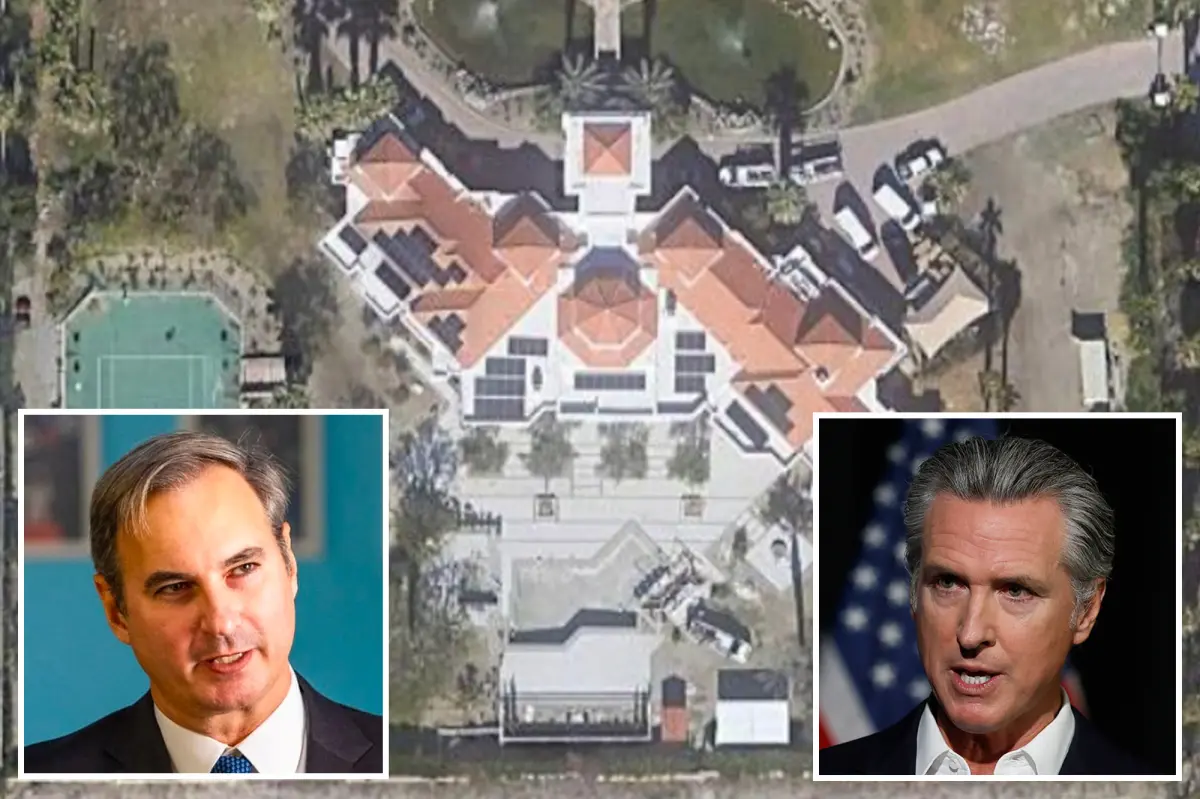
It’s a story that almost defies belief: a disgraced Wall Street trader who once pleaded guilty to bilking his own employer out of $43 million, who was publicly named New York’s number one tax deadbeat, and who now owes the state nearly $60 million, has been living out a gilded second act in the California desert. Daniel Gordon, now 50, spends his days in a sprawling 10,495-square-foot estate in Rancho Mirage, an exclusive enclave once home to Frank Sinatra, Bill Gates and President Gerald Ford. The property, worth more than $5 million, comes with a sunken tennis court, a three-hole putting green, and a resort-style pool with cascading waterfalls and a swim-up bar. It is a setting that could belong to a rock star or a tech billionaire, not a convicted felon with two active tax warrants against him. And yet, Gordon has somehow reinvented himself as a golden-state philanthropist, running a prison reform charity called Gordon Philanthropies, posing for photos with the LAPD and the California Department of Corrections, and even receiving a gushing, handwritten thank-you note from Governor Gavin Newsom. The governor’s letter, dated November 2024 and addressed to “Daniel,” closes with a large, enthusiastic “Thank you!” and is proudly displayed on the charity’s Facebook page. Newsom wrote, “Thank you again for your generous contributions. I look forward to your continued partnership.” Neither Gordon nor Newsom’s office responded to requests for comment.
To understand how Gordon arrived at this strange intersection of criminal history, political praise, and jaw-dropping tax evasion, you have to go back more than two decades. In the early 2000s, Gordon was a 24-year-old Yale graduate working as a trader at Merrill Lynch. In a brazen scheme that still haunts financial circles, he tricked his bosses into wiring $43 million into an offshore shell company, then pocketed the money as part of a fake insurance deal. He pleaded guilty to wire fraud in 2003, but the consequences did not end with a criminal sentence. The federal government and New York State both took the position that stolen money is taxable income, even if it is later repaid. During his 2013 bankruptcy trial, Gordon admitted under oath that the IRS had delivered a brutal reality check: “Under our laws you owe us taxes … regardless of the fact that it was repaid.” That legal principle has proven catastrophic for Gordon. His tax bill, originally tied directly to the embezzled Merrill fortune, has been compounding with interest and penalties for two decades. In 2016, New York tax enforcers singled him out as the state’s biggest tax dodger on its “Top 100” list, with outstanding warrants of $25.1 million. A decade later, two active Albany County tax warrants against Gordon stand at a combined $59,141,763.16. That is not a typo. Nearly $60 million in tax debt, and Gordon has reportedly been living as if the bill will never come due.
Gordon’s legal efforts to escape his debts have only made his situation worse, exposing a pattern of deception that a bankruptcy judge found insulting. In a blistering 2015 decision, US Bankruptcy Judge Robert E. Gerber denied Gordon’s attempt to wipe out his personal debts in a Chapter 7 filing, ruling that the former Wall Streeter had fraudulently hidden $3.1 million in assets and lied under oath. Judge Gerber wrote that Gordon offered excuses that “insulted the intelligence of the court.” The trial produced a parade of jaw-dropping revelations. Gordon claimed he had just $3,147 to his name, yet admitted to living in a $19,000-a-month Upper East Side apartment and spending $140,000 on a Hamptons summer rental, all while hiding the city lease behind a corporate shell. Investigators also discovered that Gordon had wired $2 million to a phantom Nevada shell company with no staff, no office, and no ledgers. Perhaps most stunningly, the court learned that Gordon had loaned $570,000 to former New York Knicks center Eddy Curry at an interest rate of 89.79 percent. In just 18 months, that loan ballooned into a $2 million debt. The judge was so taken aback that he halted questioning to confirm the number. For all his talk of being broke, Gordon was clearly a man who knew how to make money in the shadows, just not how to pay what he owed.
What makes the story even more maddening is that New York State has seemingly done almost nothing to collect this enormous debt, despite having been handed a detailed roadmap to Gordon’s assets. Leaked emails obtained by The Post reveal that state investigators failed to make a move even after a whistleblower sent them a string of tips in March 2024. The whistleblower, a Texas entrepreneur who requested anonymity due to death threats, has been locked in a bitter court fight with Gordon. In one email, the tipster flagged “$4.1mm dollars in non-exempt California Real Estate in addition to the 22mm worth of shares of stock in public companies,” and wrote, “I would really like the state of New York, at least, to get their money back.” The whistleblower even pointed investigators to an address in their own backyard: a stock transfer agent at 1 State St. in Lower Manhattan holding shares tied to a Gordon-linked corporate vehicle. A New York tax investigator identified only as Inv. Politylo replied, promising to “forward this to the appropriate department.” More than two years later, county records show New York has yet to record a single lien against Gordon’s Rancho Mirage mansion. Empire State tax warrants expire after 20 years, meaning Albany has already blown half the clock on this case. Darren Dopp, a spokesman for the New York Department of Taxation and Finance, declined to comment, citing state tax secrecy laws. He did note that debtors can drop off the “Top 100” list if officials fail to file a fresh warrant in 12 months, or if they challenge an assessment, cut a deal, die, or declare bankruptcy. But none of that explains why a $59.1 million debt appears to be sitting in limbo.
Legal experts are baffled by the state’s inaction. Edward Zelinsky, a tax professor at Yeshiva University’s Cardozo School of Law, said tracking down Gordon’s California assets should be straightforward for New York’s top lawyers. “This is certainly something that should be within the routine competence of the New York attorney general, particularly for large judgments where it would be financially feasible to acquire help from counsel in the other state,” he said. The problem, according to officials, is a bureaucratic standoff. A spokesperson for New York Attorney General Letitia James insisted the state’s top prosecutor cannot lift a finger unless tax officials formally hand over the file. “The Department of Taxation and Finance is the primary enforcement agency in matters involving outstanding public tax debts unless a referral is made to the Office of the Attorney General,” said Alexis Richards. She added, “Per the Post’s own reporting, the Department issued warrants for Mr. Gordon’s state tax debts. That is the end of the story here.” The Tax Department, however, claims it never sends collection cases to James’ office. “The AG’s office is not involved in the case,” Dopp said. “The AG’s office does not handle our collections matters.” Timothy Noonan, a partner at Hodgson Russ LLP, called the situation “very unusual.” He explained that when tax deadbeats flee the state, tax authorities “can authorize the Attorney General to pursue collection anywhere else.” Specifically, by “domesticating the warrant” in California, Albany could turn its New York tax tab into a local court judgment overnight, freeze Gordon’s bank accounts and seize his desert mansion. Steven Goldburd, a managing partner at Manhattan tax firm Goldburd McCone LLP, noted that governments love going after low-hanging fruit. “It is infinitely easier to attack a $2,000 tax bill of a taxpayer that will likely never fight back than the multimillion-dollar tax bill of a legally well-armed taxpayer that will,” he said.
Still, Gordon is not untouchable. Duncan Levin, a former Manhattan DA asset forfeiture chief, told The Post that while a wealthy tax dodger can hire high-priced consultants to shield assets and delay enforcement, “an LLC is a legal barrier, not a magic cloak.” He explained that New York cannot simply grab company assets to pay an owner’s personal tax bill, “but if the company is really his personal piggy bank, that barrier may come down.” Levin also pointed out that Gordon’s California palace could be a much easier target because it sits in his own name, though seizing real estate requires a court order. “A $5 million house is not a $5 million check,” Levin said. “The state’s job is to turn a tax warrant into a recovery. You don’t collect a debt by admiring the size of it.” Meanwhile, Gordon remains busy in California. Corporate filings show his charity, his penny stock outfit Polomar Health Services, and his GLD Partners investment arm all operate out of the same Los Angeles office suite. SEC records show he holds 49 percent voting control at Polomar, which recently spent more than $193,000 buying “Wafesil,” a dissolving sildenafil erection drug, directly from another firm Gordon controls. Disclosures reveal Polomar has also been pushing an “inhalable sildenafil” program, essentially an asthma-style rescue inhaler loaded with generic Viagra. So the same man who owes New York nearly $60 million, who was convicted of one of Wall Street’s most audacious frauds, and who was publicly shamed as the state’s number one tax deadbeat, is now hawking erectile dysfunction pills in California while collecting praise from the governor’s office. It is a surreal ending to a saga that has already lasted two decades, and unless Albany finally acts, the rest of the story may be written by Gordon himself, smiling in the desert, one ribbon-cutting at a time.