



In 1990, I found myself flat on my back in a university weight room, struggling to find the right grip for a bench press. It was my first weight training class, and I felt completely out of place—shy around the unfamiliar equipment and intimidated by the more experienced students who seemed to know exactly what they were doing. As I was trying to focus, the instructor, a graduate student I recognized from other classes but had never actually spoken to, positioned himself at the base of the bench, directly in my line of sight, standing between my legs. “I know you,” he said. I felt immediately uncomfortable and tried to pull my legs together, to abandon what I was supposed to be doing, but he just smiled at me, his eyes scanning my body up and down before someone called him away.
After that first encounter, he seemed to find endless excuses to hover near me during every class, always ready with comments about my appearance. “You’ve lost weight,” he’d say, or “Looking good,” or “You need to start working your ass.” Eventually, he offered what he called a “private session, no charge,” and I began wearing baggier sweatpants and my brother’s old T-shirts, hoping to make myself less visible, less interesting to him. I even considered skipping class altogether, but I needed the credit. Every day, he’d stand above me, comfortable in his position of authority, while his comments escalated to direct invitations. “We should go out,” he’d say, and I’d respond with increasingly direct refusals. “No thanks, I’m good.” “No, that’s OK.” “No, I don’t think so.” Finally, I said the words that surprised even me: “Stop asking me. It’s inappropriate.” A classmate looked at me with wide eyes and whispered, “That was ballsy. I hope you pass this class.”
But I hadn’t always been so comfortable saying no to men. In fact, that confidence had been hard-won over years of confusing messages about what women should do when men pursued them. Back then, there was no social media to explain misogyny or male entitlement, no viral videos teaching women how to recognize and respond to inappropriate behavior. I had grown up watching blockbuster romantic comedies like Say Anything and The Sure Thing, films where the entire plot revolved around a woman saying no and a man persisting until she eventually gave in. I absorbed that behavior as a perfectly acceptable mating dance, something that would lead to a happy ending. I genuinely believed that tenacity wasn’t disrespect—it was a sexy chase, a sign of genuine interest. Throughout college, I had experienced this behavior firsthand, watching as people reacted to the word “no” as if it meant “try harder” or, like shaking a Magic 8 Ball, “ask again later.” At first, I found this attention flattering, but soon it became irritating, even as I smiled awkwardly and hoped they would simply go away.
So where had I learned that no actually means no? That saying it can lead to peace and quiet, to a sense of having communicated a clear boundary? The surprising answer is that I learned it from a man in prison. I’ll call him Robert. It was 1984, before the internet made everyone findable with the click of a button. I was sitting in my nursing school whites, reading the newspaper, when I came across a want ad from a man incarcerated at Fishkill Correctional Facility in New York, looking for someone to write to. Looking back, I try to remember why I answered that ad. Was I fascinated by social justice or prison reform? Did I hesitate when I saw the bleak address? Did I stop to consider that sending my name and address to someone in prison might not be the safest decision? The answer to all of those questions is no. I had come from a small town and was enrolled in a small college, but I was about to graduate and knew I’d be encountering diverse populations of people in need of care. I was curious about other lives and wanted to be the kind of nurse who didn’t judge people harshly based on their circumstances. I was genuinely interested in what this man might have to say about his life. And, I admit, I liked getting mail.
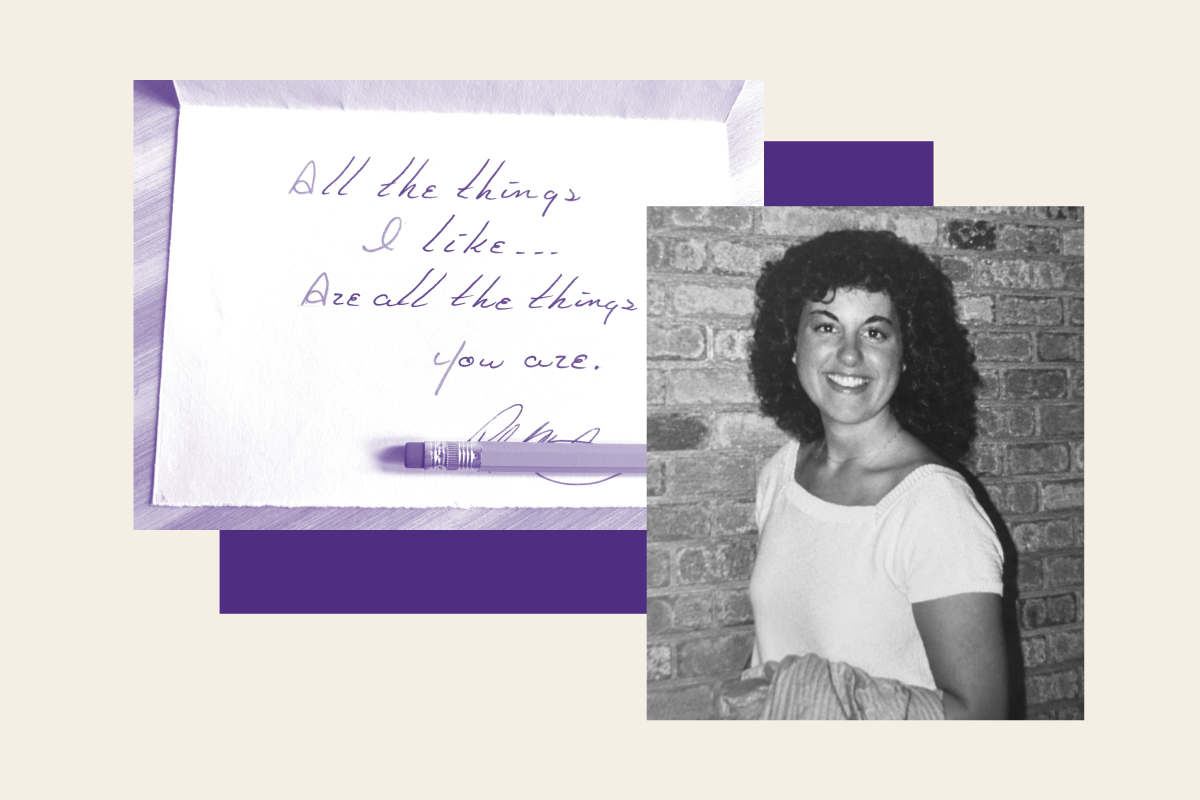
We exchanged letters back and forth for several months. My letters were filled with mundane details: “My nursing classes are hard. I had to clean between someone’s toes and tried not to get grossed out. My roommate grew up on a farm, and she knows so much more than I do about everything.” He’d reply with his own updates: “I’m getting my GED.” “They’ve given me a new cell mate.” “I work in the kitchen, mostly dishwashing.” I hadn’t even pictured him having a cellmate, nor did I know that incarcerated people could earn degrees or have jobs. Then, in one of his letters, he asked for a photograph of me. I ignored the request, blowing past it as if I hadn’t registered it, hoping he would forget. I was naive, for sure, but not so naive that I didn’t understand that when a man asks for a photograph, it’s usually for a personal reason. Since I wasn’t interested in that, I hoped he would drop it. When he asked again, I wrote back and told him that I didn’t think we needed photographs to be friends. Not long afterward, he sent me a beautiful handmade card with the words: “All the things I like are all the things you are.” The depth of those words surprised me, and I pictured him making it, feeling a warm sense of friendship. Then, in an enclosed letter, he wrote something unexpected: “You are too nice to write to incarcerated men. Do not write to men in prison anymore.”
I was surprised and disappointed, having thought we’d forged an interesting connection. But I realized that he had wanted something different from our correspondence than I did, and that was fair. People don’t always approach new relationships with full clarity of purpose, or even of their own wants. I didn’t feel manipulated. There was protection in his words. Our friendship ended kindly, and I felt cared for. What stayed with me after this experience was this: when I said no, he said OK. It had not been complicated. He didn’t write back to negotiate, didn’t try to persuade me, didn’t ask again. I can see now how the inmate modeled respectful behavior, and I absorbed it, perhaps precisely because it came from such an unlikely place. After the last day of my weight training class in graduate school, I knocked on the door of the chair of the Kinesiology Department. He answered, and I walked in, feeling small as I read the words on several diplomas and awards on his wall. I cleared my throat and, in too small a voice, told him what had happened, how uncomfortable the instructor had made me feel, and asked how to file a formal complaint. The man in charge of the department, the weight training instructor’s mentor, looked at me with a blank expression and said, “Is this the hill you want to die on?” I wish I could tell you I said yes, but I didn’t. I said, “I don’t want to die on any hill.” I remember opening my mouth to say more but not having the words or the chance. Instead, he said, “Keep your head down. Get back to work. This is nothing.”
I left his office, my complaint dismissed. I walked straight to the graduate student office and cried at my desk alone, like adults so often do. I wiped my eyes, worrying about repercussions, gossip, and my own ability to work in a place that didn’t care about me. In the end, nothing was done about the instructor’s behavior. He went on to harass me, and he graduated without, as far as I know, a mark on his record. For my part, I spread the word. I advised women to stay away from him, told them not to take his classes or volunteer to work with him. I told people what he had said and how it had made me feel. I’m not claiming that I always knew how to stand up for myself or other women after that, but I’ve devoted my life to this work. Later, as a professor teaching Global Health for over twenty years, I taught classes on manipulative behaviors, warning signs, and how to respond to discomfort from a place of autonomy and self-support. Students would return to class and discuss their real-life accounts. If not for my correspondence with Robert, I wouldn’t have written my most recent novel about a woman learning to decode language and behavior to keep herself safe. It’s a fictional primer on the importance of relying on experience and instincts when reading the world. In the end, the strength it took to stand up for myself in that weight room, and later, came from a person who was literally walled off from society. Knowing this has allowed me to feel good about my curiosity, my desire to connect with people, and my deep belief that everyone has a story. If I ever forget, it’s not for long. I still have his card pinned to my bulletin board to remind me.