

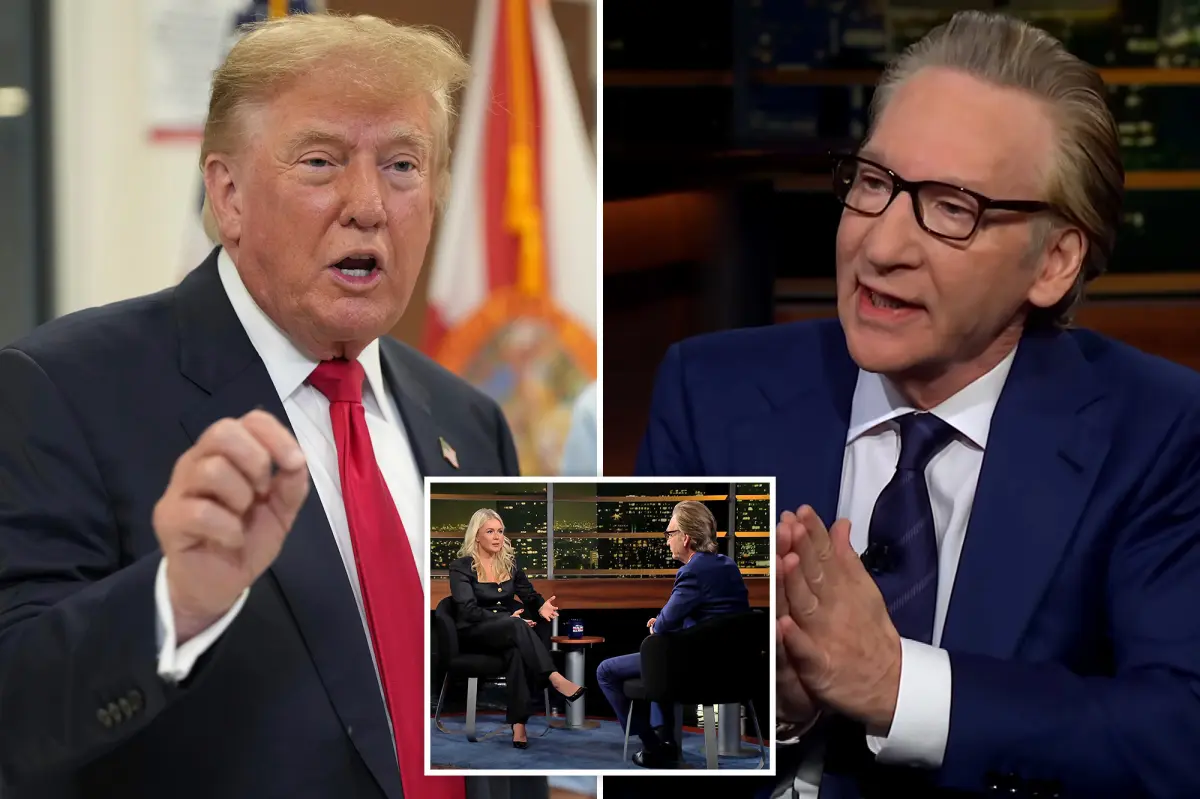
Few feuds in American public life feel as perfectly scripted for the tabloid age as the one between former President Donald Trump and late-night host Bill Maher. The two men are not natural enemies in the usual sense—Maher is a self-described liberal who has often criticized the left, while Trump is the standard-bearer of the populist right. Yet after Maher made a series of jokes about Trump’s approval ratings and the length of their recent White House dinner, Trump responded with a furious, rambling, 1,300-word social media post that broke his personal record for the longest statement ever published online. It was a spectacle of raw ego, wounded pride, and the peculiar intimacy that can only exist between two famous men who have broken bread, traded compliments, and then turned on each other with the fury of jilted allies. Trump called Maher a “complete, total loser” and a “sleazebag,” claimed his HBO show was no longer “hot,” and accused him of using a “laugh machine” to generate applause. But beneath the insults was something more human: a sense of betrayal. Trump had hosted Maher at the White House, twice. He had sat with him, introduced him to Kid Rock and Dana White, and allowed him to walk the corridors of power. And then, in Trump’s eyes, Maher went back to his old ways, mocking him on national television. The post was less a political statement than a personal grievance, the kind of late-night rant that many people can recognize from their own lives—when someone you thought you had won over, however briefly, reminds you that they were never really on your side.
Trump’s tirade did not begin with Maher himself, but with the forgotten figures in the orbit of a celebrity feud. He brought up Chuck LaBella, a television producer who worked with Maher on his old ABC show “Politically Incorrect” and later worked on “The Apprentice.” Trump used LaBella’s career to illustrate his own myth of success, describing how the show’s ratings lifted everyone associated with it. “It built many careers,” Trump wrote, before adding, with typical modesty, that some people said it even built his own career—though he insisted he would have won the presidency without it. The story then became a tale of persistent courtship. Trump claimed that LaBella would call him constantly to say how much Maher loved and respected him, and how desperate Maher was to meet. “When I became President, I agreed to meet, after the first one, and the last one, but never agreed to do his show, which he wants me to do, DESPARATELY—It won’t happen!” Trump wrote. There is something almost comical about this version of events: Maher, the sharp-tongued comedian, reduced to a nervous fan begging for a meeting through intermediaries. Whether or not it is true, it reveals Trump’s need to see every relationship as a transaction in which he is the one granting favors. He cannot simply say that he and Maher had dinner and a conversation. He has to frame it as a victory, a demonstration of his own importance, and a story in which Maher is the supplicant and he is the king. The mention of LaBella, a behind-the-scenes figure most Americans have never heard of, also humanizes the feud: it shows how these public clashes are often fueled by private conversations, old loyalties, and the small resentments that fester when people feel used.
The core of Trump’s anger was not just Maher’s jokes about his appearance or his dinner habits. It was Maher’s claim, made on “Real Time,” that Trump had the lowest approval rating of any midterm candidate ever. Trump, who has spent his entire public life obsessed with ratings, polls, and numbers, could not let that stand. He shot back with a series of statistics that were, at best, self-selected and, at worst, completely invented. He cited a CNN poll showing him at 98 to 99 percent support within the Republican Party, an all-time record high. He quoted CNN’s Harry Enten calling him “the most influential president of the last century.” He even claimed that another CNN poll ranked him as the most popular person in the history of the Republican Party, beating Ronald Reagan and Abraham Lincoln. The numbers were dubious, but the emotion behind them was real. Trump has always needed to be the best, the biggest, the most beloved. When someone challenges that image, even a late-night comedian, he feels the need to defend it with every weapon he can find. The fact that he used CNN, a network he normally calls “fake news,” as his source for these claims was a beautiful, unintentional irony. It showed that his need to win an argument is stronger than his need to be consistent. He also returned to a favorite theme: that Maher’s audience laughter is fake. “What Laughter Machine does he use?” Trump asked, suggesting that no one could genuinely find Maher funny. This accusation is so oddly specific that it feels less like a political attack and more like the complaint of a man who has stood on stage himself and knows how much a crowd’s reaction matters. For Trump, laughter is a currency, and he cannot bear the thought that someone else is getting paid in counterfeit coins.
The most surreal part of the post was Trump’s description of the two White House dinners he had with Maher. The first, on March 31, included Kid Rock and UFC chief Dana White. The second, on October 15, included Maher and sports commentator Stephen A. Smith. Trump claimed that Maher invited himself to the White House, and that he was “very nervous” during their first meeting. He described Maher as having a “seriously bruised eye and nose area, as though somebody had just beaten him up—But it wasn’t me!” He then claimed that Maher was a “major pothead” and warned that it was “very bad for his health.” At the second dinner, Trump said, Maher “looked like hell” and was “drunk and had alcohol in his hand as he walked through the White House.” Trump also disputed Maher’s account that the dinner lasted four hours, insisting it was two hours or less. “We have the timestamps,” he wrote. There is something almost sad about this part of the tirade. It reads like a man trying to convince himself that he was not impressed by his guest, that the dinner was a waste of time, that he learned nothing. But the very fact that he devoted hundreds of words to Maher’s physical condition, drinking habits, and nervousness suggests the opposite. Trump was paying close attention. He noticed the bruise, the drink, the body language. He was studying Maher, and he was hurt that Maher did not appreciate the honor of being invited into the White House. The dinner, in Trump’s telling, was supposed to be a turning point—a chance for Maher to see Trump up close and change his mind. When Maher continued to criticize him, Trump took it personally. He felt like a host who had extended every courtesy to a guest, only to have that guest insult him on the way out the door.
Trump’s tirade then spiraled into a series of unrelated grievances, the way social media rants often do. He brought up Maher’s interview with White House press secretary Karoline Leavitt, during which Maher joked that Trump wanted to turn the press briefing room into a swimming pool. Trump denied the rumor, saying he had no intention of building a pool and was merely thinking about moving the press to a different location. He praised Leavitt for defending herself against a “biased, dumb SLEAZEBAG” like Maher. He then moved on to California, claiming that Maher lied about illegal voters in the state and that the number could easily go over 1,000,000. He ended with a threat: “I’m going to have the Republicans not cover you anymore.” This part of the post reveals the chaotic, stream-of-consciousness nature of Trump’s mind. He cannot stay on one topic for long. He jumps from the swimming pool to Leavitt to California to the laugh machine to the “Dumocrats” who are destroying America. But within the chaos, there is a consistent theme: betrayal. Maher had been given access, had been treated as an insider, had laughed and clinked glasses with the president. And then he went back to his show and mocked him. In Trump’s worldview, loyalty is everything, and Maher’s failure to show loyalty after being welcomed into the White House was a sin that could not be forgiven. The post ends with Trump signing off in his signature style, “Thank you for your attention to this matter,” as if he had just issued a formal memorandum rather than a late-night rant about a comedian’s drinking habits and laugh track.
The aftermath of Trump’s post was almost as revealing as the post itself. The data platform Factba.se confirmed that the 1,300-word statement was Trump’s longest ever out of 97,455 social media posts since 2011. It was more than 600 words longer than his previous record, a September post celebrating South Korea’s investment in the United States. Maher did not respond directly to the essay, but in his monologue, he seemed to celebrate the controversy, saying, “Yeah I did it again bitches,” referring to his dinner with Trump. And perhaps the strangest part of all: just two days before the tirade, Trump had told White House reporters that the dinner was “great.” He said, “It was a very informative dinner. Smart people. Stephen A. is great. Bill Maher—I tell you what. He likes me a lot more than people understand, and I actually like him. It was a good dinner.” That statement makes the entire tirade feel like a sudden, violent mood swing. Trump went from praising Maher to calling him a loser and a sleazebag in less than 48 hours. What happened in between? Perhaps Trump saw the clip of Maher’s show. Perhaps someone told him that Maher had made fun of him again. Or perhaps Trump simply woke up and decided that he could not tolerate being liked by a man he was supposed to hate. In human terms, this is the behavior of someone who is deeply conflicted. Trump wants to be respected and liked by everyone, including his critics, but he also wants to be feared and dominant. When Maher laughed with him at the White House, Trump felt validated. When Maher laughed at him on television, Trump felt humiliated. The feud is not really about politics. It is about the fragile, complicated dance of two famous men who need attention so badly that they cannot resist each other, even when they claim to despise one another. And for the rest of us, it is a reminder that even presidents and comedians are just people, looking for approval, nursing old wounds, and lashing out when they feel betrayed.