



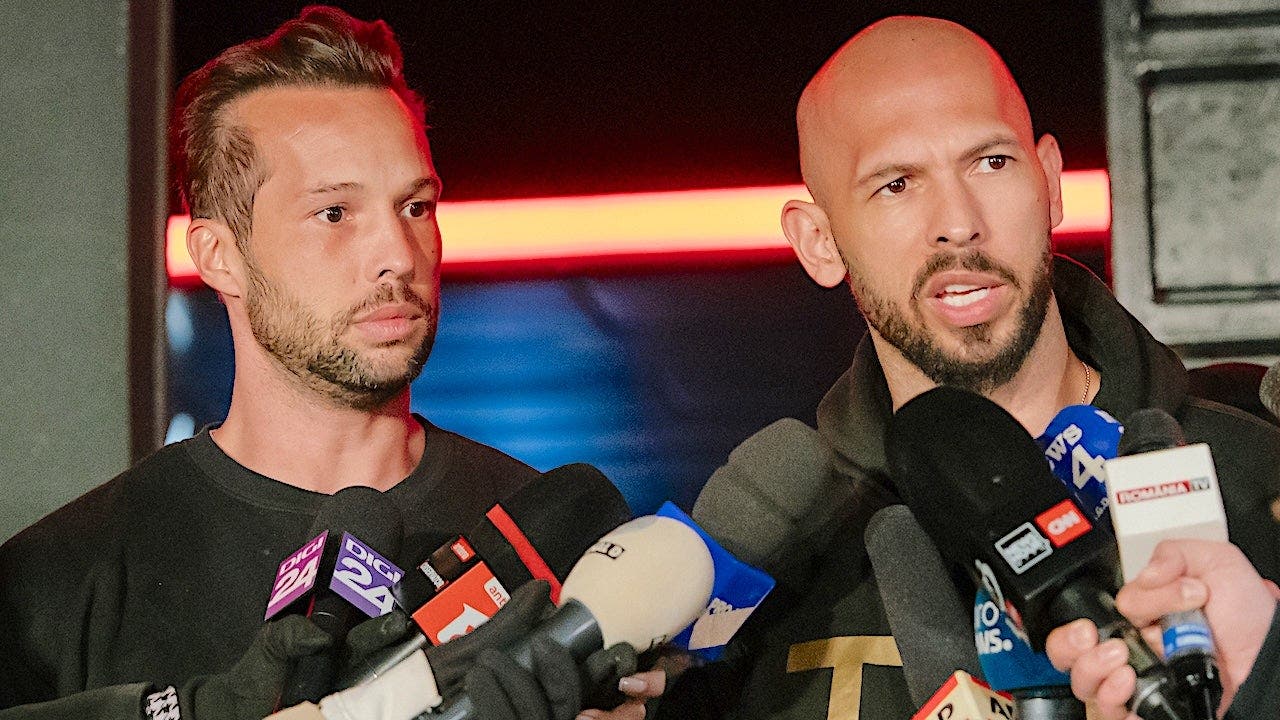
The contrast could not have been starker inside the drab, sterile confines of the federal courtroom in Miami, Florida, on Monday afternoon. For years, Andrew and Tristan Tate had carefully projected an image of untouchable, hyper-masculine opulence to their millions of online followers, posing with fleets of custom, multimillion-dollar supercars, smoking expensive cigars in private jets, and preaching a controversial gospel of absolute personal sovereignty and financial dominance. Yet, on this humid afternoon, the brothers stood completely stripped of their designer suits and luxury accoutrements, clad instead in the universal, humbling equalizer of the incarcerated: standard-issue gray jail uniforms, their ankles and wrists heavy with metal shackles that clinked loudly with every movement. Standing before U.S. Magistrate Judge Lauren Louis, the larger-than-life digital personas rapidly dissolved into two quiet, deferential defendants responding with a subdued, respectful, “Yes, your honor,” as their constitutional rights were read to them. This brief but highly significant hearing marked the formal beginning of their legal battle against the United Kingdom’s urgent bid to extradite them, a high-stakes maneuver initiated after British authorities issued a provisional arrest warrant. The brothers, who were apprehended over the weekend in Miami, now find themselves locked in a federal detention facility, a bruising reality check for men who built a global empire on the premise that they were far beyond the reach of ordinary societal constraints. As the judge scheduled a crucial status hearing for July 27, the brothers and their legal team began the arduous task of challenging not only the British extradition request but also their continued detention. Their attorney, Joseph McBride, realistically admitted to reporters outside the courthouse that he does not anticipate their release anytime soon, signaling that the glamorous, high-speed lifestyle the Tates so eagerly broadcasted has ground to a screeching, claustrophobic halt within the American federal justice system.
The legal peril facing the Tate brothers is not merely a bureaucratic hurdle, but a massive, multi-decade indictment targeting the very core of their treatment of women. The sudden arrest in Miami was triggered by a dramatic escalation in the United Kingdom, where prosecutors ran a comprehensive, multi-year investigation culminating in 38 additional charges involving four new alleged victims, pushing the total number of charges against the brothers to a staggering 59. These grave allegations span a seven-year period between July 2010 and August 2017, a timeline that predates their peak internet fame but paints a dark, pre-existing pattern of systemic exploitation. Andrew Tate, 39, is currently bearing the most severe brunt of the new accusations, which include seven additional counts of rape, sex trafficking, and the possession of indecent images of a child. Meanwhile, 38-year-old Tristan Tate is fighting charges that include two counts of rape and three counts of helping to facilitate or arrange trafficking for the purpose of sexual exploitation. Malcolm McHaffie, the head of the Crown Prosecution Service’s Special Crime Division, made it undeniably clear that these prosecutions were the result of a rigorous, deliberate investigation, asserting the state’s unyielding intent to hold the brothers accountable for systemic abuse. To read the exhaustive list of charges is to glimpse an underworld of coercion and control that stands in grim, devastating contrast to the glossy, aspirational self-improvement advice the brothers sold to impressionable young men worldwide. For the alleged victims, whose voices have long been drowned out by the thunderous roar of the Tates’ digital megaphone, this escalation represents a crucial step toward public reckoning, transforming what was once internet drama into a grave, life-altering criminal prosecution in a traditional court of law.
The geopolitical complexity of the Tate brothers’ legal battles reveals a tangled, highly coordinated web of international law enforcement agencies working in concert across multiple borders. Holding dual citizenship in both the United States and the United Kingdom, the brothers have long navigated the globe with a sense of borderless immunity, famously relocating to Romania where they openly believed the legal system was more malleable, less aggressive, or easier to outmaneuver. However, that calculation has proved to be a disastrous misstep, as they are already deeply embroiled in complex, ongoing criminal proceedings in Romania, where anti-organized crime prosecutors have been investigating and prosecuting them since December 2022 on charges of human trafficking, rape, and forming a criminal gang to sexually exploit vulnerable women. The addition of the British extradition warrant, executed by American federal marshals and the FBI on American soil, showcases an extraordinary level of international diplomatic and judicial cooperation. This multi-country legal pincer movement demonstrates that despite their immense wealth, massive online influence, and global mobility, the Tates are finding the world shrinking rapidly around them. The U.S. federal court in Miami is serving as the current arena, but it is merely the gateway; if the extradition is approved, they will be flown to London to face a British jury, all while the Romanian judicial system continues to demand their presence to answer for crimes alleged there. This high-stakes legal chess match involves complex treaties and arguments over human rights, sovereign jurisdiction, and the priority of prosecutions, leaving the brothers trapped in the middle of a massive institutional machine designed to ensnare and prosecute the most elusive international fugitives.
To understand the immense public interest and deep societal divide surrounding this case, one must examine the bizarre, highly polarized cultural phenomenon that the Tate brothers created. Long before they were household names in international legal circles, the brothers—especially Andrew, a former professional kickboxer—engineered a massive online empire by tapping into the anxieties, insecurities, and desires of young men navigating a rapidly changing modern world. Through highly edited, viral videos, they promoted an aggressively materialistic lifestyle, branding those who did not follow their path as “matrix” captives who were intellectually and financially enslaved. Andrew Tate proudly and provocatively labeled himself a misogynist, arguing that women belong to men and describing methods of controlling partners that critics argued were blueprinted training manuals for emotional and physical abuse. This ideology was highly commodified through online platforms like “Hustler’s University,” where hundreds of thousands of subscribers paid monthly fees to learn their secrets to wealth and dominance. In the eyes of their devoted followers, the current legal onslaught is not a pursuit of justice but a coordinated conspiracy by the “Matrix”—the global establishment—to silence a man speaking uncomfortable truths about masculinity and power. Their defense attorney, Joseph McBride, has leaned heavily into this narrative of victimhood and innocence, insisting that the brothers are entirely blameless and that the charges are baseless fabrications designed to destroy them. However, as they sit in the quiet of a federal cell, isolated from the digital feedback loop that fueled their egos, the brothers are experiencing the profound limits of internet celebrity when confronted with the unyielding, methodical reality of a government-led criminal prosecution.
Beyond the sensational headlines and the fierce online debates, there is a profound human cost to the lifestyle the Tate brothers allegedly ran, one centered on the voices of the women who have stepped forward. The criminal charges in the UK are mirrored by a significant civil trial brewing in Britain, brought forward by four anonymous women who accuse Andrew Tate of severe physical and sexual abuse dating back to the period between 2013 and 2015. Two of these claimants were reportedly in intimate, personal relationships with Tate, while the other two worked in his highly lucrative, webcam-based adult entertainment business—an industry that prosecutors argue served as a precursor and funnel for wider trafficking operations. These women, shielding their identities under the protection of anonymity, describe a harrowing environment of coercion, physical violence, and sexual assault, allegations that Tate’s defense team vehemently denies, claiming all sexual interactions were entirely consensual and that the accusations are financially motivated lies. British law enforcement officials have taken a deeply personal, protective stance on the matter; Assistant Chief Constable Karena Thomas, representing the major crime unit of Bedfordshire, Cambridgeshire, and Hertfordshire, publicly reaffirmed society’s zero-tolerance policy toward male violence against women and girls. This statement elevates the case from a standard criminal trial to a symbolic battleground over systemic misogyny, domestic abuse, and the modern exploitation of women in the digital age, framing the prosecution as a collective societal effort to validate the pain of victims who are often marginalized and silenced by powerful, wealthy men.
As the legal calendar ticks toward the highly anticipated status hearing on July 27, the future of the Tate brothers remains shrouded in uncertainty and isolation. The sudden transition from the absolute luxury of Eastern European villas to the sparse, disciplined routine of federal custody will undoubtedly test the psychological resilience of men who built an entire identity around absolute freedom and control. The upcoming hearings will not decide their guilt or innocence but will instead focus on the complex, mechanical arguments of extradition law—evaluating whether the British warrants meet the legal thresholds of double criminality and whether the brothers’ human rights would be violated if sent to a UK prison. While their lawyers work tirelessly to find a loophole or procedural error that could grant them temporary bail, the reality of a multi-front legal defense across three nations—the United States, the United Kingdom, and Romania—presents a logistical and financial nightmare that could exhaust even their substantial resources. Ultimately, the fall of Andrew and Tristan Tate serves as a sobering modern cautionary tale about the limits of digital power, illustrating how easily an empire built on virtual influence, toxic bravado, and the exploitation of others can crumble when confronted by the physical, unyielding machinery of international justice. No matter the final verdict, the trial of the Tate brothers will remain a landmark cultural and legal touchstone, highlighting the ongoing global struggle to protect vulnerable individuals from predatory structures disguised as lifestyle brands, and proving that in the real world, the rule of law eventually demands an answer from everyone, no matter how loud their digital voice.