


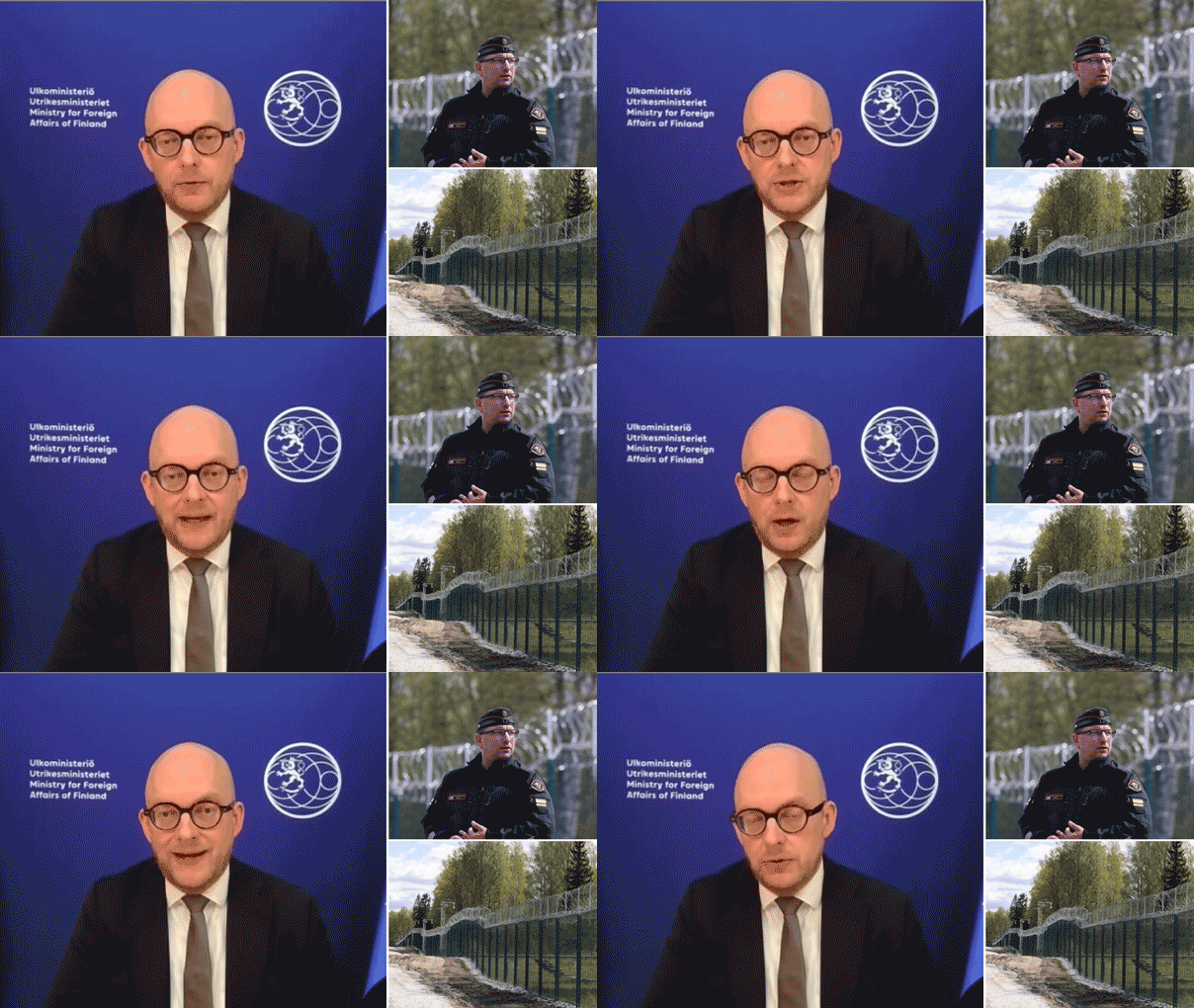
Finland has finished building a new border fence along its eastern frontier, and the sight of it says more about the state of European security than any policy paper ever could. For decades, Finland and Russia shared a quiet, pragmatic relationship, one built on geography and the simple reality of being neighbors. Helsinki kept channels open, trade moving, and borders calm. But Russia’s full-scale invasion of Ukraine changed everything, and Finland, once famously neutral, made a historic pivot to NATO in April 2023. Now, roughly 124 miles of fencing stand as a secondary but highly visible security measure designed to control the flow of unauthorized migrants. Petri Hakkarainen, political director for the Finnish Ministry for Foreign Affairs, told Fox News Digital that Finland has “in the past witnessed Russia’s attempts … to instrumentalize migrants at the Finnish border.” In plainer terms, he meant that Moscow has learned how to use human beings as weapons, pushing them toward Finnish checkpoints and forcing Helsinki to take them in. The fence is not a barrier of hatred; it is a barrier of calculation, a way to keep the border from becoming a pressure valve that Moscow can turn on at will, flooding Finnish society with asylum claims and overwhelming its systems.
Understanding why Finland felt compelled to build this fence requires understanding how hybrid warfare actually works. Russia does not always need tanks to hurt a country; sometimes it can simply create a crisis at a border and let the chaos do the rest. Hakkarainen explained that a sudden influx of migrants forces the Finnish government to process large volumes of asylum applications, which might seem manageable once or twice but becomes dangerously destabilizing if done on a massive scale. The strategy is not subtle: push people toward Finland, force the government to respond, and then watch the social, political, and legal systems strain under the weight. Finland shares an 833-mile border with Russia, the longest of any European Union or NATO member state, and that is an enormous amount of land to monitor. It is impossible to guard every forest trail or remote crossing with human eyes alone. A physical fence, along with modern surveillance and sensors, gives Finland a chance to control the narrative rather than react to it. This is especially important because the fence was never designed to be the first line of defense; it is a “secondary” measure, a backup that allows border guards to do their jobs with more clarity and less chaos. In a country that prides itself on preparedness, the fence is less about paranoia and more about preventing a weaponized migrant flow from ever gaining momentum in the first place.
The story of how Finland reached this point is dramatic, and it moved quickly. In 2023, after observing Russia’s behavior and the sudden pressure at its frontier, Finland made the bold decision to close its entire land border with Russia. For a country that had prided itself on stable relations with the Kremlin, this was a profound shift. Moscow responded with fury, filing a formal complaint and condemning the closure as “Russophobic.” The Kremlin expressed “deep regret” over the move, claiming that Finland had abandoned decades of “pragmatic, mutually respectful relations” in favor of an anti-Russian political stance. But Helsinki saw the world differently. The closure was not about ideology; it was about security. Almost immediately after Finland joined NATO, more than 1,300 migrants without visas suddenly arrived at its eastern border. The timing was too precise to be accidental. Finnish leaders accused Moscow of weaponizing migration as an act of hybrid warfare, a charge the Kremlin denied even as the evidence mounted. For the Finnish people, the message was clear: Russia was willing to use vulnerable people as political pawns, and Finland needed to protect itself. The border closure proved “very effective,” Hakkarainen said, and it gave Finland the space to design a more durable solution than simply locking the gates and hoping for the best.
That solution came in the form of the Border Security Act, a temporary law that has sparked debate both at home and abroad. The law authorizes border authorities to restrict asylum applications and turn migrants back if a foreign actor attempts to destabilize the country by funneling people across the border. It is a striking piece of legislation because it explicitly acknowledges what many European countries have been slow to admit: that migration can be used as a weapon, not just a humanitarian issue. The law immediately raised questions about human rights and international legal obligations, and Finnish lawmakers did not shy away from those concerns. Hakkarainen acknowledged that these worries are taken “very seriously,” but he also made it clear where the priorities lie. “National security and our own sovereignty … weighed more heavily in this conversation,” he said, adding that there is broad majority support for the act. In a perfect world, every asylum seeker would be processed with time and care, but Finland is not living in a perfect world. It is living next to a country that has shown a willingness to exploit human desperation for political gain. The Border Security Act is not a rejection of humanitarian values; it is a recognition that Finland must control its own borders if it wants to remain a humane and functional society at all. The debate will continue, but the Finnish position is grounded in a stark reality that many other nations are only beginning to understand.
Finland’s border fence does not exist in isolation, of course. It is part of a much larger pattern of Russian behavior that has alarmed Western officials for years. Russia remains locked in a war of attrition in Ukraine, and Western intelligence agencies have accused Moscow of launching widespread destabilization campaigns across Europe, ranging from disinformation to state-sponsored economic coercion, all designed to erode public trust and fracture alliances. The border pressure on Finland fits neatly into that playbook. Hakkarainen emphasized that Finland’s analysis matters because Finland lives next door to Russia. “We think it’s important to listen to those of us who live next door to Russia,” he said, urging the rest of the transatlantic community to pay attention. His warning is stark: “We consider Russia to be a long-term threat to transatlantic security — not only to Ukraine, not only to Europeans, but to transatlantic security as a whole.” The fence, then, is not merely a Finnish project; it is a signal to the entire alliance that the threat is real, persistent, and evolving. The urgency of that message has been reinforced by recent events, including NATO jets shooting down a drone in Lithuanian airspace and NATO Secretary General Mark Rutte warning that Russia is growing “increasingly reckless.” Finland’s experience is no longer an outlier; it is a preview of what other NATO members may face if they do not take the threat seriously.
For all the hardened concrete, steel posts, and surveillance equipment, the most human part of this story is the way Finns themselves view the fence. It would be easy to imagine that living next to a powerful and unpredictable neighbor would make a nation anxious, closed-off, or perpetually on edge. But Hakkarainen’s final observation turns that expectation on its head. “We take our security and preparedness very seriously,” he said. “I would say not despite that, but because of that, we are able to lead very normal lives here — regardless of the neighbor we have.” That is the quiet confidence of a country that has learned to prepare for the worst while still enjoying the simple rhythms of daily life. The fence is not a symbol of fear; it is a symbol of self-reliance. It allows Finnish families to wake up, go to work, send their children to school, and take a deep breath without wondering whether a sudden surge at the border will disrupt everything. The new border fence is also a reminder that security is not abstract; it is built with real materials, real laws, and real political courage. Finland cannot change the fact that Russia is its neighbor, and it cannot rely on Moscow to behave predictably. What it can do is take every reasonable step to ensure that its sovereignty remains intact. That is what the fence represents: not a wall against the world, but a door with a lock, a boundary line that says Finland decides who enters, on what terms, and for what reason. The article that captured this moment in Finland’s history is more than a news story; it is a portrait of a nation adapting to a dangerous new era without losing its sense of normalcy. As the security landscape across Europe continues to shift, Finland’s example may well become a model for other allied nations wrestling with the same questions of how to balance openness, security, and sovereignty in a world where borders are no longer just lines on a map, but active battlegrounds in a broader struggle for stability and trust.