

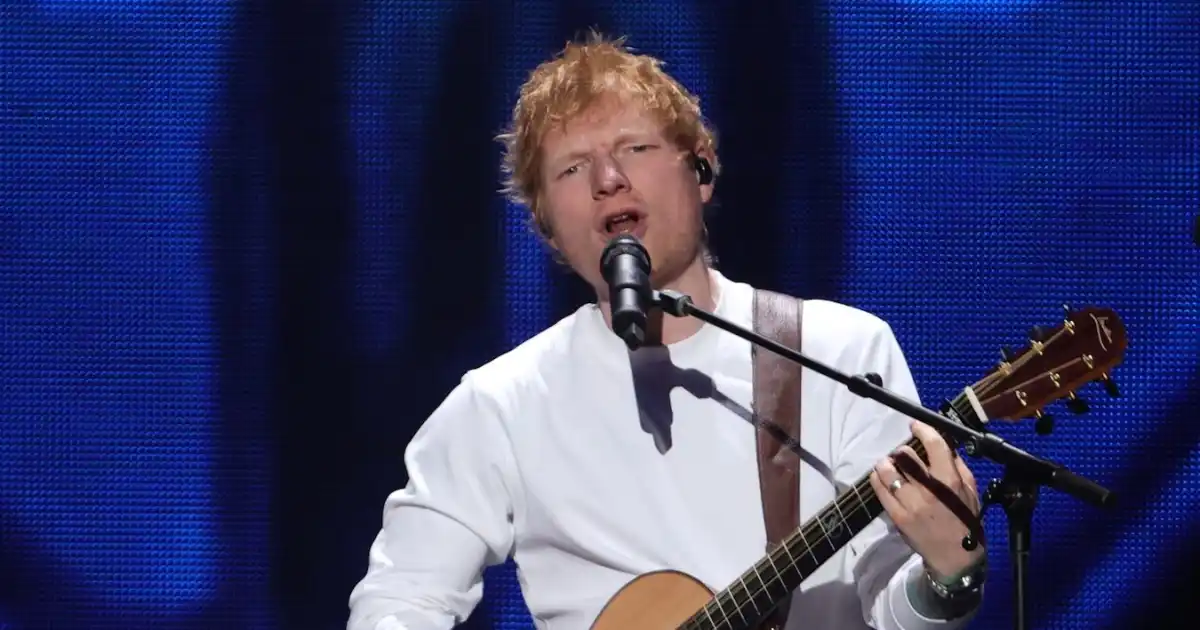
1. For fans filing into Lincoln Financial Field in Philadelphia on Saturday, September 19, something felt quietly different from the start. Ed Sheeran’s Loop Tour had always promised a night of intimate surprises wrapped inside a massive stadium spectacle, and one of the most beloved parts of that experience was the B-stage—a secondary platform where Sheeran would venture out to take spontaneous requests from the crowd. But on this particular evening, that stage was gone, and the familiar rhythm of the show had shifted. According to multiple fan accounts, the Philadelphia concert would not feature the B-stage at all, and no fan requests were taken that night. The show itself also started much later than usual, with doors and stage times pushed back to 8 p.m. instead of the typical 5:30 p.m. start. Resale ticket prices told their own story: seats that had been listed for around $100 just a few days earlier had dropped to as low as $42 by Saturday afternoon. For many in attendance, the changes felt less like a creative pivot and more like the visible ripple effects of a turbulent week—one that had placed Sheeran squarely in the middle of a global controversy he never asked for. The concert itself still went on, and Sheeran performed with the same emotional intensity his fans have come to expect, but the atmosphere was undeniably heavier, layered with the weight of everything that had happened behind the scenes.
2. The turbulence began earlier in the month, when Macklemore—the rapper best known for “Thrift Shop” and “Same Love”—was serving as one of the opening acts on Sheeran’s Loop Tour. During two concerts at MetLife Stadium in New Jersey, Macklemore used his platform to make a political statement. While performing his protest track “Hind’s Hall,” he declared “Free Palestine” to the crowd, a moment that immediately sparked controversy and drew intense attention. It didn’t take long for the fallout to reach Sheeran’s team. Reports suggested that tour promoters and venue owners—including Robert Kraft, the owner of Gillette Stadium—pressured Sheeran over allowing Macklemore to continue performing at upcoming shows. The pressure was significant enough that by Monday, September 14, Macklemore was officially removed from the lineup. The news landed like a bombshell, not only because of the political implications but because of the personal relationship involved. Macklemore and Sheeran had been friends for thirteen years, and the sudden severing of that professional connection felt deeply personal. In his public statement, Macklemore was careful not to cast himself as a victim, and he refused to paint Sheeran as one either. He acknowledged that both men were privileged, with careers, money, safety, and audiences around the world. But he also shared the painful details of their conversation, revealing that Sheeran had told him the words “Free Palestine” and the image of the Palestinian flag were hurtful to many people he had spoken with. Macklemore expressed hope that this wouldn’t be the end of their friendship, writing that thirteen years of connection doesn’t simply disappear because of one painful disagreement. He ended his statement with an open door, ready to keep listening and talking.
**3. Sheeran remained silent for a day, letting the news cycle churn and the reactions pour in. Then, on Tuesday, September 15, he broke his silence with a statement of his own. He was careful to clarify that he had not personally made the decision to remove Macklemore from the remaining eight concerts, even though he understood why people might assume otherwise. Sheeran described a week spent trying to build bridges, saying he had spoken with venues at length throughout the week in an attempt to find a solution. Ultimately, he admitted, he was unable to make it work. “I know who I am, both as a person and as an artist, and those who know my heart know my values too,” he wrote. It was a carefully worded response—one that tried to balance honesty with the constraints of a man caught between friendship, business obligations, and the expectations of powerful industry figures. Meanwhile, Macklemore continued his activism in a striking way: he announced that he would donate his entire $1 million salary from the Loop Tour to Palestinian organizations. He also challenged Robert Kraft, the 85-year-old Patriots owner, to do something similar. Kraft later confirmed that he had matched a $2 million humanitarian donation made by Sheeran himself. The gesture added another layer to a story that was no longer just about one rapper’s comments on stage, but about how money, influence, and moral conviction collide in the real world. In the span of a few days, a concert tour had become a flashpoint for discussions about neutrality, advocacy, and the limits of artistic expression.
4. By the time Sheeran took the stage in Philadelphia, he seemed determined to address the situation directly rather than let the silence speak for him. In a lengthy opening statement, he acknowledged the intensity of the past week and admitted that he had been struggling with how to respond. “This week, the criticism was about something much more important, and I’ve had to take [it in] and make difficult decisions, and I am making mistakes, and I’m so, so sorry,” he told the crowd. It was a strikingly vulnerable opening for a stadium show, a far cry from the usual upbeat kickoff fans might expect. Sheeran spoke about being placed “in the middle of an important, passionate argument,” and he did not shy away from naming the pain on both sides. He condemned what he called the “horrific” violence unleashed on October 7, 2023, while also acknowledging the “catastrophic and unjustifiable” loss of life in Gaza. He referenced a United Nations report from June stating that more than 20,000 children had been killed and over 44,000 injured since hostilities escalated. Then came the line that seemed to capture where he stood: “I’m listening and learning. I do not know enough [about the conflict].” It wasn’t a sweeping political speech, and it wasn’t a declaration of allegiance to any cause. Instead, it was an admission of humility from a songwriter known for turning his own doubts and questions into songs. For the fans in attendance, it must have felt like watching an artist wrestle with something far larger than music—a man trying to navigate a moment in history while standing in front of tens of thousands of people.
5. The absence of the B-stage and the support acts made the whole night feel strangely intimate, a reminder that even the biggest tours are not immune to the world’s chaos. Finneas and Lukas Graham, both of whom had been scheduled to perform as openers on select dates, had dropped out in solidarity with Macklemore. Their departures left Sheeran to carry the night largely on his own, supported only by the weight of the moment. Ticket prices plummeted, perhaps reflecting uncertainty or hesitation from fans uncertain about what to expect. But those who came were rewarded with a concert that felt more raw, more confessional, and more human than the usual polished production. Sheeran’s apology, his admission that he was making mistakes, and his repeated refrain that he was still listening and learning resonated throughout the arena. For a man whose public image is built on authenticity, and whose songs often explore vulnerability, this was a test not just of his artistry but of his character. There is no handbook for how to handle a controversy of this magnitude—no script for how to keep a tour alive when one of your closest collaborators is publicly removed, and when other performers walk away in solidarity. The Philadelphia show became a snapshot of a particular kind of pain, one that many people experience on a smaller scale: the feeling of being caught between a friendship you value and a system you don’t fully control, between public pressure and private doubt. Sheeran embodied that discomfort publicly, under stadium lights, with the whole world watching.
6. Looking ahead, Sheeran’s next scheduled performances are set for Gillette Stadium in Foxborough, Massachusetts, on Friday, September 25, and Saturday, September 26—the venue owned by Robert Kraft, the same man at the center of the pressure campaign. That upcoming pair of shows is bound to carry its own electric tension, layered with all the unresolved questions still hovering over this story. What does it mean to perform at a stadium owned by a man whose actions were so intertwined with the controversy? How does an artist move forward when the bridges he tried to build have collapsed? Sheeran’s own career has rarely been tied so explicitly to political controversy, and yet here he is, suddenly standing at the center of a conversation about alliances, friendships, and the difficult reality that silence itself is never neutral. And yet, there was something quietly hopeful about the Philadelphia show that should not be lost in the noise. Sheeran was still there. He showed up. He spoke honestly, apologized, admitted his limits, and kept going. Macklemore kept talking to the world about what he believes. Kraft made a contribution shepherded by donations. In the midst of all of it, the music remains—the songs, the crowd, the strange mysterious bond between an artist and his audience. That bond is not always about agreement. Sometimes it’s just about presence. And in showing up there, under the lights, ready to listen, Sheeran signaled that he understands that even in pain, even in confusion, even in the middle of an argument that may not be resolved, the best thing we can do is show up honestly and begin again, one show at a time.