



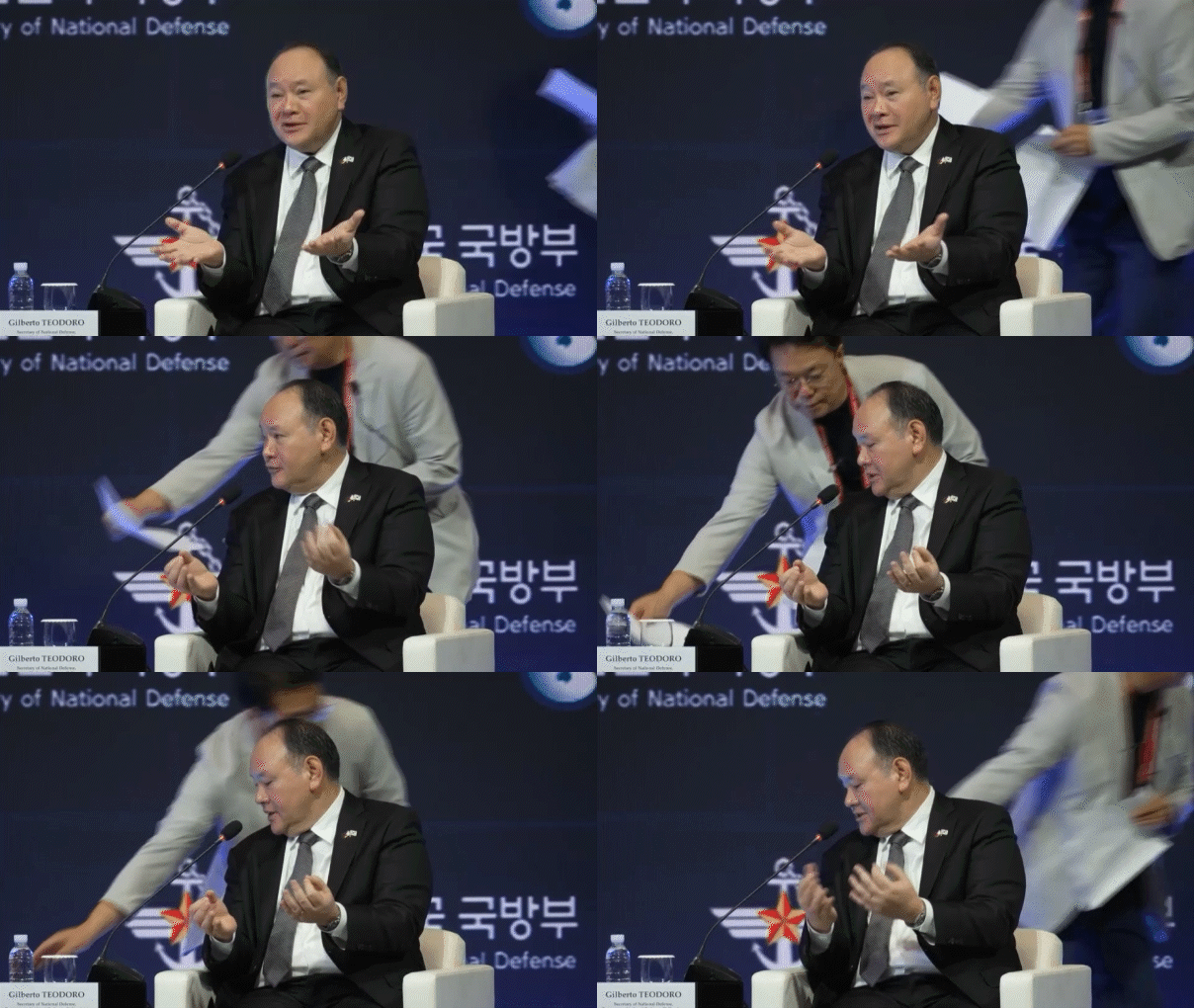
The atmosphere in the conference hall was one of intense focus, a typical scene for the high-level Seoul Defense Dialogue where international dignitaries gathered to discuss pressing security concerns. Among the speakers was Gilberto C. Teodoro, the Defense Secretary of the Philippines, who was mid-oration, delivering his country’s perspective on the complex geopolitical landscape of the region. The audience, a mix of diplomats, military officials, and policy experts, was listening intently. Suddenly, a subtle disturbance rippled through the room as a man in a white sports coat, presumably part of the official delegation process, approached the podium. With practiced discretion, he placed a single sheet of paper on the table beside Teodoro before retreating to his seat. The action was swift and silent, almost a non-event in the grand scheme of such summits, but it was a moment that would immediately derail the proceedings and capture international attention. Teodoro paused, his thoughts momentarily suspended as he glanced at the unexpected document. This was no ordinary administrative note; it was a diplomatic grenade thrown directly into the heart of the forum.
With a calm but visibly perturbed demeanor, Teodoro addressed the crowd, announcing the note’s apparent origin. “I have a note here, I think this is from China,” he stated, the pause in his speech now charged with anticipation. He sought permission from the audience before reading its contents aloud, turning a private gesture of protest into a public spectacle. The note reiterated China’s often-stated position on a critical legal matter: that the arbitral ruling on the South China Sea, a subject of intense, decade-long friction between the Philippines and China, was illegitimate. The note read that China’s position is “clear, consistent and firm” but that the arbitration itself “violates fundamental principles of international law.” By reading this uninvited interruption aloud, Teodoro transformed a covert attempt at persuasion or intimidation into an open act of confrontation, setting the stage for the rebuke that was to follow.
The reference in the note pointed directly back to the landmark 2016 legal case, a watershed moment for the Philippines and its claims in the resource-rich waters of the South China Sea. The Philippines, under the leadership of then-President Rodrigo Duterte, had brought a case against China under the United Nations Convention on the Law of the Sea (UNCLOS), challenging what it viewed as unlawful land reclamation and aggressive maritime expansion within its exclusive economic zone. The international tribunal in The Hague ruled in favor of the Philippines, declaring that China’s extensive claims had no legal basis under international law. The ruling, however, was never recognized or accepted by Beijing, which has steadfastly dismissed the tribunal’s jurisdiction and decision, asserting its position with the kind of passive resistance that frustrates international norms. For the Philippines, the ruling remains a cornerstone of its legal and diplomatic strategy, a shield against what it perceives as the erosion of its national sovereignty. The tension created by this long-running dispute has consistently erupted into tense naval standoffs, with each nation accusing the other of aggression and encroachment within the disputed waters, making it one of the most volatile flashpoints in the region.
Teodoro’s response to the note was swift and sharp. He turned to the audience and asked a pointed rhetorical question that cut to the heart of diplomatic decorum and respect. “How can you deal with a country in an international forum—beyond the question asked to me—disrespecting the organizers of this forum, how do you expect to deal with it civilly?” His voice was a mix of disbelief and indignation. He asked the crowd whether this was the proper way to deliver a message to a speaker and questioned the sanity of treating such behavior as acceptable. He lambasted the act, not just for its timing and audacity, but for what it represented. The note, he argued, was not merely a slight against him or the Philippines; it was a direct assault on international law and the fundamental principles of diplomacy. “It not only disrespects international law, throwing UNCLOS to the floor and trampling upon it, but it also disrespects the basic decency accorded that should be accorded to our most gracious host, the Republic of Korea and the rest of the audience here,” he said. By framing the incident in this way, Teodoro elevated a personal snub into a systemic critique of China’s conduct on the world stage.
His rhetoric escalated, moving from critique to condemnation. “So, perhaps basic decency and behavior is what China needs to do. This is actual coercion, bullying and aggression,” he declared, as he addressed the audience. He then seized control of the narrative, turning the note from a tool of intimidation into a symbol of his nation’s perseverance. “I will keep this paper as a memento of how desperate China is and how ineffective its position is in the face of a free audience,” he stated, his tone laced with defiance. He thanked the person who had given him the paper, in a twist of sarcastic gratitude, asserting that they had unwittingly done their country a great disservice by exposing their methods to the world. By incorporating the note into his argument, Teodoro reframed what might have been a quiet diplomatic irritant as a public demonstration of his country’s moral and legal high ground. His message was clear: the Philippines, its allies, and the principles of international law could not be cowed by such tactics, which he characterized as desperate and counterproductive.
Teodoro then expanded his critique to the broader context of the Philippines’ ongoing struggle. He asserted that the situation is well-known, referencing the daily challenges his nation faces from the People’s Republic of China. He accused Beijing of attempting to “occupy and illegally assert its presence over our territory and especially our exclusive economic zone,” a direct violation of UNCLOS conventions that underpin the global maritime order. He stressed that in an interconnected world, no state has the right to “appropriate an international common for its exclusive use or right,” framing the dispute not just as a bilateral disagreement but as a threat to the shared rules-based international system. He concluded his thoughts with a justification of the Philippines’ strategic response, explaining that the country has been “forced to enter into creative defense arrangements and alliances” as a direct consequence of China’s conduct. This concluded his public response, but the moment remained a powerful illustration of the raw, deeply personal emotions that underpin the region’s most significant geopolitical rivalry. The presentation, once a standard policy speech, had become a dramatic, live-action vignette of the clash between legal order and power politics. In the echo of the conference hall, the sound of a single piece of paper being dropped had proven more thunderous than any policy proposal, leaving a lasting impression of the fragile line between diplomacy and open conflict in the Indo-Pacific.