


Some countries are places you visit; others are places you move through. Slovenia clearly belongs to the second group. It invites you to explore on foot, by bicycle, in a kayak, or even underground. This small country—just over twenty thousand square kilometres and barely two million inhabitants—manages to pack an extraordinary range of landscapes into one compact corner of Europe. Around sixty percent of its territory is covered by forest, and more than a third is protected or included in the Natura 2000 network. It is often called the green lung of the Balkans, but that description sounds too still. Slovenia feels more like a vast natural playground, a stage built for movement. Hiking, cycling, climbing, kayaking, rafting, canyoning and caving are not just activities here; they are the most natural ways to understand the country. Distances are short enough that in a single morning you can leave a Central European capital, breathe in the mountain air beside an Alpine lake, and by afternoon be standing above an underground canyon carved by a river that has been working for millennia. We spent five days travelling around Slovenia in a camper van, and the choice made immediate sense. Camper van life slowed us down in all the right ways, letting us stop when the view demanded it, change plans when a road looked promising, and carry everything we needed without ever feeling tied to a single base. The road became part of the experience rather than just a way between places. In Slovenia, the landscape does not sit quietly in the background. It keeps inviting you to step in, to follow it, to see what lies beyond the next ridge or around the next bend.
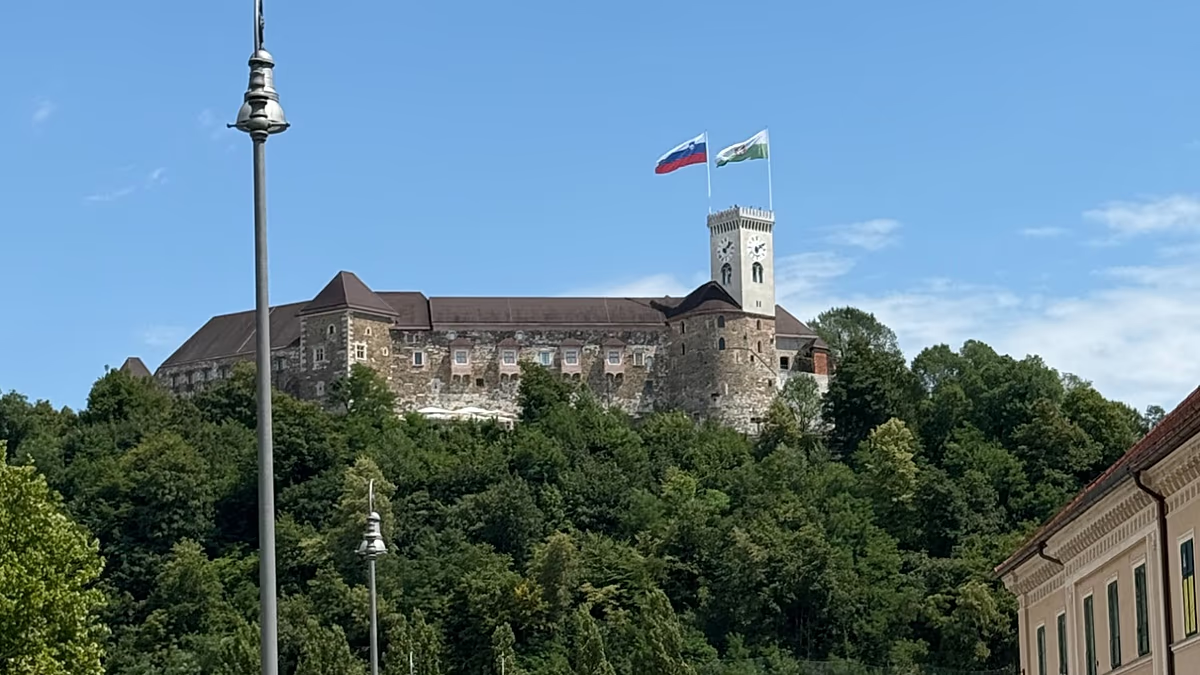
Our first stop was Ljubljana, Slovenia’s capital and largest city, yet still small enough to feel human. With fewer than three hundred thousand inhabitants, it is a city that rewards walking. The historic centre spreads out along the Ljubljanica river, where bridges, terraces and colourful buildings create a setting that is both elegant and relaxed. Bicycles drift past constantly, and in summer the riverbanks turn into an impromptu social space. People sit on steps, play volleyball, paddle boats, drink coffee, and let the afternoon slip away. Ljubljana is a city made for wandering without purpose. A stroll leads to the Central Market, where stalls heavy with fruit, vegetables and local produce give you a glimpse of everyday life; then the path follows the river to the city’s most famous bridges. One of them, the Dragon Bridge, is guarded by four large dragon statues. The dragon is Ljubljana’s symbol, and according to legend it is connected to Jason and the Argonauts, who supposedly defeated a monster in the nearby marshes. Above the old town, Ljubljana Castle has stood for more than nine hundred years. You can climb to it on foot or take the funicular, and from its tower the whole city opens up beneath you. On clear days you can even see the mountains that would soon draw us north. We lingered longer than planned. Ljubljana has a way of making you forget the itinerary. It may not have been the most active part of our trip, but it was a perfect way to start. It was only on our second morning, with the castle behind us and the Julian Alps appearing on the horizon, that we finally felt ready to move.
From Ljubljana we headed into the Julian Alps, and within an hour the landscape had transformed into the Slovenia of postcards. Lake Bled is probably the country’s most recognisable image, and the reality does not disappoint. Surrounded by mountains and forest, the lake holds a tiny island topped with a church, while a medieval castle stares down from a cliff above the water. It seems almost too perfect. The first thing we did was join the loop that circles the lake. The route is only about six kilometres, and cycling it turned out to be the perfect introduction. Every few hundred metres we stopped, unable to resist the shifting views: the church from one angle, the castle from another, the mountains reflected in the water. In summer, the lake is also hard to ignore as a place to swim. There are designated swimming areas, and after pedalling around the shore, we joined the bathers. Floating on my back with the Alps rising behind me was one of those small moments that explains Slovenia’s appeal. Bled is beautiful, but it is also one of the most visited places in the country. To find a quieter, wilder side of Slovenia, we continued to Lake Bohinj. Bohinj is larger, a little over four kilometres long, and sits deep inside Triglav National Park. It feels more untamed than Bled. There is no fairy-tale island, no cliff-top castle; the landscape itself is the star. At certain times of day the water is so still that it becomes a perfect mirror, blending forest, peaks and sky into shades of green, blue and turquoise. We hired kayaks and paddled out onto the lake. From the middle, the mountains felt enormous and the silence almost complete. Around the shore, there are hundreds of kilometres of trails, ranging from gentle lakeside walks to demanding climbs into the high peaks. Climbers will find plenty of rock faces too. And above everything stands Triglav, Slovenia’s highest mountain at 2,864 metres, a national symbol that seems to keep watch over the entire valley.
Between Bohinj and our next stop, we discovered another of Slovenia’s gifts: the journey itself. Distances are short, but the roads twist and turn through forest, mountains and tiny villages, and the scenery shifts constantly. At times the landscape reminded me of Switzerland, but more compact and less crowded. A camper van proved perfect for this kind of travel. We could pull over whenever we wanted, take a side road, or simply sit with the doors open and enjoy the silence. Our destination was Bovec, in the western part of the Julian Alps, and it did not take long to understand why this small town is considered one of Slovenia’s great adventure hubs. The reason flows just outside town, and it is almost impossible to look at it without wanting to jump in. The Soča river runs through the valley in a colour that seems to have been invented by an illustrator: turquoise, blue and emerald green, swirling between white rocks, narrow gorges and thick forest. It is one of the most beautiful rivers in Europe, and also one of the best places in the country for adrenaline. Rafting, kayaking and canyoning draw visitors from all over the world. Even if you don’t want to get wet, it is pure pleasure to stand on a bridge and watch brightly coloured kayaks slide down the currents. Bovec itself is small but full of energy, with outdoor gear hanging outside shops and groups of athletes comparing stories at the campsites and cafes. Around the town, the natural attractions keep piling up. The Boka waterfall is one of Slovenia’s most spectacular, while Virje is smaller, more intimate and impossibly blue. For hikers, Krnsko Jezero, an Alpine lake at about 1,400 metres, offers a beautiful day trip. And for those travelling by road, the Vršič Pass climbs to 1,611 metres, the highest road pass in Slovenia, with countless bends that cut through the mountains and connect the Soča valley with Kranjska Gora. Above Bovec rises the Kanin massif, known for winter skiing and equally impressive for summer hiking. Bovec, more than anywhere else, sums up Slovenia’s active spirit. Here the landscape is not a backdrop; it is an invitation.
Our final major stop took us somewhere completely different. Leaving the mountains and rivers behind, we drove to south-west Slovenia and descended into the underworld. The Škocjan Caves, a UNESCO World Heritage Site since 1986, are one of the most extraordinary karst systems on the planet. The creator is the Reka river, which over millennia has carved through limestone to form a vast hidden universe of galleries, chambers, waterfalls and underground canyons. The visit starts like a normal cave tour, with a path and a guide. But it quickly becomes something more adventurous. As you walk deeper, natural light fades, the chambers grow larger, and the sound of water begins to rise from below. At times I felt more like an explorer than a tourist. Škocjan contains one of the largest known underground river canyons in the world; the system stretches for more than six kilometres and reaches depths of over two hundred metres. The tourist route covers about three kilometres and descends roughly 144 metres below the surface. The most breathtaking moment comes at the Cerkvenik Bridge, suspended about forty-five metres above the Reka river. Standing there, surrounded by darkness, deafened by the water and enclosed by massive rock walls, I found it hard to believe that this world was still Slovenia. The tour takes about two hours and is guided. Even in summer, you need to remember that the temperature inside stays around twelve degrees all year, so warm clothing and good walking shoes are essential. It is also wise to book ahead, because in the peak season tours fill up quickly. Not far away, the Postojna Caves offer a very different underground experience. Postojna is more tourist-friendly, partly accessible by a small train that carries visitors through the formations. It is impressive, but easier. Škocjan, by contrast, feels like a real expedition. There is no train to soften the experience. You walk, you descend, you cross vast chambers while the river keeps working in the darkness below. Postojna amazes with its stalactites and stalagmites; Škocjan amazes with its scale and raw power.
After five days on the road, we packed up the camper van and pointed it towards the border. Slovenia left a clear impression: it feels much bigger than it looks on the map. Not because of distances, but because of the sheer variety of experiences packed into such a small area. In a single week we had wandered through a relaxed capital, cycled around a picture-perfect lake, kayaked across a wilder one, driven through mountain passes, stood beneath waterfalls, watched the Soča twist through its impossibly coloured valley, and descended into the depths of the earth. None of it felt rushed. The country has a way of making you feel that every place deserves your time. It also has a quiet way of encouraging you to move. The trails are there, the rivers are flowing, the mountains are waiting. For anyone who believes that active travel is the best way to see a place, Slovenia is a vast natural playground in the heart of Europe. It rewards curiosity and effort. The more you put into it, the more it gives back. And in the end, what stays with you is not just the scenery, but the feeling of having been part of it: feet on the trail, hands on the paddle, breath in the cold cave air, eyes on the mountains. We learned that the best way to understand a country is not to stand in front of its wonders but to move through them. Slovenia taught us that again and again. That is the Slovenia we came looking for, and the one we left hoping we would soon see again.