





A Hidden Facility, A Lingering Threat: Unfinished Business at Natanz
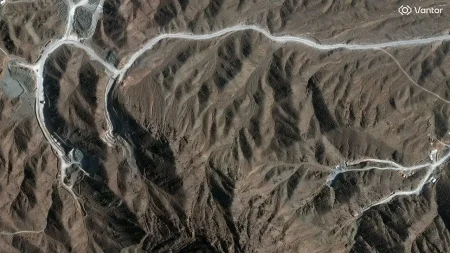
In the shadowy world of nuclear intelligence, the discovery of a single, concealed structure can rewrite the strategic calculus of nations. A fresh report from the Washington, D.C.-based Institute for Science and International Security (ISIS) has done just that, revealing that a partially submerged underground building at Iran’s sprawling Natanz nuclear complex survived the bombings of 2025 and may hold the key to Tehran’s future atomic ambitions. This separate, hardened bunker—seemingly designed for the delicate storage of uranium hexafluoride (UF6) gas, the feedstock for enrichment—was largely completed between 2015 and 2017. Its existence, and its survival, suggests that even the most punishing military campaigns have left critical pieces of Iran’s nuclear machinery intact, quietly waiting for a moment of renewed activity.
The revelation comes at a deeply complex moment. The report details that while an Iranian centrifuge assembly plant and other above-ground facilities were severely degraded in the June 2025 strikes—codenamed “Operation Midnight Hammer”—and a follow-up operation, this particular bunker was not targeted or simply escaped the devastating precision strikes. Satellite imagery shows no recent vehicle movement at the site, hinting that it is currently dormant. Yet, the very fact that it remains structurally whole is a source of profound unease for Western intelligence agencies. It stands as a physical monument to the resilience of Iran’s nuclear program: a facility built in secret, shielded by earth and concrete, and designed to outlast the political and military storms that have repeatedly threatened its parent complex. Its existence forces a sobering question: how much else remains hidden?
This unease is amplified by Iran’s rapidly advancing weapons-grade uranium stockpile. According to another recent ISIS report, between December 2024 and June 2025—a mere six-month window—Iran nearly doubled its stockpile of uranium enriched to 60 percent purity, bringing the total to approximately 440 kilograms. This is a staggering quantity, far beyond any plausible civilian need, and it dramatically compresses the time Iran would need to produce enough weapons-grade material (90 percent enrichment) for a nuclear arsenal. The convergence of this massive, highly-enriched stockpile with a hidden, intact storage facility creates a perilous “breakout” scenario. It suggests that despite the military setbacks, Iran retains the core ingredients and the critical infrastructure to potentially sprint toward a weapon faster than previously estimated, should its leadership make the call.
Expert observers are warning against any triumphalism in the wake of the strikes. Jason Brodsky, policy director at United Against Nuclear Iran (UANI), points directly at the gap in the military strategy. “The report assesses that this structure at the Natanz nuclear facility was not targeted during Operations Midnight Hammer and Epic Fury,” Brodsky told Fox News Digital. “This raises questions as to why the U.S. and Israel did not take it out. Given that Iran is not allowing IAEA inspectors into its bombed facilities, in contravention of its NPT obligations, Washington and Jerusalem will have to rely on their own intelligence to determine what is happening inside this remaining bunker. If it is still intact and can accommodate enrichment-related activity, it should be destroyed in any future strikes.”
Brodsky also pointed to the underlying, systemic failure of diplomacy. He argued that the existence of such a facility, and the continued enrichment, is a direct consequence of flawed international agreements. “The allowance of such a facility under the JCPOA demonstrates the flaws of that agreement—it permitted Iran to retain and develop an industrial-scale enrichment program following the sunsets of various provisions. This is precisely why zero enrichment in Iran must continue to be the international demand,” he stated. His comments frame the issue not just as a military or intelligence challenge, but as a fundamental failure of policy to anticipate Iranian deception and ambition, a failure that has allowed the program to burrow deeper underground.
The U.S. administration, for its part, is projecting a posture of total pressure on all fronts. In the wake of the military strikes, the Treasury Department has launched a sweeping new financial offensive, an operation its architects are calling an “economic D-Day” against the Iranian regime. Announced by Treasury Secretary Scott Bessent, this new campaign is designed to sever the final economic lifelines sustaining the Islamic Republic, squeezing its oil revenues, financial networks, and access to global markets. Anna Kelly, a White House spokeswoman, echoed this hardline stance, stating, “First, Iran’s nuclear facilities were totally obliterated during Operation Midnight Hammer. Now, Operation Economic Outcast is severing every remaining economic lifeline sustaining the Islamic Republic of Iran. President Trump has been clear that Iran can never possess a nuclear weapon, and America is entering the endgame.”
Yet, the historical record offers a sobering counterpoint. Successive U.S. administrations have designated Iran as a leading state sponsor of terrorism since the 1980s, and decades of sanctions have failed to permanently dismantle the clerical regime’s resolve or its nuclear infrastructure. The new financial offensive is undoubtedly crippling, but the question remains: can an economic stranglehold alone achieve what military action has not—namely, a complete and verifiable dismantlement of Iran’s nuclear program? The discovery of the intact Natanz bunker suggests that Tehran has become a master of playing for time, building redundancies, and hiding its most critical assets in hardened, inaccessible locations, betting that it can outlast the political will of any single U.S. administration.
Ultimately, the report paints a picture of a prolonged and unresolved nuclear crisis. The survival of a hardened secret facility, the accumulation of near-weapons-grade material, and Iran’s refusal to cooperate with international inspectors create a volatile mix. The military strikes cut the head of the snake, but the body—hidden, shielded, and hardened—remains coiled in the earth. The path forward is fraught with danger: a reliance on fallible intelligence, the risk of a new escalation, and the profound difficulty of negotiating with a regime that has repeatedly demonstrated its willingness to deceive. The bunker at Natanz, silent and intact, is not just a leftover of a past conflict; it is a stark warning that the nuclear question is far from closed and that the next round of this long-running confrontation might be even more dangerous than the last.