



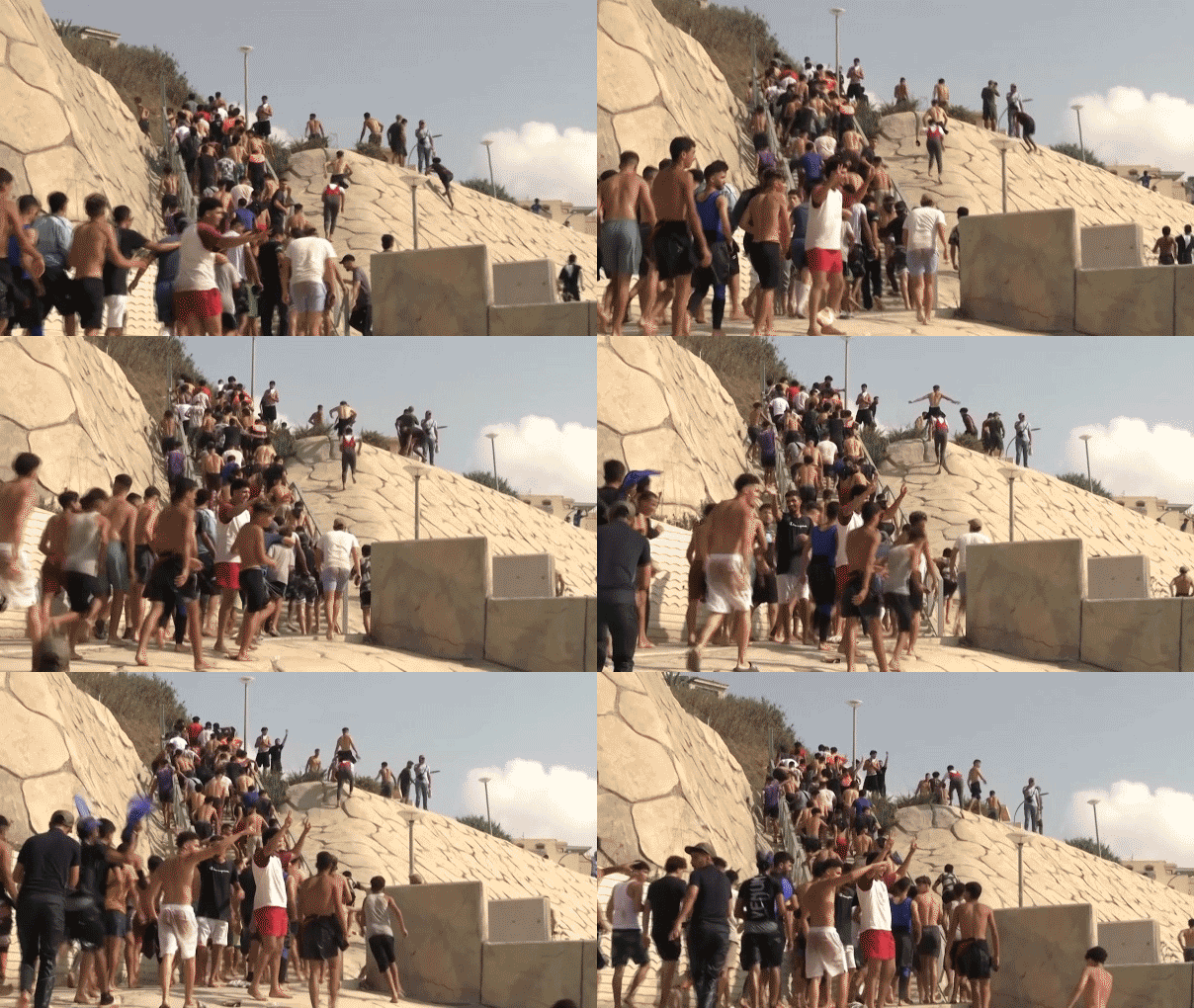
Under the scorching North African sun, the quiet, seven-square-mile Spanish enclave of Ceuta suddenly became the epicentre of a staggering human drama, as an unprecedented wave of sixty thousand migrants surged across the Moroccan border, seeking a foothold on European soil. For days, the shores and fortified fences of this tiny territory, which sits like a European island on the edge of a different continent, were overwhelmed by a sea of humanity—thousands of desperate individuals, mostly young men, swimming through treacherous currents or scaling towering barriers in a frantic bid for survival and opportunity. Among the chaos and the hope, the stark, heartbreaking reality of this mass movement was laid bare by the tragic loss of at least fifty-seven lives, souls claimed by the unforgiving sea before they could ever reach the safety of the shore. As local residents watched in disbelief and emergency services worked to the point of exhaustion, the sheer scale of the influx transformed what began as a localized Spanish border emergency into a profound humanitarian crisis, leaving tens of thousands caught in a liminal space of uncertainty. Though the Spanish Interior Ministry would later report that nearly fifty thousand of these travelers voluntarily returned to Morocco, leaving fewer than two thousand in the enclave, the psychological and physical shockwaves of those intense days had already shattered the delicate status quo, forcing the international community to confront the raw, unvarnished desperation of people willing to risk everything for the promise of a future across the water.
The tremors of the Ceuta crisis immediately radiated outward, crossing the Mediterranean to strike at the very heart of the European Union’s foundational promise: the dream of a borderless continent where citizens can move freely without passport checks. In a swift, defensive reaction that sent shockwaves through Brussels, Italian Prime Minister Giorgia Meloni announced the temporary restoration of border controls on travelers arriving from Spain, a dramatic move designed to protect national security and preempt any spillover of the migration wave into the Italian peninsula. By coordinating with France to tighten security along their shared Alpine frontier, Italy effectively suspended the spirit of the Schengen Agreement, demonstrating how quickly internal European walls can rebuild when the outer perimeter is breached. This retreat from the open-border ideal has ignited a fierce debate across the continent, as conservative leaders and anxious citizens question whether the Schengen zone can survive when individual member states feel forced to reclaim national sovereignty to manage external pressures. For the millions of tourists and commuters who rely on seamless travel, the sudden appearance of passport checks and police lines served as a stark reminder that the high-minded ideals of European integration are ultimately fragile, highly vulnerable to the harsh realities of global migration patterns and the political survival instincts of national governments.
At the center of this gathering political storm stands Spanish Prime Minister Pedro Sánchez, whose progressive coalition government is facing a fierce domestic and international backlash for policies that critics argue paved the way for the disaster. In the weeks leading up to the crisis, a controversial Spanish Supreme Court ruling restricted the government’s ability to summarily deport migrants intercepted at sea, mandating instead that they be processed through the slow, complex machinery of the standard asylum system—a legal shift that critics claim acted as a powerful invitation. Compounding this legal gridlock was the Sánchez government’s ambitious regularization program, which aimed to grant legal residency and work permits to hundreds of thousands of undocumented migrants already living within Spain’s borders to integrate them into the formal economy. While designed as a compassionate, pragmatic solution to a complex social issue, the program’s scale far exceeded expectations, drawing nearly one million applicants and fueling accusations from political opponents that Madrid was inadvertently signaling an open-door policy to the wider world. Critics, such as Nile Gardiner of the Heritage Foundation, argued that offering what they characterized as “amnesty” on such a massive scale inevitably creates an irresistible pull factor, turning the perilous journey across the Strait of Gibraltar into a gamble that millions of hopeful individuals are increasingly willing to take.
Beyond the borders of Europe, the dramatic footage of the Ceuta breach quickly became a potent weapon in the global ideological warfare surrounding national identity and border security, reaching all the way to the highest levels of American politics. At a Cabinet meeting at Camp David, former U.S. President Donald Trump seized on the images of the overwhelmed Spanish enclave to deliver a stark warning to the American electorate, painting a dark picture of a similar “catastrophe” unfolding at the United States’ southern border if liberal immigration policies are allowed to prevail. This rhetorical bridge between the Mediterranean and the Rio Grande highlighted how local border crises are no longer isolated events, but rather chapters in a larger, interconnected global narrative about sovereignty and the perceived weakness of Western democracies. Across the English Channel, Reform UK leader Nigel Farage warned that the fallout from the Spanish crisis would inevitably reach British shores, while in France, right-wing icon Marine Le Pen used the emergency to demand a permanent tightening of French borders. Even in the diplomatic corridors of the United Nations, the crisis sparked sharp exchanges, with Israeli Ambassador Danny Danon criticizing Spain’s government for lecturing other nations on security while failing to maintain basic control over its own national boundaries, illustrating how a physical breach in a remote border fence can instantly trigger a cascade of diplomatic recriminations across the globe.
Beneath the visible surface of humanitarian desperation and political posturing lies a darker, more calculated dimension of regional geopolitics, where human lives are frequently weaponized as pawns in diplomatic chess matches. Foreign policy experts, including Andrew Fox of the Henry Jackson Society, suggest that the sudden, massive influx of migrants may not have been an entirely spontaneous event, but rather a deliberately engineered crisis permitted—or even orchestrated—by Moroccan authorities in response to Spain’s shifting diplomatic engagements with Morocco’s regional rival, Algeria. This theory of “migration as gray-zone warfare” exposes the extreme vulnerability of European nations that rely on neighboring non-EU states to act as gatekeepers, showing how easily border security can be turned off or on like a faucet to extract geopolitical concessions. When Moroccan security forces eventually did intervene to stop the crossings using water cannons and warning shots, it only reinforced the troubling reality that European security remains deeply dependent on the whims of foreign governments. Furthermore, this dynamic highlights a profound, systemic failure in the international asylum and refugee framework, which was drafted in the mid-twentieth century and was never designed to handle the scale, complexity, and geopolitical manipulation of twenty-first-century mass migration, leaving modern states trapped between their humanitarian obligations and the primordial duty of national self-preservation.
As the immediate chaos in Ceuta begins to subside and thousands of migrants are returned to the Moroccan side of the border, the deeper existential questions raised by the breach continue to haunt the future of the European Union. The crisis has exposed a deep, ideological rift between those who view open borders and humanitarian compassion as the crown jewels of Western civilization, and those who warn that without rigid border enforcement, the very social and economic structures of Europe will inevitably collapse. For commentators like Nile Gardiner, the events in Ceuta are not just a passing emergency, but perhaps the first visible cracks in the foundation of the European project itself, warning that the dismantling of the Schengen agreement could trigger a domino effect that ultimately unravels decades of political and economic integration. Yet, beyond the grand theories of geopolitics and the fierce rhetoric of political campaigns, the human heart of the crisis remains unresolved: thousands of individuals waiting in the shadows of the border fences, gazing across a narrow strip of water toward a continent that represents both their greatest hope and an increasingly fortified fortress. The legacy of the Ceuta surge is a sober reminder that in an interconnected world, the struggles of the global South cannot be walled off or ignored, and that the search for a balance between security and humanity will remain the defining challenge of our era.