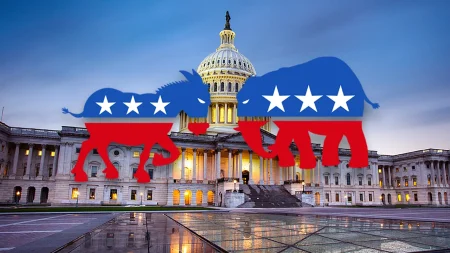



On the night before Election Day, the country holds its breath. The last rallies are over, the mail has been delivered, and the lawn signs stand like small flags in a long campaign that has left everyone weary. In Washington, strategists gather around whiteboards and phone banks, but no one pretends to know exactly what will happen. The Republicans are bracing for losses. There is no confident swagger this year, no talk of a broad wave that will sweep them safely into another term. Instead, there is a defensiveness, a sense that something has gone wrong and that the party in power is going to be blamed for it. The reason is not hard to find. The president’s economic leadership has left ordinary voters struggling to make ends meet in a time of rising prices, stagnant paychecks, and constant uncertainty. The war in Iran has added a layer of fear and sorrow that no political advertisement can brush away. Together, these two issues have created a backlash that is much bigger than any single Senate campaign. They have seeped into the most personal parts of life—what families can afford to put on the table, whether a child will have to give up hopes of college because the bank account is thin, whether a deployment will end safely, whether the world is tilting toward something darker. That is why the biggest question on Tuesday is not simply about candidates or poll numbers. It is about whether the Republican Party will have to give up control of the Senate because so many voters have decided that the people who hold power no longer understand their lives.
The economy is always the first thing voters mention when they are angry, and this year the anger is visible in grocery store aisles and gas station lines. A mother buying food for her family handles each item carefully, comparing prices, deciding which brand can be skipped and which need the lights to stay on. A father who used to take his children out for pizza on Fridays now cooks at home because the bills have piled up and the future feels too fragile for extras. A retired couple sits at their kitchen table, talking quietly about whether they can stay in the house they have lived in for thirty years. None of them think in terms of statistics or interest rates. They think in price tags, credit card statements, and the sinking feeling that comes when the paycheck is gone before the week is over. They see that their wages have not grown as fast as their expenses, and they draw a straight line from the president’s policies to their own struggles. There are always explanations for inflation—supply chains, global markets, the aftereffects of so much uncertainty—but those explanations do not help a person choosing between medicine and heat. The administration says the economy is improving, but the people who feel its leadership most directly do not feel the improvement. They feel the opposite. And because the party in the White House is the party being judged, it must answer for the comfort level of every dinner table. The Republicans have tried to use this frustration to their advantage, pointing to failures in governance and promising to bring back stability. But when the whole country is uneasy, the party in power cannot simply stand outside the status quo. It is part of the status quo. That is what makes the economic pain so politically dangerous. It is not just an issue to be debated on cable news; it is a feeling to be expressed in the voting booth.
The war in Iran is the other shadow, and it is heavier than most campaign speeches can capture. It is not an abstract foreign policy debate to the families who send their sons and daughters toward danger. It is not an academic question to the communities that hold vigils, write letters to soldiers, and count the days until a deployment ends. Every time the news breaks, they think about their own loved ones. Every time there is a report of a strike or a skirmish, they feel the ground shift beneath them. The war has dragged on so long that some people have grown numb, but numbness is not acceptance. It is exhaustion. It is the tiredness of a nation that has watched its leaders put people in harm’s way without a clear ending, a clear strategy, or a clear sense of what has been gained. Many voters now see the Iran war as a mistake that cannot be undone, a door opened too easily and then left swinging in the wind. They are not necessarily pacifists. They are not sure what the right answer is. They are simply convinced that they do not want the same hands on the wheel. Republicans have often tried to wrap themselves in the flag and speak of strength, but this is a moment when the flag is carried by families who are tired of war, not just by politicians eager to stand before it. The war has also pushed up fuel prices and disrupted trade, so it is not separate from the economic pain; it is folded into it. It makes people feel less secure, less prosperous, and less proud. And that is a feeling no number of rallies can erase.
Inside the Republican Party, there is an uncomfortable recognition that the country may be turning against more than just the president. It is turning against the tone, the divisions, and the spectacle of a party that has spent years fighting itself as much as it fights its opponents. In state after state, primaries produced candidates who reflect the most passionate parts of the base, sometimes at the expense of the broader electorate. Those candidates are now struggling to persuade suburban women, independents, and young voters that they will make life better. At the same time, the party’s older establishment and its newer populist wing are pointing fingers at each other, with each side saying the other has doomed the cause. Some Republicans believe the only way to survive is to lean harder into the anger, to give the public someone to blame. Others believe the party has become too focused on grievance and not focused enough on the cost of groceries, the safety of streets, and the quiet desire for a normal life. The result is a fragile coalition. The base will likely turn out in large numbers, energized by fear of crime, frustration over the border, and loyalty to the forces that remade the party. But there may not be enough of them to overcome the erosion in places where the party once won comfortably. The suburbs, once safe territory for Republican candidates, are now full of voters who split tickets and hold their noses. They like low taxes but cannot understand why the party seems so resentful. They are not looking for a revolution. They are looking for someone who can fix the furnace, keep the streets safe, and bring the soldiers home. That is a different kind of political message, and it is hard to deliver when the party at the top is more associated with chaos than with competence. Republican operatives say privately that the map is difficult, but the toughest truth may be that the party has lost the benefit of the doubt.
The Senate, in particular, is where all of this comes to a head. Unlike the House, where districts are many and local, the Senate is a collection of statewide contests that magnify personality, message, and the national mood. Six years is a long time for a senator to be away from the voters, and several Republicans on the ballot have been in office long enough to carry a record. They cannot simply run against Washington; they are Washington. Every vote they have cast, every compromise they have made, every decision to support the president’s war policy or economic program becomes a piece of evidence for the other side. The Democrats have made this election a referendum on whether the country wants a one-party grip on the presidency and the Congress, or a check on that power. Sometimes that argument works. But the most powerful argument in any midterm is the argument of anger, and this year the anger is aimed at the president and the party in charge. If the Republicans lose the Senate, it will be because they absorbed the full force of that anger in a country that feels bruised and betrayed. If they hold on, it will be by a razor-thin margin, because no one is predicting a stable or comfortable majority. A single seat can mean the difference between confirming a judge, passing a budget, or starting an investigation. It can mean the difference between a president who legislates boldly and a president who cannot get anything done. That is why so much attention is focused on a handful of states where the polls are too close to call, where the candidates are already preparing for either outcome, exhausted and wary. In those places, every voter’s decision becomes a national decision. The person who enters a voting booth with a sore heart and a busy day may not be thinking about Senate procedure or parliamentary rules. They may be thinking only about which box will make the country feel more like the country they once believed in. But that simple thought, multiplied across millions of people, can change history.
In the end, Tuesday is not only about Republicans and the Senate. It is about what citizens do with their disappointment. Democracy is a strange and often messy way to deal with anger. It does not promise that those elected will be good; it only promises that they can be replaced. That is exactly what is on the table. Some voters will go to the polls with hope, hoping that a new face can repair what has been broken. Others will go with clenched teeth, casting a vote that is more a rebuke than an embrace. Still others will stay home, overwhelmed by the sense that nothing really changes. But those who do vote will tell a story about the country. They will tell it in the way they talk about their children’s future, in the way they mention the price of a home, in the way they look down when asked about the war. They will not use the language of political scientists. They will use the language of their own lives. And the politicians who survive this night will be those who understand that the backlash is not just a problem to be managed; it is a cry to be heard. The Senate majority will be won or lost on Tuesday, but the deeper question is whether the people in Washington can begin to hear that cry. If they can, there is hope. If they cannot, this will not be the last election filled with quiet dread. The republic has survived many anxious nights, and it will survive this one too. But it will need the men and women it elects to remember what waits inside the polling booth—not pollsters or pundits, but human beings. They are tired. They are worried. And they are still willing to believe that their vote matters. That belief is the strongest thing we have.