


There are some tragedies that feel so distant they barely register, and then there are others that reach across the sky and grab hold of someone who thought they were simply watching the news. For Joe Mixon, the two-time Pro Bowl running back, Sunday’s deadly plane crash in Palm Beach County, Florida, was not a remote headline. It was a personal shock. The Learjet 60 that plunged from the sky, killing all nine people aboard, was the very same aircraft Mixon had flown on only about a month earlier. The two pilots in the cockpit that day were the same two men he had trusted with his own life. When Mixon learned what had happened, he was absolutely devastated. In a sorrowful tribute posted to X on Tuesday, he put words to the kind of grief that sits heavy in the chest, writing, “I flew on that exact aircraft last month with those same two pilots. They were incredible professionals and genuinely wonderful people.” It was a reminder that the people who crew these private flights are not anonymous figures in uniforms. They are human beings with families, dreams, and personalities—people who leave impressions on passengers long after the wheels touch down. For Mixon, the memory of that flight now carries an unbearable weight, and his public message radiated a kind of raw vulnerability that fans rarely see from professional athletes.
Mixon’s tribute did not stop at expressing his own shock. He also took time to honor the youngest life lost in the crash, and her story clearly struck him deeply. Twenty-year-old co-pilot Nathalia Gadelha Filgueiras was just beginning a career that seemed destined for something remarkable. She had grown up in Palm Beach County and earned her private pilot’s license at seventeen, while still in high school, before she even had a driver’s license. That detail alone says so much about who she was—driven, bold, and impossibly passionate about aviation. By the time she died, she had been flying commercially for nine months and had logged 1,300 hours in the air, an impressive achievement for someone so young. Mixon wrote, “Hearing the young woman’s story and learning about the bright future she had ahead of her makes it even more heartbreaking that her life was cut so short.” Her family, heartbroken and reeling, spoke to The Post about the daughter who had chased the clouds with everything she had. There is something uniquely painful about losing someone whose whole life was still ahead of them, someone who had already worked so hard and sacrificed so much to build the life she wanted. Nathalia was not just a co-pilot; she was someone’s daughter, someone’s friend, someone’s love. In the minutes before the crash, she had texted her boyfriend, Justin, telling him they had hit turbulence and were dealing with icing. It would be the last message she ever sent.
The final moments of that flight were nothing short of terrifying. The jet had been traveling from Austin, Texas, to the Bahamas when the pilots encountered trouble. They had asked air traffic control for permission to climb to roughly 37,000 feet, hoping to get above bad weather. They reported icing and turbulence, and then something went horribly wrong. The aircraft entered a steep nosedive, plummeting at a rate of more than 20,000 feet per minute. In the chaos, 55-year-old pilot Jeff Gregory could be heard on air traffic control audio reciting the Lord’s Prayer in the final seconds, a haunting sound that speaks to the desperation of the moment. Nathalia, the young co-pilot, could be heard screaming as she radioed a controller, her voice a raw expression of pure terror. To imagine what those final moments felt like is almost unbearable. There was no time for goodbyes, no time for final thoughts, only the frantic effort to survive and the quiet words of faith from a man confronting the end. The aircraft was flying through temperatures of minus fifty degrees Fahrenheit, and the conditions were brutal. The plane began to break apart before impact, scattering debris across a half-mile radius. It was not a controlled descent and not a quiet end. It was the kind of catastrophic event that leaves investigators sifting through wreckage and families searching for answers that may never come.
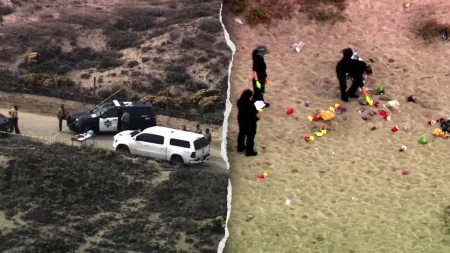
When the jet slammed into a mobile home park in Palm Beach County, it knocked down power lines and gouged an enormous crater into the ground, destruction that made the violence of the impact impossible to ignore. The people on board were not strangers to each other; they were a connected network of family and friends, all of them caught up in what should have been a routine flight. Among the dead were 44-year-old multimillionaire tech executive Adam Robinson, his wife Helen Sharp, and their two young children, four-year-old Emma and two-year-old Charlie, all confirmed by Robinson’s brother on Monday. Also lost were family friends Rachael Reed and Charmi Fehr, along with the family’s nanny, Anita Maria Apellido Cetina. There is no way to look at that list without feeling the weight of what was stolen. A husband and wife, their babies, a nanny who likely helped care for those children, and friends who were probably looking forward to time together in the Bahamas. It is a cruel reminder that every passenger on every plane is someone’s whole world. The people waiting on the ground for that flight will never see their loved ones walk off the jet. The families of the pilots, too, have been left to reconcile the fact that their loved ones died doing the jobs they loved, jobs that had probably felt routine a thousand times before. For the community in Palm Beach County, the crash is also a scar that will not heal easily. The debris scattered across the ground is more than wreckage—it is the remains of nine lives.
Federal investigators have not yet determined what caused the jet to plummet so suddenly, and the uncertainty only deepens the pain. The National Transportation Safety Board has said the plane began breaking up in the air before impact, which adds a layer of complexity to an already agonizing tragedy. There are still unanswered questions about whether the aircraft had a cockpit voice recorder, and even if it did, whether the device survived the crash. For the families of the victims, that lack of clarity is another kind of mourning. They want to know what happened. They want to understand how nine lives were lost on a flight that should have been routine. They want someone to look at the weather conditions, the temperatures, the reports of icing and turbulence, and explain how a plane could fall so fast. Maybe the answers will come in time, and maybe they will bring some measure of comfort, but for now, there is only grief and the hollow ache of loss. The crash is a stark reminder that even in an age of advanced aviation technology, of weather radar and sophisticated instruments, human beings remain fragile passengers on a journey they cannot fully control. No amount of experience, no number of logged hours, no depth of faith can change what happened in that final descent. All that is left is to hold on to the memory of the people who died, to honor them, and to hope that something can be learned from their deaths to protect others in the future.
Joe Mixon closed his tribute with words that have echoed across social media and into the hearts of those who read them: “Love on your loved ones while you can, because you never know what tomorrow may bring.” It is the kind of thing people say often but rarely truly sit with. The passengers and pilots aboard that Learjet did not wake up that morning expecting to die. They made plans, sent texts, boarded the plane, and believed they would land safely on the other side. Nathalia texted her boyfriend about turbulence, probably not thinking it was the last thing she would ever say. Adam Robinson and Helen Sharp brought their toddlers onto that flight with the normalcy of any family trip. Jeff Gregory recited a prayer in his last seconds on earth, clinging to the only thing that mattered as the ground rushed closer. They were not statistics. They were people. And Mixon’s message, born of his own shock and sorrow, is a call to all of us to stop taking tomorrow for granted. Life is beautiful precisely because it is fragile. It can change in an instant, in the space of a single engine failure, a patch of unexpected ice, or a sudden nosedive through the sky. There is no way to make sense of a tragedy like this, no way to wrap logic around so much loss. But perhaps the best tribute to the nine people who died is to remember them, to hold our families a little tighter, and to be a little kinder, a little more present, in the ordinary moments we too often overlook. The sky gave them back to the earth, but they will live on in the memories of everyone who loved them—and in the quiet reflection of a football player who once shared a plane with them, and will never forget.