





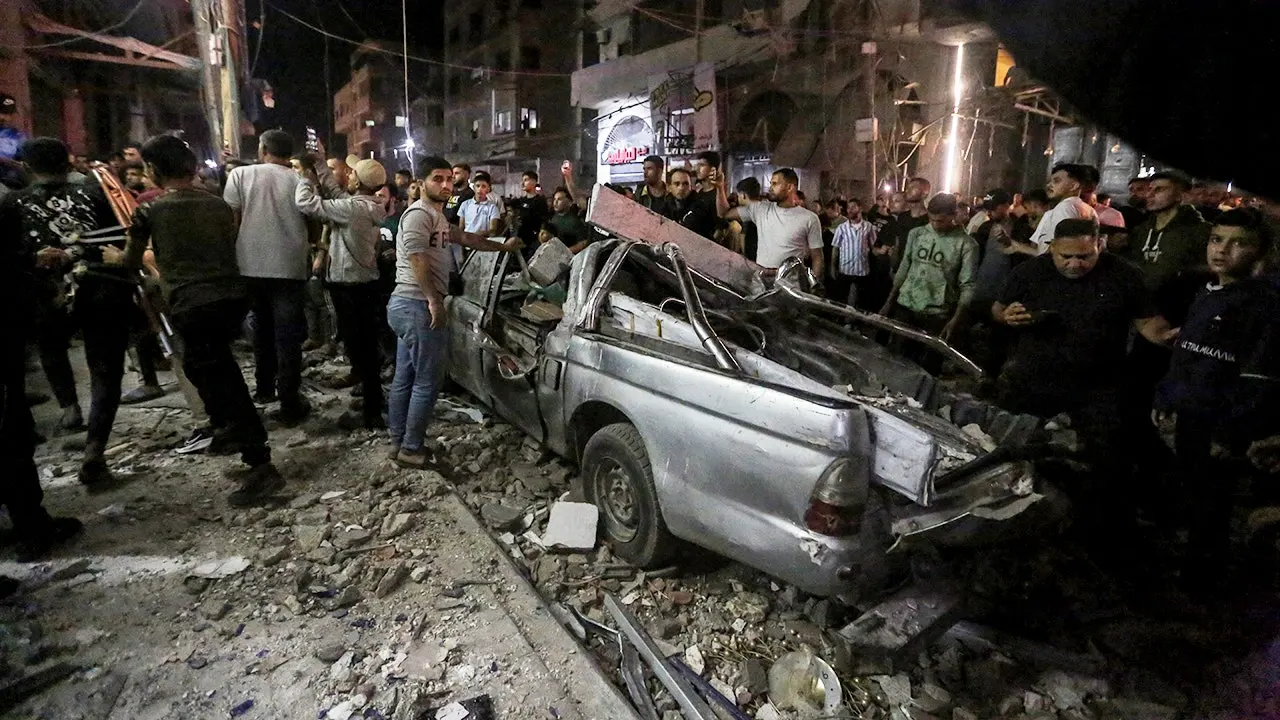
The relentless, high-stakes military campaign in the Gaza Strip has reached another critical, highly charged juncture with the official announcement by the Israel Defense Forces that Mohammed Odeh, the newly appointed commander of Hamas’s military wing, has been killed in a targeted airstrike in northern Gaza. Odeh had only recently stepped into this high-profile leadership vacuum—a position fraught with extreme, immediate danger as Israel systematically hunts down every single orchestrator of the devastating October 7 attacks. According to Israeli military intelligence, Odeh was not merely a passive figurehead but a key operational mastermind who was “responsible for planning and coordinating Hamas terrorists’ infiltration and attack targets during the October 7 Massacre” itself. Following his elimination, the IDF released a poignant visual to the media—a graphic depicting Hamas’s top leadership structure with Odeh’s face aggressively crossed out alongside other fallen commanders, sending a clear, chilling message about the rapidly shrinking circle of Hamas’s military command. In a joint declaration that reflected the absolute, unyielding resolve of the Israeli state, Prime Minister Benjamin Netanyahu and Defense Minister Israel Katz emphasized that the pursuit of justice would remain ruthless, stating, “We will continue to pursue anyone who took part in the October 7 massacre. Sooner or later, Israel will reach them all.” This significant military development underscores the uncompromising, harrowing reality of the current conflict: a cycle of rapid elimination and swift succession that defines the current phase of the war. For the Israeli public, still deeply traumatized by the horrors of October 7, Odeh’s death represents a necessary, therapeutic step toward national security, yet it also serves as a sobering reminder of the deeply entrenched, fanatical nature of the enemy they face. By targeting the very apex of Hamas’s command structure, the IDF aims to permanently shatter the group’s ability to coordinate large-scale incursions, even as the human cost of this prolonged, asymmetric warfare continues to rise on both sides.
The death of Mohammed Odeh cannot be fully understood without examining the demise of his direct predecessor, Izz al-Din al-Haddad, who was killed by an equally precise Israeli Air Force strike in Gaza City earlier this month. Haddad was one of Hamas’s most enduring and experienced veteran commanders, having climbed the group’s hierarchy over several decades to become a pivotal player in its governance and military operations. Following the high-profile deaths of top Hamas leaders Yahya Sinwar and his brother Mohammed Sinwar, it was Haddad who stepped forward to assume operational control, immediately working to rebuild the group’s shattered military infrastructure and command networks. The IDF characterized Haddad’s rebuilding efforts as a “blatant violation of the ceasefire agreement,” illustrating the profound, frustrating difficulty of establishing lasting diplomatic peace when rogue military elements actively work to reconstitute their forces during fragile humanitarian pauses. Beyond his strategic role in planning the logistical horrors of the October 7 invasion, Haddad was directly implicated in the maintenance and distribution of the numerous Israeli hostages taken into Gaza. IDF Chief of the General Staff Lt. Gen. Eyal Zamir highlighted this grim human connection, noting that in nearly every debriefing session with returned hostages, Haddad’s name was repeatedly mentioned, painting him as a looming, terrifying shadow during their dark days of captivity in the tunnels. The elimination of such a deeply embedded and feared commander was a major intelligence achievement for Israel, but it also forced Hamas to hastily promote Odeh to fill the vacant role, setting off a rapid chain reaction that ultimately led to Odeh’s own death just weeks later. This rapid succession highlights the highly fluid, volatile dynamics of Hamas’s command structure, which continues to splinter under the weight of sustained military pressure.
This rapid destruction of Hamas’s leadership tier—moving from Yahya Sinwar to Mohammed Sinwar, then to Izz al-Din al-Haddad, and finally to Mohammed Odeh in a matter of months—represents an uncompromising and highly coordinated decapitation strategy aimed at completely dismantling the organizational and operational capacity of the militant group. Historically, asymmetrical warfare has shown that while killing individual leaders can temporarily disrupt operations, it often triggers a cycle of rapid succession where younger, potentially more radicalized figures step eagerly into the vacant roles. However, the sheer intensity, speed, and velocity of Israel’s current campaign have given Hamas virtually no room to breathe, adapt, or stabilize its internal command structure. The IDF’s methodology relies on an incredibly sophisticated, real-time intelligence apparatus, blending technological surveillance with ground-level espionage, allowing them to track these leaders as they move through a vast network of subterranean tunnels and congested urban environments. Each successful strike is designed to sever a vital link in Hamas’s nervous system, fostering an atmosphere of deep paranoia, distrust, and operational isolation among the surviving cadres. Yet, this high-pressure campaign also raises critical questions about the long-term efficacy of targeting individuals; as soon as one commander falls, another is thrust into the line of fire, driven by an ideology that has spent decades preparing its foot soldiers for what they view as a holy struggle. For the Israeli government and military establishment, the systematically planned removal of these military figures is a non-negotiable prerequisite for any future security paradigm, a sentiment forcefully echoed by Lt. Gen. Eyal Zamir when he declared that the military “will not relent until we reach them all.” This promise of relentless, uncompromising pursuit serves to reassure a traumatized Israeli citizenry that their sovereign state will protect them, while simultaneously signaling to adversaries worldwide that the cost of attacking Israel is absolute.
Amidst the clinical military pronouncements of assets destroyed and leaders eliminated lies the profound, unfolding human tragedy that has defined this conflict since October 7, 2023. The names of Mohammed Odeh and Izz al-Din al-Haddad are not just entries on an IDF target list; to the victims, they are the faces of a calculated campaign of terror that shattered the lives of thousands of innocent civilians. The October 7 attacks remains an open, bleeding wound in the Israeli collective consciousness, marked by the systematic slaughter of families in their homes, the massacre of youth at a peace rally, and the brutal kidnapping of hundreds of individuals. For the families of those still held in captivity, the military’s relentless campaign against Hamas commanders is a source of both hope and profound anxiety, as they navigate the terrifying reality that their loved ones are being held in the very areas subjected to intense bombardment. The harrowing testimonies of returned hostages, who spoke of Haddad’s terrifying, bureaucratic oversight of their captivity, humanize the cold statistics of the war, transforming strategic military communiqués into living narratives of psychological torment and survival. This human dimension underscores that the war is not merely a geopolitical clash of militaries, but a desperate rescue mission and an agonizing struggle for the preservation of human dignity. For many Israelis, the elimination of figures like Odeh brings a grim, necessary sense of closure and accountability, proving that the state will keep its promise to defend its citizens. However, this satisfaction of justice is heavily tempered by the agonizing knowledge that dozens of hostages remain unaccounted for, their survival hanging in the balance as the military pressure intensifies and the leadership of their captors continues to undergo violent transitions. Each day that passes without their return is a painful reminder that military victories, while necessary, cannot fully heal the fractured hearts of the families waiting at home.
On the other side of the heavily fortified border, the civilian population of the Gaza Strip continues to bear an unimaginable and devastating burden as a direct consequence of this relentless cycle of violence. The targeted airstrikes that neutralized Mohammed Odeh in northern Gaza and Izz al-Din al-Haddad in Gaza City occurred within a broader landscape of total physical ruin and an unprecedented humanitarian crisis. For the millions of Gazans who have been forced to flee their homes multiple times over, the war has stripped away the basic necessities of human existence, transforming once-flourishing neighborhoods into vast fields of gray rubble and dust. While the IDF maintains that its operations are meticulously planned to minimize civilian harm while prioritizing the eradication of Hamas fighters who hide within civilian infrastructure, the daily reality for ordinary Palestinians is defined by pervasive fear, acute hunger, and overwhelming grief. Hamas’s long-standing strategy of embedding its military apparatus within densely populated urban areas has effectively turned schools, hospitals, and residential blocks into active combat zones, leaving innocent civilians tragically caught in the crossfire. The death of high-profile external or internal commanders like Odeh often sparks intensive localized clashes and retaliatory measures, driving the displacement cycle anew and making the simple quest for potable water, basic medicine, and safety an almost impossible task. This catastrophic environment raises urgent questions about what will remain of Gaza once the weapons are finally laid down, as the systematic destruction of social infrastructure threatens to breed a new generation of deeply traumatized, dispossessed youths. Truly humanizing the conflict demands recognizing that the pursuit and elimination of Hamas’s command structure, while essential to Israel’s national survival, is taking place amidst a catastrophic civilian emergency that complicates any future prospect of peaceful co-existence. The innocent lives lost in this crossfire are a stark reminder of the immense human toll of a war that has engulfed entire communities in despair.
Looking ahead, the successful targeting of high-ranking commanders like Mohammed Odeh raises a fundamental, existential question about the long-term resolution of this historic conflict: can an exclusively military strategy pave the way for lasting peace, or does it merely reset the clock for the next inevitable conflagration? The Israeli military and political leadership’s explicit philosophy of “seeking and reaching them all” serves as a powerful deterrent, signaling to any potential aggressor that the nation will spare no resource to defend its borders and citizens. However, the deeply entrenched ideological nature of Hamas suggests that while tactical victories are absolutely critical for severely disrupting immediate, large-scale threats, they do not automatically dissolve the underlying political grievances and radicalization that fuel the conflict. The rapid disintegration of Hamas’s established command structure could theoretically create a strategic window for a fundamental transformation in how the Gaza Strip is governed, potentially allowing for the introduction of moderate Palestinian administrative bodies or international peacekeeping coalitions to oversee a massive reconstruction effort. Yet, without a clear, comprehensive diplomatic vision that offers hope, dignity, and security to both Israelis and Palestinians, the persistent danger remains that newer, even more extremist factions will rise from the physical and economic ruins of this war. Ultimately, the path toward a sustainable future demands a delicate, incredibly complex balance between fierce, uncompromising national self-defense and the long-term diplomatic imagination required to construct a lasting regional security architecture. Until such a balance is found, the Holy Land remains locked in an agonizing cycle where military actions dominate the headlines, and the collective memory of the innocent lives lost on both sides serves as a painful, urgent testament to the need for a peace defined not by the silencing of weapons, but by the shared recognition of our common humanity. True security will only be achieved when both nations can envision a future free from the shadow of terror and devastation.