




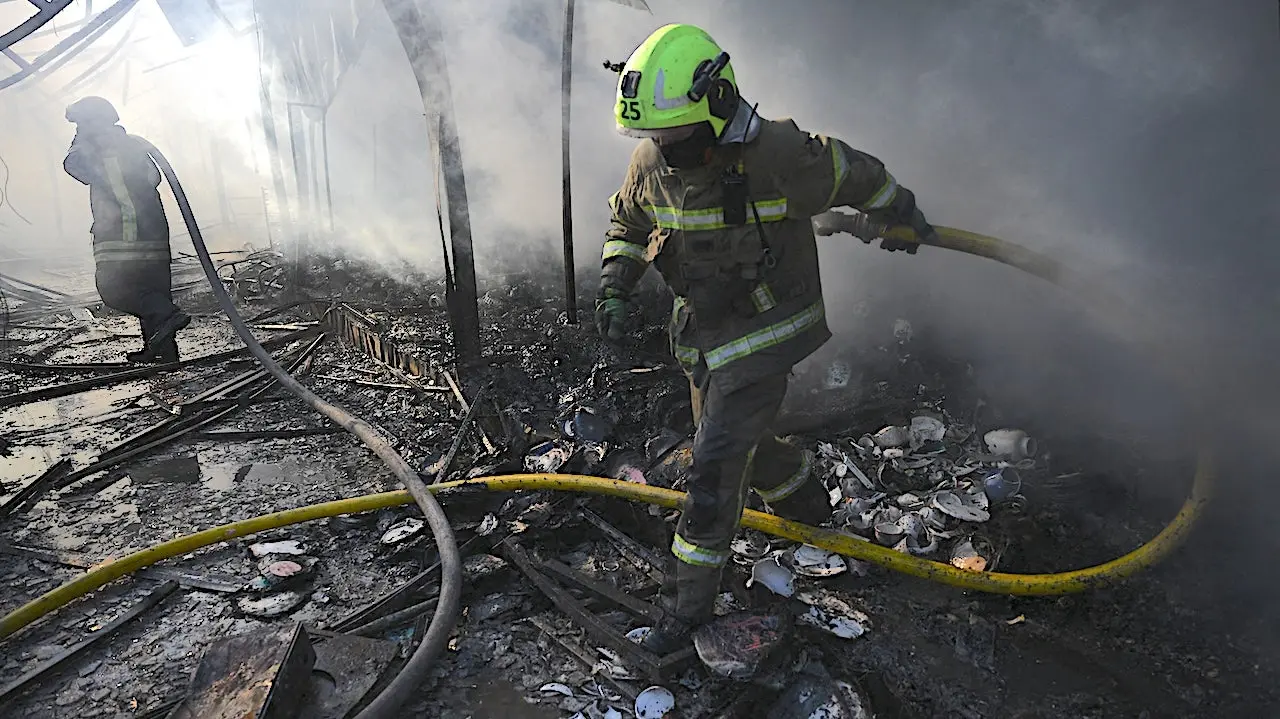
The agonizing human cost of a war without borders was laid bare in the dark, early hours of Thursday morning as Russia unleashed a devastating torrent of violence across Ukraine. A massive barrage of more than 70 missiles and roughly 280 drones illuminated the night sky with explosions, claiming at least eight innocent lives and leaving dozens injured from the historic streets of Kyiv to the western hub of Lviv. In the city of Kryvyi Rih, the strikes struck at the very heart of civilian life when a Russian Iskander-M ballistic missile obliterated a private home. The attack killed six people, young and old, including two sisters aged just five and twelve. For those who survived, the night was defined by terror and desperate rescue efforts. In Lviv, just forty miles from the safety of the Polish border, emergency teams worked frantically under floodlights, pulling a young boy and other trapped survivors from the jagged concrete ruins of destroyed apartment complexes. In Kyiv, thousands of exhausted families retreated once again to the cold concrete of underground subway stations, sheltering for more than five hours while the foundations of their city shook above them.
This latest night of horror exposed a critical, agonizing vulnerability in Ukraine’s defense network: the sheer shortage of interceptor missiles capable of stopping Russia’s fastest munitions. While Ukraine’s air defenders managed to down a remarkable 55 missiles and 265 drones, they were almost entirely helpless against the faster ballistic missiles, intercepting only one of the nine launched. Traveling at several times the speed of sound, these weapons can only be reliably stopped by the American-made Patriot system, a resource that President Volodymyr Zelenskyy warns is arriving far too slowly and in desperately small quantities. Returning from a high-stakes diplomatic mission to the United States, a weary but resolute Zelenskyy pleaded with Western allies to understand that the survival of Ukrainian civilians is not a logistical equation, but a moral choice. “The protection of people’s lives depends directly on their willingness” to supply these vital air-defense shields, Zelenskyy stressed, point-blank connecting Western hesitation to the mounting casualties on the ground.
The terrifying reach of the conflict was felt deeply by Ukraine’s neighbors, bringing the shadow of war directly to NATO’s doorstep. Early Thursday morning, Polish military radars detected an unidentified object crossing into Poland’s airspace, prompting Warsaw to scramble F-16 fighter jets and place its entire air defense network on high alert. Though the object quickly vanished from radar, investigators later discovered a massive, 33-foot-wide crater surrounded by scattered debris in a quiet farm field near Tarnawa-Kolonia, less than two miles from nearby homes. Polish Prime Minister Donald Tusk announced that all initial evidence points to the object being a Russian Kh-101 cruise missile that had veered off course, though it was not believed to have intentionally targeted Polish soil. With American investigators joining the probe, Tusk delivered a sobering warning to the international community, declaring that the ultimate trajectory and fate of the war could very well be decided within the next 100 days, signaling that the window for decisive action is rapidly closing.
In response to the escalating crisis, international allies are moving to fortify Ukraine’s defenses, though the timeline of this aid remains a race against Russian advancement. Hours after the devastating strikes, the European Union announced the urgent disbursement of $4 billion. This funding, part of a massive, pre-approved $100 billion loan package, is earmarked specifically to help Kyiv procure advanced drones, missiles, fighter jets, and air defense systems. Yet, Ukrainian leadership knows that temporary shipments of aid are not a permanent shield. During his recent trip to the United States, Zelenskyy sat down with President Donald Trump and top executives from Lockheed Martin to discuss a more sustainable, long-term solution: securing U.S. manufacturing licenses to allow Ukraine to produce Patriot interceptors on its own soil. While European nations have offered to fund the purchase of more American-made interceptors, Ukrainian leaders recognize that building domestic production capabilities is the only way to escape the precarious cycle of foreign supply delays.
This desperate search for security was also the driving force behind Zelenskyy’s emotional visit to Washington, D.C., which coincided with the funeral of one of Ukraine’s most steadfast American allies, the late Senator Lindsey Graham. In a poignant tribute to the defense hawk who died unexpectedly earlier this month, the U.S. Senate advanced the “Lindsey O. Graham Sanctioning Russia and Iran Act of 2026” with an overwhelming, bipartisan majority. Zelenskyy watched from the Senate gallery, still mourning his friend, as lawmakers cleared major procedural hurdles to honor Graham’s legacy. The sweeping legislation represents a devastating economic strike against Moscow, imposing harsh sanctions on Russian oligarchs, financial institutions, and energy projects. Crucially, the bill authorizes punitive tariffs of up to 100 percent on nations that facilitate Russia’s evasion of sanctions or purchase its oil and gas, while simultaneously choking off Iran’s energy and weapons sectors—a vital pipeline for the drones currently terrorizing Ukrainian cities.
Ultimately, these parallel dramas—the physical destruction of Ukrainian homes, the narrow escape of a Polish village from a stray cruise missile, and the solemn debates in the halls of the U.S. Capitol—reveal a conflict that is rapidly reaching its boiling point. The war is no longer a localized border dispute; it is a live threat to European stability and a ultimate test of Western resolve. As rescue workers in Lviv continue to sift through the dust of shattered lives and polish fighter pilots stand ready at their hangars, the world is forced to confront the ticking clock described by Donald Tusk. The choices made by global leaders in the coming weeks will determine whether the defense of democracy is a collection of hollow promises, or a shield strong enough to protect a family sleeping in Kryvyi Rih.