


The quiet routine of a late Tuesday night at Germany’s busy Leipzig/Halle Airport was abruptly and terrifyingly shattered when an alert ground worker made a chilling discovery that would quickly reverberate through the highest corridors of European security. Nestled on the cold tarmac near the south runway, shockingly close to a parked Ukrainian transport aircraft, was a small, unmanned drone. This was no hobbyist’s misplaced toy; it was rigged with an active, highly dangerous, and unknown explosive device designed to cause catastrophic destruction. As the gravity of the situation became clear to the ground crew, airport operations ground to a sudden and frantic halt, triggering an immediate emergency shutdown of both major runways at one of Europe’s most vital cargo hubs. For pilots navigating the dark skies above, the sudden closure transformed routine, peaceful descents into a tense scramble for safety, forcing multiple flights to abruptly divert to alternative airfields far from their intended destinations. Among those disrupted was a passenger aircraft, its travelers suddenly feeling the sharp tilt of a mid-air diversion and hearing the anxious announcements of the crew, while down on the ground, a massive wave of federal police sirens began to wail across the tarmac. This was not just a technical glitch or a minor security breach; it was a physical, terrifying manifestation of a modern shadow war creeping directly into the heart of Western Europe. The atmosphere at Leipzig/Halle shifted instantly from the mundane hum of late-night commercial logistics to a high-stakes, nerve-wracking crisis zone, as heavily armed tactical units and emergency response teams flooded the airport, desperately trying to contain what officials would soon warn was a threat of a completely different, unprecedented magnitude.
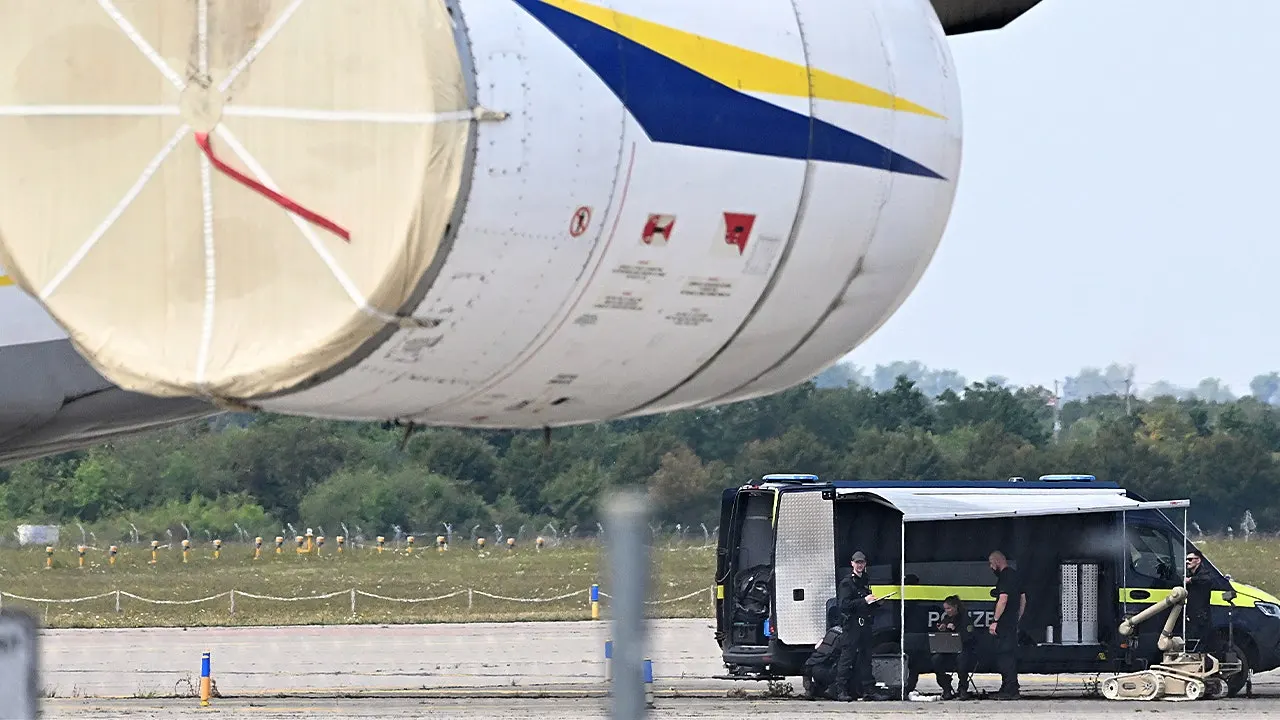
As the ground teams scrambled to secure the area around the explosive-laden drone, the crisis escalated further into the night with a second, deeply unsettling occurrence in the airspace nearby. Shortly before midnight, air traffic controllers and pilots spotted another unidentified flying object hovering menacingly near the airport perimeter, adding a layer of sheer unpredictability to an already volatile situation. A cargo aircraft, attempting to navigate the chaos, was forced to abort its landing sequence due to the sudden runway closures, only to collide mid-air with this second mysterious object. The pilots, displaying immense skill and composure under extreme duress, managed to stabilize their damaged vessel and steer it away from the danger zone, embarking on an anxious, tense 125-mile journey to Hannover Airport. Upon landing, relieved but shaken ground crews inspected the fuselage, finding minor structural damage that served as a physical testament to the close call they had just survived. Meanwhile, back on the Leipzig tarmac, a silent, high-stakes battle of nerves was unfolding as a specialized explosives disposal robot was gingerly deployed toward the first drone. Under the watchful, sweating eyes of security experts operating from a safe distance, the robotic arm delicately probed the sophisticated machine, eventually neutralizing the immediate catastrophe by carefully removing its detonator. This mechanical standoff highlighted the terrifyingly sterile nature of modern sabotage, where physical danger is delivered not by visible, traditional infiltrators, but by silent, remote-controlled machines operating in the blind spots of night, turning a peaceful German infrastructure hub into a high-risk bomb disposal site in the blink of an eye. The sheer technical precision required to disarm the device without detonating the unknown payload was a stark reminder of the deadly professionalism behind the plot, leaving investigators to grapple with the disturbing reality of how easily such a devastating weapon had bypassed initial outer security perimeters.
The targeted aircraft itself carried a deep, undeniable symbolic weight, transforming the incident from a random act of terror into a pointed, politically charged statement. The plane, proudly bearing the vibrant blue and yellow colors of the Ukrainian flag, was emblazoned with the English-language slogan, “Be Brave Like Kherson”—a poignant, defiant tribute to the southern Ukrainian region that endured brutal foreign occupation before its triumphant, hard-fought liberation. For the Ukrainian crew members, airport workers, and the global diaspora watching from afar, this aircraft was not merely a mechanical transport vehicle, but a flying testament to national resilience, courage, and the ongoing, painful struggle for survival against ruthless aggression. Leipzig/Halle Airport has long served as a crucial sanctuary and key operational base for massive Ukrainian Antonov transport aircraft, making the facility a highly visible and emotionally significant hub for Ukraine’s remaining civilian, humanitarian, and logistics fleets. To target such a vessel with a lethal explosive device in the heart of a peaceful European nation was a calculated, cold-blooded move designed to strike at the very heart of Ukrainian morale, signaling that no safe haven is truly beyond the reach of those who wish to destroy them. The visual of a robotic bomb disposal unit working desperately under the shadow of the Ukrainian colors and the words “Be Brave” served as a stark, heart-wrenching reminder of how the violence of the war in the East is actively bleeding across sovereign borders, transforming quiet European logistical sanctuaries into tense proxy battlegrounds where the symbols of Ukrainian survival are actively hunted. For the everyday workers who fuel and maintain these aircraft, the realization that they were standing feet away from a potential catastrophe brought a deeply personal sense of vulnerability, shifting the war from a distant headline on their television screens to a tangible, life-threatening reality right in their own workplace.
In the immediate wake of the close call, German officials were quick to recognize the profound and alarming shift in the European security landscape, with German Interior Minister Alexander Dobrindt delivering a sobering, urgent assessment of the situation. Dobrindt did not mince words, openly declaring to a concerned public that the discovery of the explosive-laden drone represented a significant, highly dangerous escalation of hostility, characterizing the event as a textbook “hybrid attack scenario” designed to terrorize and disrupt. While acknowledging that simple drone sightings and low-level electronic threats have become increasingly common in recent years, he emphasized that finding an actively weaponized drone carrying lethal explosives at a major international airport crossed a terrifying and unprecedented threshold. This incident was the realization of a worst-case scenario that security agencies had spent months quietly preparing for behind closed doors. Dobrindt pointed to the establishment of Germany’s Joint Centre for Countering Hybrid Threats earlier in the year as proof that the government had long anticipated such clandestine aggression, though seeing it play out in real-time on a commercial runway was a stark, chilling validation of their deepest fears. The massive investigation, which now pulls together extensive resources from both federal and state intelligence and security agencies, is meticulously analyzing the physical construction of the drone, the specific chemical signature of the explosives, and its complex flight telemetry to trace its origin. The German government’s grave reaction underscores a growing, uncomfortable domestic anxiety: the realization that the nation’s critical infrastructure is remarkably vulnerable to asymmetric warfare tactics that bypass traditional defenses, forcing ordinary citizens and officials alike to confront a reality where the line between peace and conflict is permanently blurred. This new doctrine of warfare relies heavily on deniability, leaving nations like Germany to defend against an invisible enemy that strikes without declaring war, using the very tools of modern technology to turn domestic transport hubs into potential disaster zones.
While official German investigations remain meticulously cautious, refusing to jump to premature conclusions, the diplomatic and political fallout was instantaneous, with fingers pointing directly toward the Kremlin as the most likely mastermind behind the failed sabotage. Ukraine’s outspoken ambassador to Germany, Oleksii Makeiev, captured the prevailing sentiment of many anxious Western observers when he bluntly asked on German national television, “Who else could it be but Russia?” This sharp accusation is not born out of mere speculation, but rather a deeply disturbing pattern of increasingly aggressive, reckless Russian covert operations designed to destabilize European nations supporting Ukraine’s defense. Security analysts have long warned that Moscow is actively utilizing a vast “shadow fleet” of vessels, cyber warfare, and plausible-deniability tactics to systematically probe NATO’s drone defenses and map out critical infrastructure vulnerabilities. Leipzig/Halle Airport itself is no stranger to these shadowy, dangerous tactics; in 2024, a highly sophisticated incendiary device ignited inside a logistics center at the very same airport, engulfing a freight container in flames in an incident that Western intelligence agencies strongly suspected was a dry run or an active sabotage operation orchestrated by Russian intelligence operatives. By targeting a hub that specifically houses vital Ukrainian Antonov cargo planes, the perpetrators are sending a clear, menacing message to Germany and its allies: your continued military and logistical support for Ukraine comes with a direct, physical cost, and your domestic soil is no longer a safe zone. This escalating pattern of covert arson, cyberattacks, and now explosive drone deployments reveals a highly coordinated effort to test the limits of NATO’s resolve, exploiting the gray zones of international law to inflict damage without triggering a direct, full-scale military retaliation. The psychological impact of these actions is profound, creating a pervasive sense of unease among the European public, who must now come to terms with the reality that their daily lives and commerce are being targeted by a foreign power seeking to undermine their security from within.
Ultimately, the terrifying events at Leipzig/Halle Airport serve as a profound, urgent wake-up call for the international community, illustrating with stark clarity that the battlefields of the twenty-first century are no longer confined by geographic borders or traditional military doctrines. The image of a bomb disposal robot delicately disarming an explosive device on a commercial runway, beneath the wings of a plane painted in the colors of a war-torn nation, is a powerful and unsettling metaphor for the fragile state of modern peace, where global conflicts can instantly spill over into the quiet, mundane routines of civilian life. It forces a radical, long-overdue reassessment of how democratic nations protect their critical transport, energy, and communication infrastructure, demanding a swift shift from passive security measures to active, high-tech defense systems capable of detecting and neutralizing sophisticated aerial threats long before they reach their targets. As Germany and its NATO allies grapple with the chilling realities of this relentless hybrid warfare, the resilience and bravery of everyday citizens, ground crews, and security personnel remain a crucial, human bulwark against the terror and disruption these attacks are specifically designed to sow. The inspiring slogan painted on the targeted Ukrainian plane, “Be Brave Like Kherson,” ceases to be just a tribute to a distant, liberated city’s struggle; it becomes a universal mandate for a contemporary Europe facing an era of unprecedented, invisible, and highly unpredictable threats. In the face of covert sabotage, silent weaponized drones, and calculated political intimidation, the only viable path forward for the free world is one of collective vigilance, absolute resolve, and an unwavering refusal to be cowed by those who seek to use the cover of darkness to shatter the peace and stability of sovereign nations. By standing firm against these shadow operations, Western societies can prove that their commitment to democracy, human rights, and mutual support cannot be dismantled by remote-controlled terror, ensuring that the skies remain open and safe for all.