





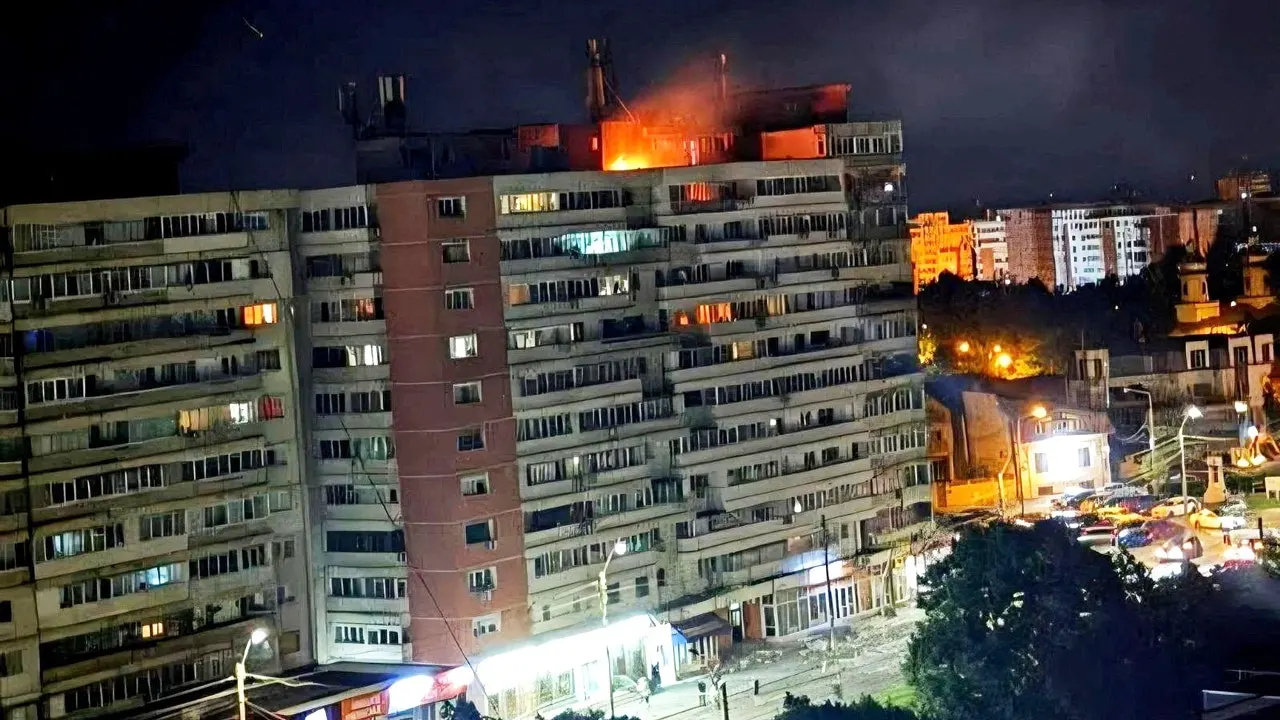
For the unsuspecting residents of Galați, a peaceful municipality nestled in eastern Romania along the Danube River, the arrival of Friday morning was supposed to herald the quiet, anticipated transition into a relaxed weekend. Instead, the peaceful pre-dawn silence was shattered by a deafening, mechanical roar that quickly materialized into a nightmare of modern warfare, violently crossing over an international border and tearing through innocent lives. Without warning, a remote-controlled Russian military drone, loaded to capacity with highly volatile explosives, plunged rapidly from the dark Romanian sky and slammed directly into the roof of a populated, ten-story residential apartment building. The impact was instantaneous and devastating; the drone’s entire payload detonated on contact, unleashing a violent, earth-shaking shockwave and igniting a fierce fire that quickly consumed the upper levels of the structure. Families who had gone to sleep believing they were entirely safe under the protective canopy of the North Atlantic Treaty Organization (NATO) were abruptly thrown from their beds as window glass shattered inward, walls fractured, and thick, toxic black smoke began to fill the corridors. Among those caught in the immediate epicenter of this terrifying tragedy was a young mother and her vulnerable child, who were suddenly forced to flee for their lives through the dark, burning hallways. While they survived the physical blast, they were quickly rushed to a local hospital to be treated for minor physical wounds, leaving them to bear the profound, invisible psychological scars of surviving a bomb blast. For other residents, the suddenness of the explosion manifested in overwhelming panic attacks, requiring frantic, on-the-spot treatment from emergency medical technicians who worked tirelessly to bring calm back to the terrified community. No longer was the war in Ukraine a distant tragedy viewed passively on television or phone screens; for the people of Galați, the violence had breached their very sanctuary, proving that the modern theater of war knows no borders.
This catastrophic strike marks a highly dangerous and unprecedented escalation in the region’s security landscape, representing the first time a rogue military drone has directly targeted and struck a populated civic area within Romanian territory. Since the Russian Federation launched its brutal, unprovoked invasion of neighboring Ukraine in February of 2022, Romania—as both a proud member of the European Union and a key pillar of NATO’s eastern flank—has found itself reluctantly cast as an anxious bystander to a relentless war of attrition. Over the past two years, Romania’s Ministry of Defense has meticulously recorded more than two dozen separate security incidents involving Russian drones illegally crossing into sovereign Romanian airspace. In previous instances, these erratic machines, which are often sent to bombard Ukrainian grain ports and critical shipping infrastructure just across the Danube, crashed harmlessly into the marshy, uninhabited wetlands of the Danube Delta or fell silently onto vacant agricultural fields. These early incursions were treated as highly concerning but ultimately manageable near-misses, warning signs of a conflict that was burning dangerously close to home but had not yet crossed the threshold of direct civilian harm. Friday’s tragedy, however, shattered any lingering illusions of safety that the citizens of Galați and other border towns clung to, making it devastatingly clear that Russia’s high-stakes aerial campaigns carry a massive, uncontrollable margin of error. As long as Moscow continues its intense overnight bombardments of Ukrainian shipping corridors, the stray, malfunctioning weapons of this aggressive campaign will inevitably threaten the lives of innocent European citizens who happen to live within the scattering path of these deadly payloads. The proximity of these attacks has transformed the quiet, daily rhythms of the Romanian border communities, turning once-peaceful riversides into zones of constant, anxious vigilance where mothers and fathers look nervously toward the night sky. The realization that national borders offer no physical shield against falling shrapnel and malfunctioning guidance systems has cast a dark shadow of fear over a population that is now forced to live with the heavy knowledge that their homes are effectively located inside a collateral-damage zone of a neighboring country’s war.
In the frantic minutes following the catastrophic detonation on the apartment rooftop, the local emergency infrastructure in Galați swung into high gear with a level of frantic intensity reserved for a national defense emergency. As sirens wailed through the smoky morning air, heavily equipped fire crews, agile search-and-rescue teams, and fleets of ambulances rushed to the scene to confront a complex disaster high above the city streets. Responders encountered a chaotic scene of thick, billowing smoke pouring from the tenth floor of the building, requiring them to immediately execute a high-risk evacuation of seventy terrified residents who were guided down pitch-black, soot-stained stairwells to temporary safety. Simultaneously, high above the unfolding civilian tragedy on the ground, the military defense apparatus of Romania and NATO reacted with swift and decisive force. The Romanian Ministry of Defense immediately scrambled two high-performance F-16 fighter jets and deployed an armed military helicopter to patrol the contested border skies, placing their pilots on high alert. These military aviators, flying high-speed patterns over their own sovereign territory, carried the immense weight of operational authority, having been given the green light to shoot down any hostile, incoming aerial threats that posed an active danger to Romanian lives. For the ordinary citizens watching from the ground, the roaring sound of advanced fighter jets cutting through the clouds alongside the smoke of a bombed residential building served as a visceral, alarming reminder of how close their peaceful homeland is to being dragged into a direct, active military conflict with a hostile world power. These military operations were not merely exercises in defense; they were active, real-time responses to a breach of sovereign airspace that required split-second decisions by pilots who knew that a single misstep could trigger a geopolitical butterfly effect. The intense visual of heavily armed military helicopters hovering over residential roofs while firefighters battled the blaze below encapsulated the bizarre, dual reality of a nation currently caught between peacetime normalcy and the active preservation of its national survival against external aggression.
The diplomatic fallout radiating outward from the burning apartment complex in Galați was swift and severe, vibrating through the halls of power from Bucharest to the headquarters of NATO in Brussels. Romanian political and military leaders did not hesitate to loudly condemn the drone strike, characterizing the flight path of the Russian weapon as a flagrant and incredibly grave violation of international law. In the wake of this unprecedented territorial strike, Romanian officials urgently contacted their partners in the North Atlantic Alliance, requesting the immediate deployment of advanced anti-drone capabilities and specialized air defenses to secure their vulnerable eastern provinces. This incident has reignited pressing questions regarding the practical limits of NATO’s cherished Article 5 collective defense guarantee, which states that an armed attack against one member is an attack against all. Military analysts and international diplomats are now forced to navigate an increasingly dangerous theological minefield: at what point does a series of destructive, accidental technical “overflows” of a neighboring conflict transform into a deliberate act of war that warrants a full-scale, collective military response? While Western leaders have repeatedly and loudly declared their unwavering commitment to defend “every single inch” of coalition territory, the traumatized families of Galați are left to grapple with the cold reality that rhetorical guarantees cannot physically stop a malfunctioning drone from falling through their roofs. This delicate tightrope walk leaves the eastern flank of Europe in a state of perilous suspense, where a single, errant trajectory of a Russian explosive could accidentally spark a global conflagration. The tension is palpable as Romanian citizens look to their government and their international allies for concrete assurances that their skies will be protected. The request for additional anti-drone systems highlights a growing consensus that the existing defensive infrastructure along Europe’s eastern border is dangerously inadequate to meet the unpredictable, hybrid threats of modern, automated warfare.
The dangerous situation unfolding on Romania’s border is deeply connected to the broader, increasingly desperate struggle for air defense supremacy taking place within Ukraine, where President Volodymyr Zelenskyy has spent months appealing to the global community for vital military aid. Earlier this week, Zelenskyy raised the alarm regarding the critical shortage of Patriot air defense missile systems, warning Western powers that delayed deliveries have left both Ukrainian cities and neighboring European countries dangerously exposed to Russia’s relentless air campaigns. During an official state visit to Sweden, the Ukrainian president expressed his deep frustration to reporters, urging the United States of America to act with far greater speed and efficiency to honor its security commitments. This critical delay in the global supply of heavy weaponry is heavily exacerbated by competing geopolitical crises, most notably the escalating tensions in the Middle East involving Iran, which have severely strained United States military resources and forced strategic planners to ration their precious stockpiles. Zelenskyy’s persistent warnings have now taken on a prophetic quality; the strike in Galați proves that when Ukraine is left without the means to shoot down Russian drones in its own skies, those very same threats will inevitably cross over into the sovereign airspace of unprepared NATO members. The failure to secure the skies over Ukraine does not merely threaten the survival of Kyiv; it directly exposes the innocent civilian populations of neighboring European democracies to the hazardous fallout of an unchecked military aggression. The realization that the global chain of defense is deeply bottlenecked by political stalling and resource competition has created a sense of profound vulnerability. Civilian safety in places like Galați is now inextricably linked to political debates in Washington and the manufacturing capacity of Western defense contractors, illustrating the deeply interconnected and fragile nature of contemporary global security networks that fail to move at the speed of the crises they are designed to prevent.
Ultimately, the smoking ruins of the tenth-floor apartment in Galați stand as a somber, undeniable testament to the human cost of a war that is slowly but surely spilling over its geographic boundaries. The average citizens of Romania, who once viewed the violent struggle of their Ukrainian neighbors with deep sympathy but relative detachment, must now adapt to a terrifying new reality where their own homes can be transformed into a combat zone in the blink of an eye. This unprecedented event has shattered the psychological safety barrier that once kept the domestic peace of the European Union separate from the industrial-scale destruction being unleashed upon the cities of Ukraine. As the local community in Galați begins the long, difficult process of rebuilding their physical structures and healing their wounded, the broader global community is left to contemplate a highly unstable future where national borders are increasingly meaningless to autonomous weapons. The profound loss of peace of mind along the Danube is a permanent casualty of this strike, a silent wound that will linger in the hearts of families who now glance nervously at the clouds whenever they hear the distant hum of an engine. If diplomatic rhetoric cannot be matched with swift, decisive actions to secure the skies, then the terrifying morning experienced by the families of Galați may simply be an ominous prelude of what is to come for the rest of democratic Europe. The enduring lesson of this tragic morning is that peace is not a passive state guaranteed by treaties, but a fragile fabric that requires active, unyielding defense. Until the global community recognizes that the security of a border town in Romania is directly bound to the fate of the skies over Ukraine, the shadow of war will continue to stretch across the continent, threatening to disrupt more quiet mornings with the violent intrusion of a conflict that refuses to stay contained.