


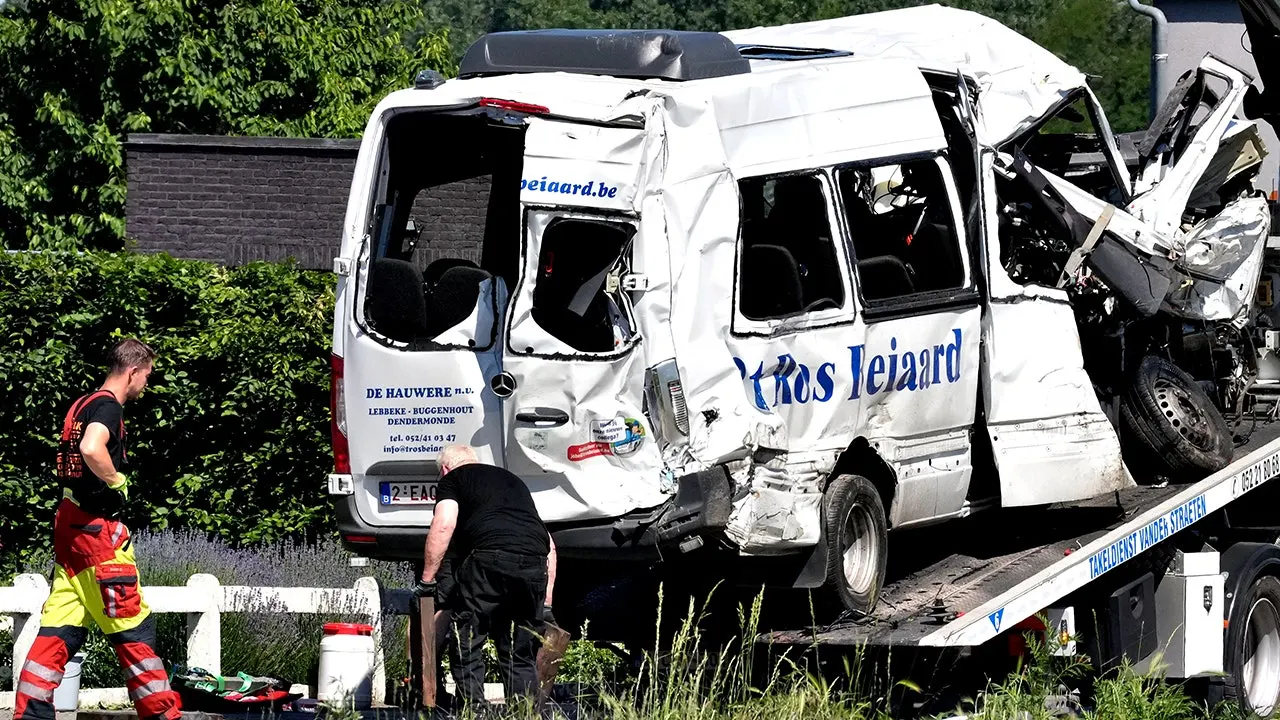
The delicate peace of a crisp Tuesday morning in East Flanders was shattered in an instant when a routine commute transformed into an unimaginable tragedy. In the quiet, scenic commune of Buggenhout, located just twenty miles northwest of Brussels, a local school minibus embarked on its daily route, carrying nine souls through the familiar, mist-laden roads of the Belgian countryside. For the young passengers on board, the ride was meant to be a mundane prelude to a day of learning, laughter, and friendship. Parents had waved goodbye to their children just moments earlier, sending them off with the quiet comfort of routine, entirely unaware that a devastating sequence of events was about to unfold at a nearby railway crossing. As the morning rush hour peaked, the fragile boundaries between everyday life and catastrophic disaster dissolved, leaving a community—and an entire nation—grieving a loss of profound and heartbreaking proportions.
The violent intersection of human vulnerability and industrial momentum occurred with terrifying speed. A passenger train, carrying approximately one hundred commuters and traveling at an unrelenting speed of about 75 miles per hour, was barreling down the tracks when the school minibus appeared in its path. At such high speeds, the physics of a railway transport render immediate braking an impossibility; the train operator was left with no time to react, let only decelerate, before the massive steel locomotive collided with the comparatively fragile vehicle. The impact was described by emergency officials as extraordinarily violent, a deafening clash of metal that instantly crushed the front end of the minibus and flipped it onto its side, leaving a scene of devastating wreckage scattered across the tracks. Amidst the chaos of the immediate aftermath, emergency sirens pierced the morning air as first responders rushed to the site, confronted with a heartbreaking tableau of destruction that stood in stark, silent contrast to the relatively undamaged train engine parked further down the line.
At the very heart of this disaster is a devastating human cost that numbers can never fully capture, leaving families shattered and a community weeping for lives cut tragically short. Among the four individuals who lost their lives in the collision were two innocent children, aged just 12 and 15, whose bright futures and untapped potential were stolen in a single fraction of a second. The crash also claimed the lives of the minibus driver and a dedicated school escort—adults who had begun their day committed to the safe transport of the children in their care. For the families of the deceased, the world stopped spinning the moment they received the news that no parent or loved one should ever have to bear. Meanwhile, the tragedy continues to hang in the balance for five other children who survived the initial impact but suffered critical, life-threatening injuries; they remain hospitalized, fighting desperately for survival as medical teams work tirelessly and their families keep agonizing vigils at their bedsides, suspended between hope and despair.
In the wake of such a catastrophic event, the search for answers has yielded a haunting and perplexing puzzle that investigators are now scrambling to piece together. Preliminary evidence, including footage captured by nearby security cameras, reveals a chilling sequence of events: the minibus apparently drove directly through the closed railway crossing barrier, bypassing the flashing red warning lights designed to prevent such a disaster. The national railway infrastructure manager, Infrabel, quickly confirmed that the crossing’s safety systems, including the gates and signaling lights, were functioning perfectly at the time of the approach. This revelation leaves investigators, local authorities, and the public grappling with the agonizing question of “why”—wondering what combination of morning glare, momentary distraction, cognitive freeze, or sudden mechanical failure could have led the driver to steer the vehicle past the protective gates and into the path of the oncoming train. As the East Flanders public prosecutor’s office conducts its meticulous inquiry, the silence of the closed barrier stands as a grim reminder of how quickly a single decision can lead to irreversible sorrow.
The emotional ripples of the accident have spread far beyond the municipal borders of Buggenhout, enveloping the entire country of Belgium in a cloud of collective grief and shock. Belgian Prime Minister Bart De Wever gave voice to the national sorrow, expressing that he was “deeply moved by the horrific accident” and extending his deepest, most heartfelt condolences to the suffering families who are now facing an unbearable reality. In the train carriage, none of the one hundred passengers suffered physical injuries, yet they emerged from the train visibly shaken, carrying the psychological weight of having witnessed first-hand the sudden loss of human life. At the local schools, empty desks now stand where vibrant, laughing children sat just the day before, leaving classmates and teachers to grapple with the terrifying reality of mortality and the abrupt absence of their peers, as grief counselors step in to help young minds navigate an adult-sized tragedy.
As the physical debris is cleared from the tracks and rail service is eventually restored, the long, painful journey toward healing and reflection begins for a wounded community. This disaster serves as a somber reminder of the inherent risks that exist at the intersections of our daily lives and high-speed infrastructure, prompting renewed discussions about transport safety, crossing guards, and the psychological pressures faced by school transport drivers. Yet, beyond the systemic inquiries and engineering assessments, the true legacy of this tragedy lies in the enduring memory of the four lives lost and the resilience of the five children fighting to recover. The people of Buggenhout and the broader Belgian nation will undoubtedly rally around the affected families, offering a sanctuary of solidarity and love in the face of immense darkness, ensuring that the beautiful lives cut short on a mundane Tuesday morning are never forgotten.