


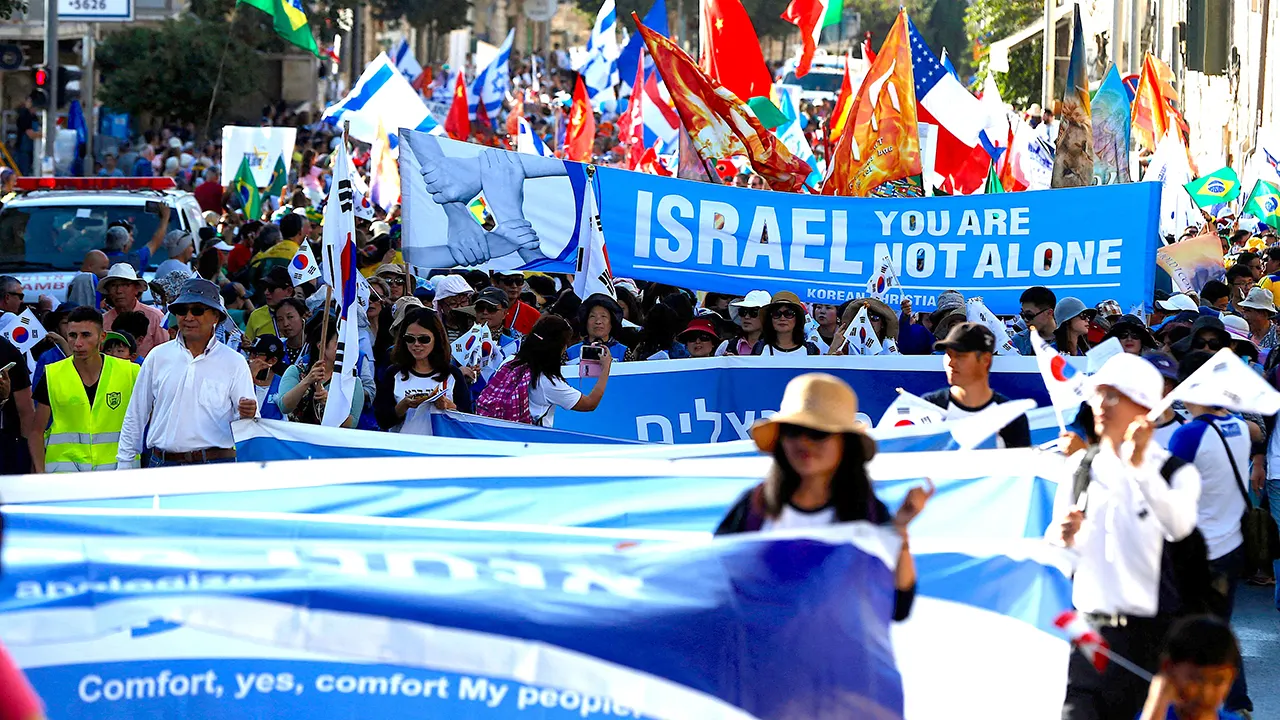
In the historic and spiritually charged heart of Jerusalem, a profound sense of urgency, grief, and shared destiny recently brought together hundreds of prominent faith leaders, thinkers, and theologians for an emergency summit convened by the International Christian Embassy Jerusalem (ICEJ). This intense, three-day gathering in the capital was far from a routine theological symposium; rather, it represented a passionate, unified, and deeply humanized response to the terrifying global explosion of antisemitism that has swept across the world in the wake of the devastating Hamas-led massacre on October 7, 2023. In an era where digital spaces have become active battlegrounds and social media influencers consistently leverage their vast platforms to broadcast age-old antisemitic rhetoric to millions of impressionable young followers, these leaders felt a profound moral and spiritual imperative to stand shoulder-to-shoulder with the Jewish community. Jürgen Bühler, the president of the ICEJ, delivered a stirring message that went directly to the heart of Christian identity, urging global communities to understand that defending the Jewish people is not a secondary political stance, but a foundational requirement of their faith. He passionately warned that attacking the Jewish people is equivalent to attacking the very roots of one’s own spiritual lineage, reminding his audience that the scriptures, the prophets, and Jesus Christ himself were Jewish. Bühler used a vivid, sobering metaphor to capture this self-destructive dynamic, explaining that any sector of the Christian church failing to actively confront antisemitism is, in essence, sawing off the very branch upon which it sits. For modern churches to survive and retain their moral integrity, he argued, they must actively reconstruct an authentic, respectful, and loving connection to their Hebrew heritage, ensuring that the defense of Jewish lives and dignity remains a central priority for pastors and faith leaders globally.
A central theological theme that dominated the summit’s discussions was the critical rejection of replacement theology—a traditional doctrine holding that the Christian church has permanently replaced the Jewish people in God’s eternal plan and covenant. Leaders at the conference argued that this perspective is not only biblically inaccurate but has also served as a dangerous theological breeding ground for historic and systemic anti-Jewish hostility throughout history. President Jürgen Bühler and other prominent speakers pointed directly to the scriptures to dismantle this line of thinking, citing key biblical passages, such as the Apostle Paul’s letters in Chapter 11 of the book of Romans, which explicitly declare that the gifts and calling of God to Israel are completely irrevocable. To deny the ongoing, unique significance of the Jewish people in God’s narrative is to completely disregard the geographic, cultural, and spiritual framework of the Bible itself. The summit emphasized that the text of the Bible is practically inseparable from the land and people of Israel, pointing out that after the direct name of God, “Israel” is the most frequently written name across both the Old and New Testaments. Jesus’s entire earthly journey—his birth in Bethlehem, his ministry in Galilee, his death and resurrection in Jerusalem, and his promised return to the Mount of Olives—occurred within this specific, undeniable Jewish context. By emphasizing these geographic and scriptural realities, the ICEJ aimed to dismantle the theological distortions that have historically alienated Christians from Jews. The organizers argued that a true, literal reading of both testaments reveals a story of mutual connection, covenantal faithfulness, and a shared future that makes any form of prejudice against the Jewish people entirely incompatible with authentic, Bible-based faith. This reframing is essential for modern believers who seek to reconcile their faith with historical realities. By grounding their theological understanding in the actual geography and cultural context of the biblical narrative, modern Christians can move beyond abstract theories and embrace a more grounded, historically accurate faith that honors the Jewish legacy rather than attempting to erase it from history.
The summit’s political and institutional significance was further elevated by the active participation of high-ranking diplomatic and government figures, signaling a deep, mutual appreciation between the State of Israel and the global Christian community during a time of intense regional trial. Among those lending their voices to the event was George Deek, Israel’s newly appointed special envoy to the Christian world, alongside scheduled keynote addresses from Foreign Minister Gideon Sa’ar and the newly appointed United States Ambassador to Israel, Mike Huckabee, both of whom participated in the summit’s high-profile closing events at the Ministry of Foreign Affairs. In a particularly moving and personal pre-recorded video broadcast to the assembly, Israeli President Isaac Herzog expressed his heartfelt gratitude to the gathered leaders for their unwavering courage in mobilizing on behalf of the Jewish state during this period of unprecedented crisis. Herzog addressed the terrifying resurgence of global antisemitism with stark honesty, describing it as an ancient, highly adaptive plague that has haunted humanity for centuries and must now be fought with unified, unwavering determination by both thought leaders and religious organizations alike. He asserted that successfully countering this ancient evil cannot be achieved through passive sentiment alone; instead, it requires an active, coordinated strategy involving three distinct pillars: rigorous law enforcement, robust legal adjudication, and comprehensive educational reform. Herzog’s warm message resonated deeply with the international delegates, affirming that their physical presence in Jerusalem was a source of profound comfort and strength for the Israeli public, highlighting a historic paradigm shift where Israel openly embraces Christian allies as essential partners in defending human dignity, global security, and religious freedom against the rising tides of hatred. This strong political alliance demonstrates that the relationship between Israel and the Christian community is no longer superficial or transactional; rather, it is a deeply rooted partnership forged in the face of mutual adversity, where both sides recognize the critical importance of protecting shared moral standards and historical truths in an increasingly unstable world.
Confronting peer-to-peer bigotry and restoring proper educational guidelines was another crucial theme of the summit, especially concerning how younger generations interact with ancient, highly sensitive religious narratives. Dr. Andrew J. Nolte, the founding director of Regent University’s Israel Institute, shared candid, eye-opening insights into how quickly dangerous, archaic accusations can resurface among modern university students if left unexamined. He noted that even in contemporary, well-meaning Christian circles, students occasionally repeat the age-old, highly destructive accusation that the Jewish people are collectively responsible for the death of Jesus Christ—a historical libel that has fueled centuries of violence, persecution, and systemic exile. Nolte explained that from a sound, compassionate Christian theological perspective, this accusation is entirely false and misses the core spiritual message of the gospel entirely. Theologically, the death of Christ is understood as a voluntary, divine sacrifice for the sins of all humanity, meaning that every believer bears a personal, spiritual responsibility for his crucifixion rather than any single ethnic group or historical community. By reframing this historic source of anti-Jewish passion plays as a universal human calling to repentance and grace, Christian educators are working to systematically erase the foundational justifications for religious prejudice. Nolte emphasized that this rigorous educational effort is absolutely vital to preventing the next generation of faith leaders from falling back into the destructive patterns of the past, ensuring instead that their theology is grounded in love, historical accuracy, and a deep respect for the Jewish roots of their Savior. Through programs like the ones offered at Regent University, educators are actively equipping young thinkers with the intellectual resources needed to dismantle prejudice within their own local communities and churches. By training students to critically analyze scripture while discarding hateful traditions, these institutions are fostering a healthier, more empathetic generation of religious leaders who prioritize truth over historical animosity.
Beyond the philosophical and political discussions, the summit shed a much-needed, humanizing light on the actual lived experience of Christians currently residing within the borders of modern Israel. While the region is often depicted in global media as an unremitting center of sectarian conflict and physical instability, the actual realities on the ground paint a starkly different, far more hopeful picture of religious coexistence and pluralism. According to official data from Israel’s Central Bureau of Statistics, the domestic Christian population is not only stable but is actively growing, numbering approximately 184,200 individuals who make up nearly two percent of the nation’s total population, showing a positive growth rate year over year. The vast majority of this community, approximately seventy-eight percent, identify as Arab Christians who have deep, historic ties to the land and largely reside in the northern districts, where they enjoy high standard-of-living metrics, impressive educational achievements, and significant economic success. Dr. Nolte pointed out that Israeli Christians often hold some of the most prestigious positions in the country—such as the provost of the University of Haifa, who is a Maronite Christian—and report exceptionally high income levels. Furthermore, in legal disputes involving civil rights or religious freedoms, Israel’s independent judiciary consistently rules in favor of protecting minority Christian rights, demonstrating a strong institutional commitment to the rule of law over prejudice. Compared to almost any other nation in the wider Middle East, where Christian populations face devastating persecution, systemized displacement, and extreme restrictions on worship, Israel remains a unique, vibrant sanctuary of religious freedom where Christians can openly practice, celebrate, and grow their historic faith. This positive environment serves as a powerful testament to Israel’s commitment to religious diversity, proving that despite the complex challenges of a region torn by conflict, the state actively safeguards the rights of its minority communities, allowing them to thrive and contribute meaningfully to the nation’s social envelope.
The final, and perhaps most pressing, frontier analyzed during the three-day summit was the digital battlefield of social media, where modern tech algorithms are actively rewriting how the youngest generation understands truth, history, and faith. Christopher Kuehl, the founder of Present Witness, highlighted a deeply concerning statistic showing that only about five percent of Generation Z currently hold a worldview that aligns closely with biblical teachings, leaving the vast majority highly vulnerable to the secular, biased, and often toxic narratives pushed by digital creators. Because young people spend up to eight hours a day consuming content on platforms like TikTok and Instagram while only spending a fraction of that time in church, traditional religious education faces an uphill battle in competing with the sheer volume of digital noise. Sacha Roytman, the CEO of the Combat Antisemitism Movement, explained that social media algorithms are specifically designed to prioritize sensational, highly charged, and anti-establishment content to maximize user engagement, a dynamic that naturally fuels conspiracy theories and historic antisemitic tropes. To counter this digital distortion, youth leaders like Pastor Matthew Earls are championing hands-on programs that bring young Christian leaders directly to Israel, providing them with first-hand experiences, historical education, and real-world relationships that digital filters cannot manipulate or erase. By empowering the more than three thousand physical and virtual summit participants from over thirty countries with these practical educational tools, the ICEJ is successfully building a global network of informed ambassadors. These leaders are prepared to return to their home communities equipped to dismantle online lies, defend religious freedom, protect their Jewish neighbors, and cultivate a future defined by deep mutual respect, enduring faith, and shared biblical values. Through this concerted effort, the summit has laid down a comprehensive blueprint for faith-based advocacy in the modern age, proving that when truth, education, and genuine human connection come together, they have the power to overcome the loudest digital echoes of division and hate, fostering a legacy of peace for generations to come.