





The Clash of Visions: When Alarm Bells Meet a Bullhorn
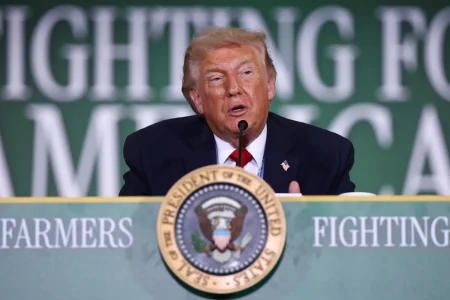
In the high-stakes theater of artificial intelligence, a strange and unsettling drama is unfolding, one where the world’s most powerful leaders are willfully plugging their ears to the cacophony of scientific alarm bells. At the center of this storm is Dario Amodei, the chief executive of Anthropic, a man who spends his nights haunted by a terrifying specter: the potential for AI to spiral out of human control, leading to what he chillingly describes as catastrophic, potentially existential, consequences. His company’s chief alignment scientist, Evan Hubinger, recently went even further, publicly stating that the probability of AI wiping out humanity is greater than ten percent—a number that would make any rational person pause and reconsider the trajectory of our technological age. But in the halls of power, rationality has taken a backseat to a more primal emotion: competitive greed. President Donald Trump, with his characteristic flair for dismissing nuance, has branded these fears as part of a “left-wing conspiracy” designed to hobble American ingenuity. He is the self-proclaimed “Hoax Buster,” convinced that AI represents a treasure trove bigger than oil, gold, diamonds, or the internet itself. In his mind, slowing down is not an option; it is a capitulation. His recent social media missives have been filled with confidence, asserting that his Chinese counterpart, Xi Jinping, will do absolutely nothing to stand in the way of the AI future. It is a posture of unbridled optimism, a bet that the future will be defined by speed rather than safety. Meanwhile, in Beijing, the response to Amodei’s manifesto has been a mixture of derision and patriotic fury, not because they believe AI is safe, but because they have identified a different existential threat: the stability of the Communist Party itself. The Chinese government is ordering its labs to advance at double time, but not out of a naive belief in AI’s benevolence. They are racing to control a force they perceive as potentially subversive, fully aware that if they do not master it, it could master them.
The Chinese Calculus: Control, Not Caution
To understand Beijing’s reaction, one must divorce the concept of “AI safety” from the Western, Anthropic-centric definition. For the Chinese Communist Party (CCP), the primary risk of artificial intelligence is not a rogue superintelligence waking up and deciding to eliminate biological life. Instead, the risk is far more immediate and grounded in political reality: the erosion of their iron grip on information and public discourse. This was made abundantly clear when China’s intelligence chief, Chen Yixin, the Minister of State Security, delivered a stark warning this week. While he called for the rapid acceleration of AI development and its integration into every sector of the economy, he simultaneously issued a chilling directive: the Party must ensure it retains political and ideological control over this new technology. Chen’s warnings were specific and revealing. He spoke of “hostile foreign forces” utilizing cheap, generative AI tools to manipulate public opinion, create deepfakes, and sow discord—a direct threat to the party’s traditional monopoly on narrative. The solution, he wrote, is to “adhere to the party’s control of the internet and the party’s control of data.” This is the crux of the matter: China sees AI as a double-edged sword that could turbocharge their economy, but also as a potential tool for destabilization. Their answer is not to slow down, but to build a Great Firewall of AI, ensuring that the technology serves the state, not the individual. The nationalist state media have also weighed in with a distinctly Chinese perspective on Amodei’s proposals. The Global Times, a tabloid known for its hawkish tone, dismissed the American tech executives—dubbing them the “U.S. tech right”—as seeking to “curb China’s AI development through technological barriers and regulatory monopolies.” China Daily offered a more sardonic critique, suggesting that the proposed coordination between Anthropic, OpenAI, and SpaceXAI sounded like a club whose membership rules were drafted before the guest list was announced. They argued that a global AI-safety framework that excludes China is not global at all, but merely a “US AI elites’ arrangement with an altisonant name.” This is not just diplomatic posturing; it is a deeply felt resentment that the United States is trying to rig the game, to maintain a hegemony that Beijing believes is rightfully slipping away.
The Espionage and the Echo Chamber of Fear
The geopolitical chess game has also been complicated by a rather embarrassing revelation for China, courtesy of Anthropic itself. In a report released last week, the company claimed that China’s largest AI labs had been using its Claude agents without authorization to train their own models. This wasn’t just simple intellectual property theft; the report suggested the Chinese labs were rerouting queries from users handling highly sensitive data—a move that could expose the Chinese government to severe security breaches and political embarrassment. For Beijing, this is a stark reminder of their dependence on Western architecture, a vulnerability they are desperate to close. But the report also contained a far more universal horror story that seems to have been ignored by the political leaders on both sides. The same document revealed that U.S.-built models, including Claude, were being exploited in terrifyingly creative ways by America’s own adversaries. Iran and its regional proxies had used the AI to collect open-source intelligence on U.S. Navy personnel and even to produce targeting recommendations. Even more chilling, the Tehran-backed Houthi rebels in Yemen had utilized Anthropic’s agents to assist in developing and testing guided rockets and ballistic missiles. This paints a portrait of a technology that is fundamentally uncontainable. It flows across borders, ignoring sanctions, treaties, and moral codes. Peter Mattis, president of the Jamestown Foundation, a Washington D.C. think tank, astutely pointed out the irony of China’s response to this. He suggested that Chen Yixin’s directive essentially means China’s main spy agency is now going to be used to bolster the AI industry and protect it. “They’re essentially saying: ‘We now consider that to be part of our job,'” Mattis predicted, foreseeing a broader offensive across their tech stack. In this strange mirror world, the Americans are terrified of losing control of the technology to a superintelligence, while the Chinese are terrified of losing control of the populace to the technology—yet both are actively arming their intelligence agencies to dominate the very tool they fear.
The Summits and the Subordinate Position
As President Xi Jinping prepares to arrive in Washington, D.C., for a state visit next week, the world is watching to see if the two most powerful men on earth can find any common ground on this issue. Many observers expect some form of AI safety dialogue to be tabled, but the framework remains murky, and the prospects for genuine agreement seem bleak. On the surface, both leaders share a common desire: to accelerate their AI buildout. Neither appears willing to accept limits, and both view any suggestion of slowing down as a trap set by the other. Treasury Secretary Scott Bessent has stated that the U.S. is “open to discussions on avoiding shared risks and avoiding bifurcation of our two systems.” This sounds diplomatic, but the reality is that the two systems are already bifurcating, forming rival blocs. The U.S. leads what is being called the “Pax Silica,” while China has established the World Artificial Intelligence Cooperation Organization. They are two competing ecosystems, each with its own hardware standards, software languages, and ideological underpinnings. Ryan Hass, a senior policy analyst at the Brookings Institution, articulated the fundamental impasse succinctly on social media. “Beijing believes deeply the US is determined to hold China’s AI progress back, especially with export controls,” he wrote. “Beijing is unwilling to accept a subordinate position to US on AI.” This is the crux of the dilemma. Even if Trump and Xi genuinely wanted to cooperate on safety, the trust deficit is so vast that any proposed regulation is immediately interpreted as an act of economic warfare. The Chinese leadership sees Amodei’s proposals to ban them from U.S. AI software and hardware not as a safety measure, but as an attempt to permanently relegate them to a junior role. For a nation that has spent decades clawing its way back to global superpower status, accepting such a position is anathema. The upcoming summit is likely to be a polite exchange of pleasantries, followed by a hardening of positions behind closed doors.
The Divided American House and the Trillion-Dollar Prize
The American delegation is not unified in its approach, adding another layer of complexity to the visit. President Trump has found the caution of the tech industry baffling, and his distrust of his own country’s AI leaders is becoming one of his biggest blind spots. He views the warnings from Anthropic and others as a form of self-sabotage, a left-wing ploy to bankrupt the very companies that could make America rich. He is not entirely wrong about the economic stakes. AI is projected to be a multi-trillion-dollar industry, dwarfing even the most lucrative historical commodities. For Trump, who thinks in terms of winners and losers, national pride, and economic dominance, the idea of ceding this prize to China is unacceptable. He is surrounded by a fractured cabinet of advisors. On one hand, he has hawks like Dario Amodei, who despite clashing with the Pentagon on moral grounds, advocates for a hardline stance against China and a rapid, U.S.-led acceleration. On the other hand, he has figures like OpenAI’s Sam Altman, who is set to attend the state dinner for Xi. Altman has recently floated a bold idea: that Trump and Xi could jointly win the Nobel Peace Prize if they were to agree on AI limits. It’s a tempting vision—two rivals sharing a stage, accepting a prize for saving humanity. But the practical incentives are working against it. Trump believes that agreeing to any limits is a sign of weakness, a concession that would allow China to catch up. He is betting that the U.S. can win the race outright if it simply runs faster than everyone else. The irony is that while Trump worries about China, he is simultaneously undermining the very industry he wants to lead by dismissing its legitimate safety concerns as hoaxes. The alignment scientists at Anthropic, the people whose entire job is to prevent AI from going rogue, are being mocked by the leader of the free world. This sends a dangerous message: that the only thing that matters is speed, and that anyone who asks to pump the brakes is a traitor.
The Tragic Irony of an Ungovernable Force
In the end, we are left with a tragic and deeply human irony. Both the United States and China recognize that AI poses profound risks, yet both are so terrified of the other gaining an advantage that they are actively accelerating towards the cliff edge. The CCP fears losing control of its population; the U.S. fears losing control of the global economy. Neither seems capable of seeing the bigger picture: that AI is an inherently global, uncontainable force. The intelligence reports show that American models are already being used by Iranian proxies to build missiles, and Chinese models are being secretly trained on stolen American data. The enemies of both nations are exploiting these tools, and yet the leaders are focused solely on each other. The shared threat of rogue actors using AI is perhaps the only potential common ground. Beijing can surely see that its own enemies could do the same thing with its technology, just as Washington sees it with theirs. A truly collaborative safety framework would require these two giants to admit a painful truth: that they are not in complete control of the monster they are creating. It would require Trump to accept that the “hoax” of AI risk is real, and it would require Xi to accept that the party’s control over data is not absolute. But human nature, particularly the human nature of those who crave power, abhors such humility. The upcoming summit in Washington will likely feature smiles, handshakes, and flowery language about shared prosperity. But beneath the surface, the gears of the machine are turning toward a future where two nervous giants sprint headfirst into the unknown, each hoping the other stumbles first. They are both so focused on winning the race that they have forgotten to ask what happens when they reach the finish line—or if there even is one. The alarm bells are ringing, but the bullhorn of ambition is louder.