






Leah Rhodes has never been the kind of shopper who enjoys a leisurely stroll through a mall or the predictable convenience of an online order. For her, the real excitement lives in the cluttered aisles of thrift stores, church bazaars, and garage sales—places where the merchandise is as unpredictable as the weather and every shelf holds the potential for a small miracle. “I get an actual dopamine rush from walking into a thrift store with absolutely no idea what I’m going to find,” the Nashville-based Rhodes told Newsweek. “There is just something deeply satisfying about digging through 400 things you don’t want and then suddenly finding the one thing you can’t believe someone donated.” That feeling, she explains, is what keeps her coming back again and again. It is a kind of treasure hunt for grown-ups, a sport that rewards patience, curiosity, and a willingness to look past the obvious. It is also, in her view, a welcome antidote to the sterile efficiency of modern online shopping, where algorithms predict your tastes before you even know them and packages arrive at your door with all the mystery of a utility bill. The thrill of thrifting is precisely that it is not efficient. You have to show up, look closely, and take chances. And she is far from alone in that obsession. According to figures published by Capital One Shopping, the thrifting industry has grown by a remarkable 143 percent since 2018, a sign that more and more people are discovering the joys of secondhand shopping. Part of the appeal, Rhodes says, is that it serves as a throwback to a simpler era of commerce. “You can’t just go online and add what you want to your cart. You have to hunt for it,” she said. “There’s a history to everything, maybe even a story behind it, and when you find something really special for a great deal, that little victory high is unmatched.” It was this very thrill of the hunt that led her to a discovery she could hardly believe—a set of plates that would turn out to be worth far more than the small change she paid for them.
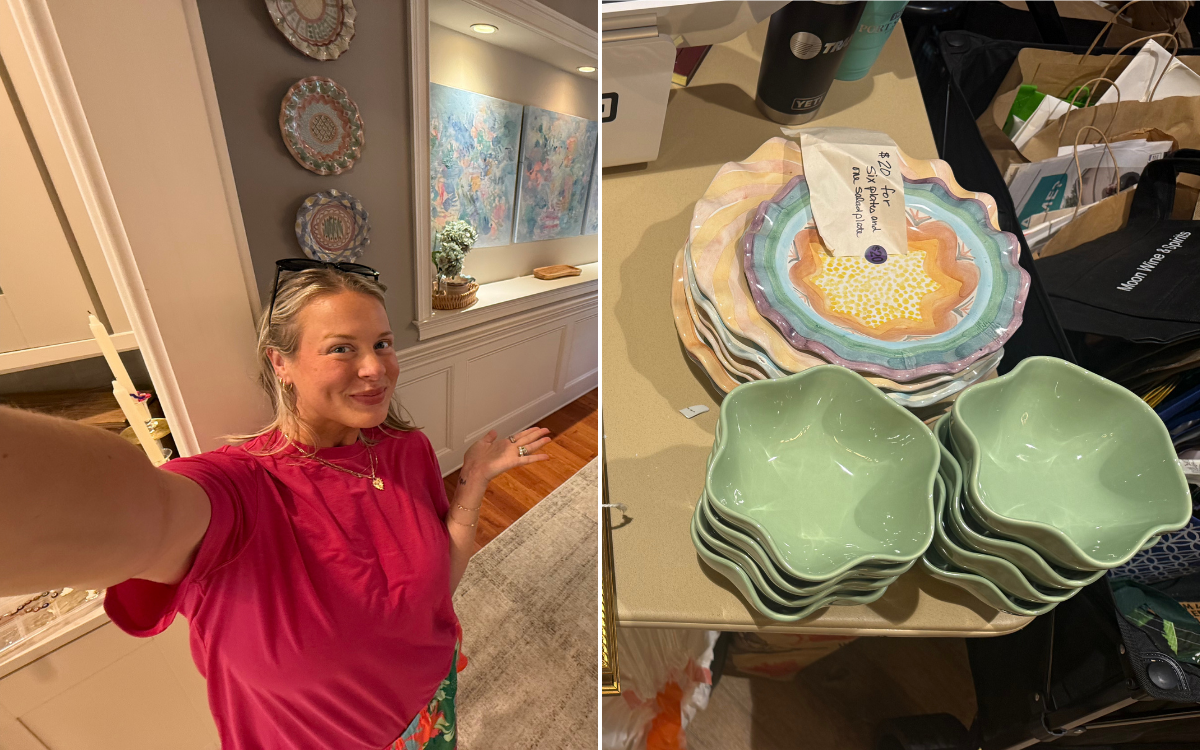
On an unremarkable afternoon, Rhodes stopped by a church bazaar in nearby Franklin, Tennessee, a community event where donated goods are laid out on folding tables in hopes of raising a little money for the congregation. She was browsing without any particular agenda, the way seasoned thrifters often do, letting her eyes wander over the mismatched collection of household items, clothes, and knickknacks. Then her gaze landed on a stack of plates that immediately caught her attention. “I spotted the stack of plates and just thought they were super unique and fun,” she said. They were colorful, whimsical, and unmistakably hand-painted, with patterns that seemed to dance somewhere between rustic charm and high-end artistry. The signature black-and-white checkerboard details, so often associated with the MacKenzie-Childs name, gave them a playful sophistication that set them apart from everything else on the table. Intrigued, she picked one up and turned it over. There, stamped on the underside, was the name MacKenzie-Childs. Rhodes recognized the label. She knew it was a brand associated with quality and style, but she was honest with herself about her level of expertise. “I knew the brand,” she admitted, “but I am far from an avid collector.” At that moment, she had no idea just how special her find really was. She purchased all eight plates for just $20, a price that seemed reasonable for their beauty and craftsmanship, and walked away feeling like she had found something delightful. Perhaps she imagined using them at a dinner party or displaying them as art. It was only later, after she had left the bazaar and gone about her day, that the true scale of her luck would begin to sink in. The plates, she would soon learn, were not just pretty decorations. They were coveted collectibles, pieces of a storied brand with a devoted following, and their value was exponentially higher than the few dollars she had handed over at that church table.
MacKenzie-Childs is not a household name for everyone, but for those who know it, the brand carries serious cachet. Founded in 1983 by Victoria and Richard MacKenzie-Childs in Aurora, New York, it quickly became known for its luxury American home décor and tableware, characterized by hand-painted ceramics, bold and joyful colors, and the signature checkered patterns that have become a kind of visual calling card. The brand’s pieces are not mass-produced in the anonymous way of ordinary dinnerware; each one feels like a small work of art, meant to be used and admired in equal measure. Because of this, MacKenzie-Childs plates are highly collectible, and retired pieces from the 1980s and 1990s are especially sought after. Online marketplaces like Etsy show a wide range of prices, with common examples selling for anywhere from $50 to $150, while desirable retired patterns in excellent condition can command between $125 and $250 per plate. Rhodes, however, was blissfully unaware of all this as she carried her eight plates out of the church bazaar. It wasn’t until a couple of hours later, while sitting in her kids’ school pickup line, that she decided to look them up on her phone. “I Googled them and was shocked to discover what I had found,” she said. The numbers were staggering. Based on her estimates, the eight plates she had bought for $20 could be worth as much as $1,000 if sold as a set. The realization was enough to make anyone’s head spin. She had stumbled onto a genuine bargain, the kind of find that thrifters dream about but rarely experience. For a moment, she probably wondered if she had misread the listing, if there was some catch, if the plates were somehow too good to be true. But no—the proof was right there in her hands, and the thrill of discovery, the very thing she loved about thrifting, had just delivered the payoff of a lifetime.
How eight MacKenzie-Childs plates ended up at a small-town church bazaar is a mystery that may never be solved. Rhodes has her own theory. “My best guess is that someone from the church donated them while cleaning out a home and either didn’t know what they were worth or simply didn’t care,” she said. It is a common story in the world of secondhand goods: an heirloom is boxed up during a move, a relative passes away, a house is cleared out, and the contents are sent to a donation center with little thought to their provenance. In this case, the plates may have once sat proudly in a china cabinet, displayed for special occasions, or been used for holiday dinners. They may have been a wedding gift, a family treasure, or a spontaneous splurge by someone who loved beautiful things. Now they had found their way to a folding table at a church event, waiting for someone with sharp eyes and a sense of adventure to give them a new life. For Rhodes, that moment of serendipity felt almost magical. She had walked into the bazaar with no expectations and left with a piece of history—eight pieces, to be exact. The fact that their journey to her was so improbable only adds to their charm. It also speaks to the deeper appeal of thrifting, which is not simply about getting a deal but about rescuing objects that still have stories to tell. Every scratch, every brushstroke, every slightly worn edge is evidence of a life lived. Someone once chose these plates, perhaps saving up for them, perhaps receiving them as a cherished gift. Someone else let them go, not realizing what they held. And now they belong to a new story, one that began with a casual browse at a church bazaar and ended with a wall display that will make any visitor ask, “Where did you get those?” It is a wonderful reminder that the things we donate or discard are never truly without value; they are just waiting for the right person to see them.
Despite the obvious financial windfall sitting on her wall, Rhodes is in no hurry to sell the plates. Instead, she has hung them in a place of pride in her home, where she can see them every day and remember the improbable way they came into her life. The decision has sparked plenty of conversation among friends and family. “There are tons of people suggesting I keep them and several people suggesting I sell them for a profit,” Rhodes said. It is a familiar dilemma for anyone who has ever found something valuable at a bargain price: do you cash in, or do you keep the magic? For Rhodes, the answer is not as simple as looking at a price tag. The plates are not just an investment; they are a tangible reminder of the joy of the hunt, the kindness of community, and the thrill of discovery. Every time she walks past them, she is reminded of that ordinary afternoon and the extraordinary moment when a stack of hand-painted ceramics transformed a routine errand into a memory. They have become part of her family’s story, an heirloom in the making, even if their monetary value is far less than the sentimental one she has assigned to them. She also has a characteristically generous idea in mind if she ever does decide to part with a piece or two. “If I did decide to sell one or two, I would donate that money back to the church that sold them to me as a way to say thank you for adding to our family keepsakes,” she said. It is a sentiment that perfectly captures her approach to thrifting: the point is not just to gain something for yourself, but to participate in a larger cycle of giving, receiving, and appreciation. The church bazaar may have unknowingly sold her something valuable, but in her eyes, the real value lies in the meaning she has attached to it. By keeping the plates on her wall, she has turned a lucky find into a family treasure, a story she will likely tell for years to come.
Leah Rhodes’ story is a reminder that value is a slippery concept, shaped as much by emotion and context as by market prices. The plates she bought for $20 are worth more in monetary terms, but their true worth is tied to the joy they have brought her and the memories they represent. Thrifting, at its best, is about more than saving money or even making a profit. It is a way of connecting with the past, of honoring the lives and homes that came before us, and of finding beauty in unexpected places. It is also a form of sustainability, a small rebellion against the relentless churn of consumer culture, where everything is new, identical, and forgettable. The growth of the thrifting industry suggests that many people are hungry for this kind of connection. They want to touch objects that have histories, to participate in the hunt, to feel that little spark of recognition when they find something special. For Rhodes, that spark is everything. She describes it as a “little victory high,” and it is impossible not to smile when she talks about it. The church bazaar, the stack of plates, the moment of discovery—these are the moments that make the 400 disappointing finds worth it. And if she ever does sell a plate or two, and donates the money back to the church, the story will come full circle in the most beautiful way. Until then, the plates will hang on her wall, not as a display of wealth, but as a celebration of luck, curiosity, and the simple joy of finding a treasure where you least expect it. In a world that often feels increasingly disconnected, Rhodes’ story is a warm reminder that wonder is still out there, hiding on folding tables and in thrift store bins, waiting for someone willing to look.