


Patrick Stewart was many things to many people: a Shakespearean knight, a starship captain, a mentor to mutants, and a man who found love later in life with a jazz singer who once waited tables at a Brooklyn pizzeria. The acclaimed British actor died on Wednesday, October 28, at his home in Los Angeles at the age of 86, according to a statement posted to his Instagram. The cause, his family shared, was a “brief and poignant journey” with Alzheimer’s disease and Lewy body dementia. In his final days, Stewart was in the “loving care” of his wife, Sunny Ozell, the American singer-songwriter whose music draws on jazz, blues, soul, and Americana. For the countless fans who grew up watching him command the bridge of the USS Enterprise or guide young mutants through the halls of Xavier’s School, the news lands like a blow. Yet the statement also reminded everyone that Stewart’s life was not just a list of credits; it was a story of friendship, resilience, and second chances. He was born in Yorkshire, England, and rose to become one of the most recognizable faces in science fiction, but he never lost the humility that made him beloved. As the tributes begin to pour in, it’s easy to remember him as a cultural icon. But those who knew him describe someone far more gentle: a man who signed autographs for hours, who remembered the names of crew members, and who, even after decades of fame, could be star-struck by a great piece of writing. He was the rare celebrity who seemed genuinely surprised by his own success, and grateful for every chance to perform. His death is a reminder that even the largest legends are human—and that a life well lived is measured not only in awards and box office totals, but in the people you touch along the way. For Stewart, those people included audiences, colleagues, and above all, the family he built outside the spotlight.
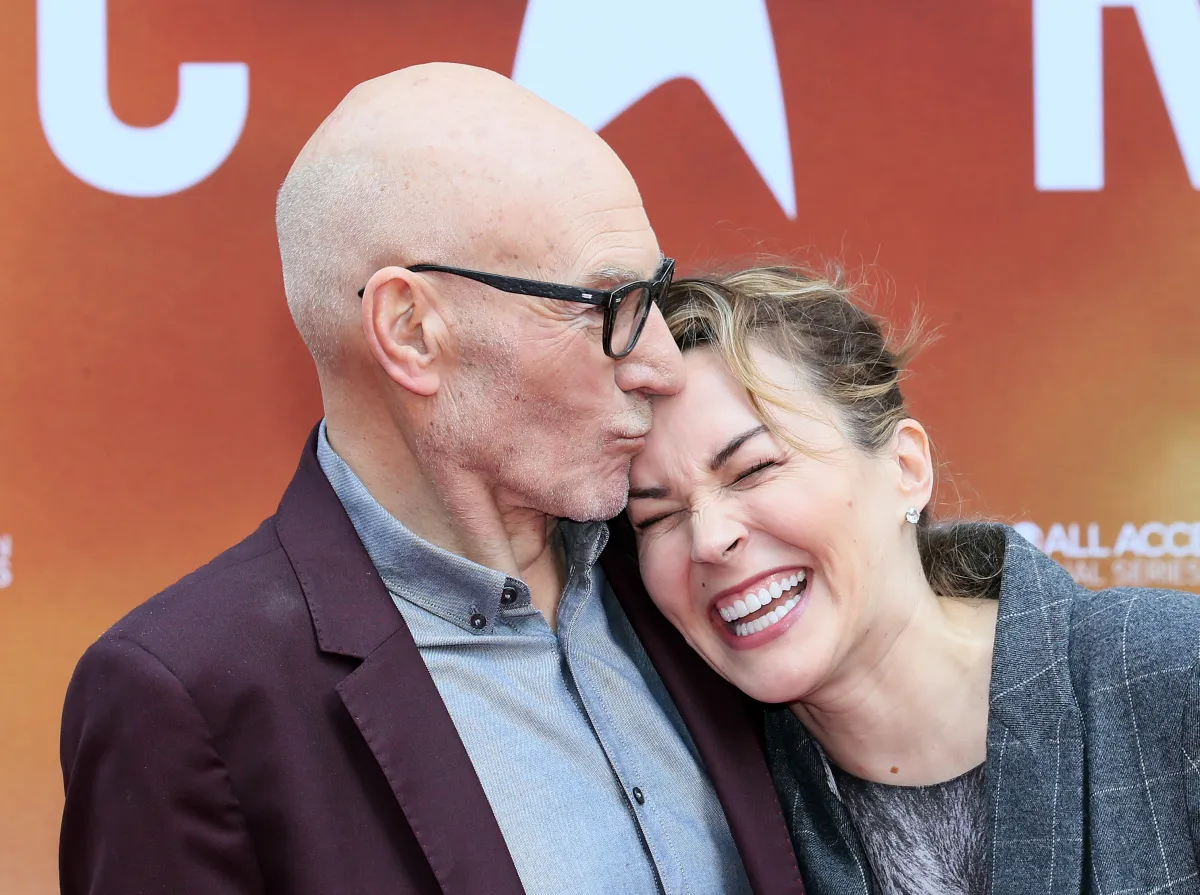
Stewart’s late-life romance was as improbable and delightful as any role he ever played. In 2008, he was in New York starring in Shakespeare’s Macbeth. One evening, he found himself at Franny’s, a now-closed pizzeria in Brooklyn, where a young woman named Sunny Ozell was working as a waitress. As she approached his table to offer dessert, the conversation turned to theater. Ozell mentioned that she wanted to see Macbeth but couldn’t get tickets—the production was completely sold out. That small moment might have ended with a shrug. Instead, it left a deep impression on Stewart. He gave her his phone number, and she later came to see the play, reconnecting with him backstage before they went out to dinner. In a 2022 interview with PEOPLE, Stewart remembered the encounter with the warmth of someone who still couldn’t quite believe his good fortune. He was in his late sixties, she was decades younger, but the conversation was the only thing that seemed to matter. “I’ve never met anyone like her before,” he said of Ozell. “She is so smart and so informed. And her intellectual accomplishments are extraordinary. She remembers everything.” The image is almost too charming to be real: a knighted Shakespearean actor handing his number to a waitress at a pizza joint, not caring about status or appearances, just genuinely curious about a smart, interesting woman. It says a great deal about Stewart that he was not only open to that connection, but eager to pursue it. He had spent decades as an international celebrity, yet he remained approachable, unguarded, and delighted by everyday encounters. That openness defined his later years, and it gave him one of the great loves of his life at a time when many people might have settled into comfortable routines. If his on-screen characters taught us to be brave, his own life taught us that it is never too late to start again.
Patrick Stewart and Sunny Ozell married on September 7, 2013, after five years of dating. The ceremony took place at Lake Tahoe, Nevada, with roughly 100 family members and friends looking on. Ozell was from nearby Reno, so the location held a special meaning. In one of the day’s happiest details, Stewart’s longtime friend and X-Men co-star Ian McKellen officiated. McKellen was a familiar presence on screen, but in real life he and Stewart shared a friendship that went back decades. The ceremony was joyful, warm, and informal. Then came a twist that could have come from a sitcom. The couple later discovered that their Lake Tahoe ceremony wasn’t legally binding—McKellen’s credentials were only valid in California. Rather than let the mix-up dim their happiness, Stewart and Ozell simply did it again, holding a legal ceremony at a Mexican restaurant in Los Angeles. McKellen officiated again, this time wearing what Stewart, with characteristic humor, described as a “kind of robe.” On a 2020 appearance on Jimmy Kimmel Live!, Stewart recalled the evening with a grin. “We were formally married in a Mexican restaurant,” he said. For a man who had commanded the Enterprise and mentored the X-Men, he seemed most at ease when he wasn’t acting—when he was just another groom in a restaurant, surrounded by people who loved him. It was a perfect reflection of who Stewart was: someone who could play a famous leader on screen, but who never took himself too seriously. The restaurant ceremony was intimate, slightly ridiculous, and full of love—exactly the kind of moment that makes a marriage memorable. Friends and family gathered around tables, no grand cathedral, no fuss. Just two people promising themselves to each other, with a good friend and a good meal nearby. Stewart often said that Ozell made him feel lucky. Their wedding story suggests that the feeling was mutual. The mix-up, far from being a source of frustration, became one of their favorite stories—proof that a great love doesn’t need a perfect ceremony, only a genuine promise.
Before Sunny, Stewart’s personal life had its share of chapters. He married his first wife, Sheila Falconer, in 1966. She was a dancer and choreographer, and they had two children: Daniel, born in 1967, and Sophie, born in 1972. Their marriage lasted nearly a quarter of a century before ending in divorce in 1990. For much of that time, Stewart was building his career, first on the British stage with the Royal Shakespeare Company, then in television and film. The demands of his work, as with so many marriages in the public eye, took their toll. In 2000, Stewart married Wendy Neuss, a television producer he had met on Star Trek: The Next Generation. Neuss had worked behind the scenes on the beloved series, and their relationship bridged two worlds—deep-space fiction and real-life production. But that marriage, too, ended in divorce after three years. It would be years before Stewart found his lasting match. When he finally did, he seemed to understand it was rare. “I’ve never met anyone like her before,” he told PEOPLE in 2022, speaking about Ozell with the wonder of someone who had been given a second chance at love. “She is so smart and so informed. And her intellectual accomplishments are extraordinary. She remembers everything.” Stewart was often described as a deep thinker, a man who loved literature and language. In Ozell, he found a partner who matched his curiosity and added a musical dimension to his life. Her own career as a singer-songwriter blends jazz, blues, soul, and Americana—a soundtrack, perhaps, for the life they built together in Los Angeles. He was sixty-eight when they met, seventy-three when they married, and eighty-six when he died. His long life included no shortage of love, loss, and reinvention. Those experiences informed his performances, giving his characters a depth that audiences could sense even under prosthetic foreheads or bald caps. He once said that every role is shaped by who you are, and it’s impossible not to see traces of Stewart himself in the dignity and kindness he brought to Picard and Professor X.
Stewart’s fame rested on two towering roles. As Captain Jean-Luc Picard in Star Trek: The Next Generation, he made leadership seem thoughtful and compassionate. Picard was not a swashbuckler; he was an archaeologist at heart, a diplomat who preferred to talk first and fight last. Stewart’s performance turned a bald, British character into one of science fiction’s most beloved icons. Then, in the X-Men films, he became Professor Charles Xavier, a telepath and teacher who devoted his life to protecting outsiders. That role introduced Stewart to a new generation of moviegoers and spanned more than twenty years, from the first X-Men movie to appearances in Doctor Strange in the Multiverse of Madness and a scheduled return in Avengers: Doomsday, expected to be released on December 18, 2026. But Stewart’s roots were in the theater. He joined the Royal Shakespeare Company in 1966 and spent years performing Shakespeare before he ever stepped onto a starship. That classical training gave him an unmistakable command of language and an ability to make even the most fantastic lines feel human. His voice was a thing of beauty—measured, warm, and musical, capable of turning a simple warning into a stirring speech. He also showed surprising comedic range, starring in the satirical comedy Blunt Talk and providing endless deadpan amusement as CIA Deputy Director Avery Bullock in the animated series American Dad!. He could swing from a bare stage in a Royal National Theatre production to a cartoon voice booth without missing a beat. He played King Henry II in The Lion in Winter, starred opposite some of the finest actors of his generation, and somehow never stopped working. It was a career built not on chasing fame but on loving the work itself. Stewart had a way of making each role feel like the most important thing he had ever done, because to him it was. That intensity, combined with warmth and humor, is why audiences of all ages will remember him.
One of the most poignant reflections on Stewart’s life came from his own memoir, Making It So, published in 2023. In a passage later shared on Instagram, he wrote about his connection to Captain Picard: “Like me, Jean-Luc has lived an unusual life that has taken him far beyond the bounds of normal human experience,” Stewart wrote. “But he is also someone who has remained true to his earthbound roots, for they are what gave him his identity. In the end, he feels the call of home, as do I.” Those words now read like both a farewell and a comfort. Stewart never forgot where he came from—the working-class boy from Yorkshire who loved words and became a knight. He spent his life traveling through time, space, and the human heart, but he always knew what mattered: family, friendship, and the small ordinary moments that form the foundation of a meaningful life. In his final years, surrounded by the steady love of his wife Sunny, with his children, his audiences, and his colleagues, he found something close to peace. The announcement of his death emphasized that he was in Sunny’s loving care, and that he faced his illness with the same courage and clarity he gave to his characters. It is impossible to watch a Picard scene now without feeling a particular ache—not only because of what Stewart was, but because of what he showed us about grace. In a world that often prizes spectacle over substance, Stewart was an artist. He believed in storytelling. He believed in the power of a single well-chosen word. And he believed in people. The roles he leaves behind will keep him with us for generations, but the man himself was something rarer: a person who seemed to understand that fame is temporary, while kindness is eternal. As the lights dim on his final act, perhaps the best tribute we can offer is to be a little more like him—curious, gracious, and open to unexpected pizza-shop conversations that can change a life. Patrick Stewart may have left the stage, but his voice will continue to echo in our memories, his face will continue to gaze at distant stars, and his heart will remain, as it always was, at home.