

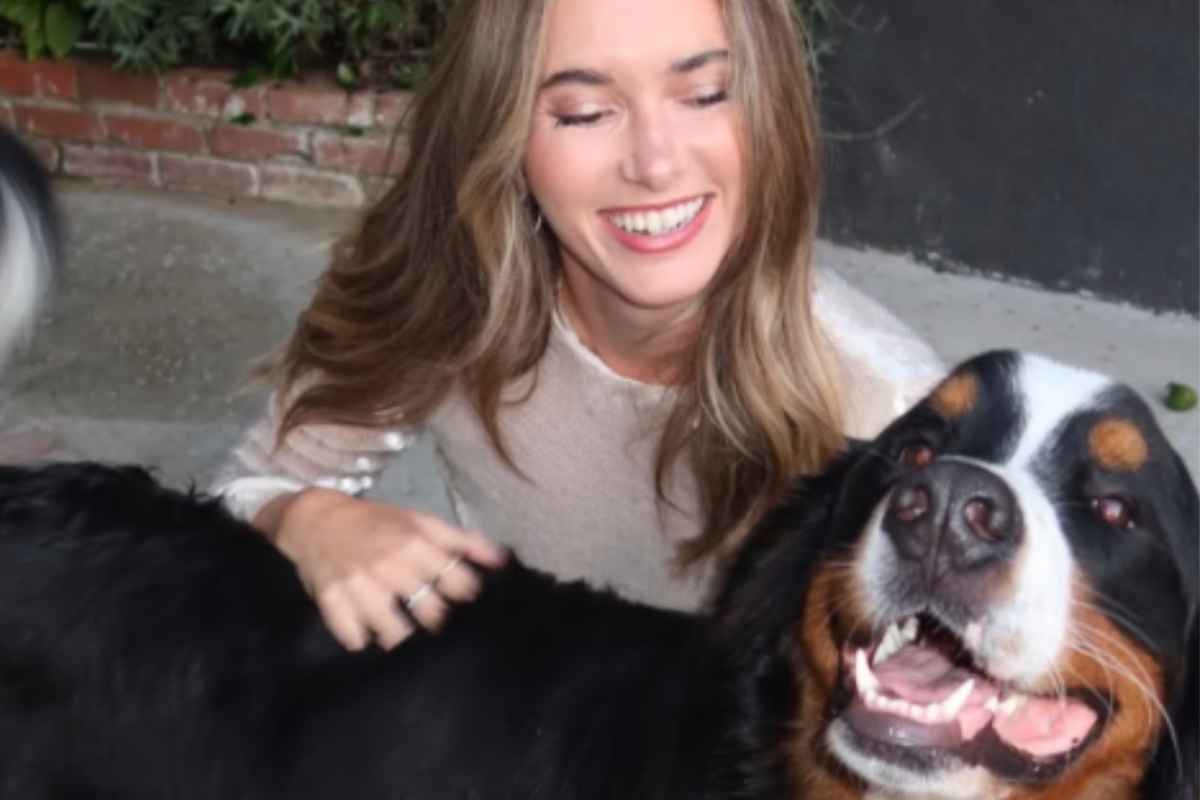
There are moments in life that change the way you see the world—not because of something that happened to you, but because of something that happened to someone you love. For Madeline White and Andrew Fedyk, that moment came in August, when they were thousands of miles away in Europe with their newborn daughter, Juliet, and received a phone call that no pet parent should ever receive. Dunkin, their beloved two-year-old Bernese mountain dog, had died. They had left him with Smart Dogs Dog Training, a Los Angeles-based facility, for what was supposed to be four weeks of basic training and boarding. Instead, they got a call roughly 36 hours after leaving him in the care of the trainer, saying that Dunkin had died of heatstroke. There was no rush to a veterinarian, no frantic attempt to save him, no final chance. Fedyk later said the dog was never taken to a vet at all. “They just decided he was dead and called me hours later,” he said. “He never even had a chance to be saved.” The couple was left to grieve from across the ocean, holding their infant daughter, trying to make sense of a loss that felt deeply wrong. Dunkin was not just a dog. He was a member of their family, a bright, gentle presence in their daily lives, and the silence he left behind was deafening. The tragedy could have ended there, as just one more heartbreaking story, but instead it became the spark for something bigger—a fight for accountability, for change, and for a law that would carry Dunkin’s name into the future.
Out of that grief, Congressman James Gallagher, a California Republican, stepped forward. Gallagher shared a post on Instagram alongside White and Fedyk, announcing a new bill that would come to be known as “Dunkin’s Law.” The post was simple but powerful. When the couple entrusted Dunkin to the facility, Gallagher wrote, “they expected him to be safe. Instead, they lost a member of their family and have been fighting for answers and accountability ever since.” The bill, if passed, would amend the Animal Welfare Act to provide for the protection of companion animals held or cared for at certain facilities. Its goals are straightforward but significant: hold commercial care facilities accountable when animals are harmed or neglected under their watch, apply similar accountability standards to rescues and shelters, and give pet owners a real path to seek justice when their animals suffer harm. For years, people who have lost pets in kennels, training studios, boarding facilities, or shelters have found themselves in a painful gray area. Animals are often treated as property under the law, leaving grieving owners with little recourse beyond small claims court and unanswered phone calls. Dunkin’s Law aims to change that by recognizing that animals deserve legal protection, and that the people who love them deserve transparency and justice when their trust is betrayed. Gallagher’s announcement signaled a shift in how we think about companion animals—not as mere possessions, but as beings whose welfare matters enough to protect in the halls of power.
The pain of Dunkin’s death did not happen in a vacuum, and Gallagher made sure to connect it to a broader pattern of animal suffering in California. Just weeks before Dunkin’s death, another appalling case had made headlines, and it weighed heavily on the conversation. In June, the Humboldt County Sheriff’s Office announced that investigators had found 117 dogs in various states of decomposition at Miranda’s Rescue Animal Sanctuary, a well-known animal shelter in Northern California. The discovery was horrifying, and it raised serious questions about how animals are sometimes treated even in places meant to save them. No charges have been filed, and the owner, Shannon Miranda, has denied any wrongdoing. The shelter briefly closed for violating county codes but has since reopened, and an investigation remains ongoing. The sheriff’s office said it began looking into the shelter after receiving “credible information” in April regarding allegations of felony animal abuse, animal cruelty, fraud, and conspiracy. That connection—between a beloved pet dying in the care of a commercial trainer and dozens of animals found dead at a supposed sanctuary—showed a systemic problem. In California, someone who intentionally kills a dog or animal can face felony imprisonment or misdemeanor animal cruelty charges, and animal cruelty is punishable by a fine of up to $20,000. Animal cruelty is a crime in all 50 states, but penalties differ wildly across the country, and enforcement is inconsistent. More importantly, the law has often been slow to address the spaces in between—places where people pay for care and boarding, or where shelter animals wait for a second chance, only to be failed by the very systems designed to protect them.
White and Fedyk have refused to let Dunkin’s story fade into the background. In the weeks after his death, they used their platforms to speak openly about their loss, their anger, and their determination. In September, Fedyk, who is one half of the DJ duo Loud Luxury, called for greater regulation of the dog training industry. He said that dog training should require a license, that unlicensed services need to be removed from online listings, and that wrongful pet deaths should entitle owners to damages. Those demands were not just the words of a grieving man; they were a blueprint for a safer, more responsible world for animals. When word of Dunkin’s Law spread, Fedyk again took to Instagram and expressed gratitude for Gallagher’s efforts, saying that he and White were grateful that someone was fighting to ensure that “the families of dogs are not only protected, but have necessary vehicles of justice.” He added, “The fight is far from done.” White, for her part, had shared her own heartbreak in August, writing, “Heartbroken doesn’t even come close to describing how we feel. We will not rest until we get justice for our sweet Dunkin man.” In the midst of that pain, the couple somehow found the strength to keep going, to keep loving. They married in July of 2025, welcomed their daughter, and recently revealed that they had welcomed a new Bernese mountain dog into their home. His name is Carl. He will never replace Dunkin, but he is proof that love, even after loss, continues to grow.
What Dunkin’s Law represents goes far beyond one ill-fated boarding stay. It is about creating a world where the people and places entrusted with an animal’s life are actually accountable for what happens behind their own doors. For pet owners, the name Dunkin is becoming synonymous with the kind of loss that no one should have to endure, and with the determination to make sure other families do not have to face the same silence. The law would close loopholes that have allowed commercial care facilities to operate with little oversight, where a dog can die of heatstroke without a veterinarian being called, and where owners are left with condolences instead of answers. It would also turn the spotlight onto rescues and shelters, communities that are supposed to be havens for animals but, as the Miranda’s Rescue case shows, are not always immune to neglect or cruelty. By bringing these facilities under the same standards of accountability, Dunkin’s Law would send a powerful message: Loving an animal is not an act of weakness, and losing one is not something to take lightly. It says that when someone takes money to care for a dog, they are taking on a grave responsibility. It says that when an animal is harmed, there must be consequences. It says that owners deserve a seat at the table, a way to seek justice, and a voice that cannot be dismissed. In a country where animal cruelty is already a crime in all 50 states, this law moves the conversation forward, from simply punishing outright cruelty to demanding accountability from the everyday places where animals are temporarily placed in the hands of strangers.
There is no law that can bring Dunkin back, and no bill can erase the grief that White and Fedyk carry with them every day. But in his name, something meaningful is taking shape. Dunkin’s Law is still just the beginning of a long journey through Congress—there will be hearings, revisions, debates, and votes—and it will need public support to survive. But Gallagher’s announcement has already done something remarkable. It has turned a private tragedy into a public mission, and transformed the story of one dog into a call for justice on behalf of animals everywhere. It speaks to anyone who has ever loved an animal and feared for their safety, anyone who has ever dropped off a dog at a kennel and worried about whether they would be okay, anyone who has ever held a leash and understood that some relationships are not measured in words. This is not just about pets. It is about the people who love them, and the responsibility we all share to protect the innocent lives we bring into our homes. As Fedyk said, the fight is far from done. But it is a fight worth having. And in Dunkin’s memory, it is a fight that will continue until no family has to ask why no one stepped in, why no one called a vet, why no one said the words that might have saved a dog’s life. For Madeline, Andrew, and little Juliet, and for all the families who have felt that same helplessness, Dunkin’s Law is a promise that their loss will not be forgotten—and that no dog’s life will be treated as if it never mattered.