


There is a unique kind of pressure that comes with wearing the iconic yellow jersey of the Brazilian national football team, a weight of expectation so heavy that it can crush even the most talented athletes. For the Canarinho, football is not merely a sport; it is an intrinsic part of the national identity, a secular religion where nothing less than absolute perfection is tolerated. As the team crossed the equator to compete in the highly anticipated 2026 FIFA World Cup, they carried with them the heavy burden of a twenty-four-year World Cup title drought. It has been nearly a quarter-century since the legendary Ronaldo Nazário, with his iconic haircut and lethal finishing, guided Brazil to their fifth star under the Yokohama sky in 2002. To any other country, reaching the knockout stages or consistently qualifying for the tournament would be considered a resounding success, but for the most decorated nation in football history, this decades-long drought has felt like an eternity of wandering through a sporting desert. Yet, despite the years of heartbreak, near-misses, and the psychological scars of past tournaments, anyone foolish enough to dismiss Brazil as a fading dynasty does so at their own peril. This is still the land of joga bonito, a footballing juggernaut that possesses an unmatched genetic repository of talent, artistry, and passion, and their arrival in North America signaled the beginning of a fresh narrative written by a brand-new generation of dreamers.
The script of Brazilian football has evolved dramatically over the last decade, marked by a poignant transition of power from the old guard to the vanguard of the future. For years, the hopes, dreams, and immense anxieties of over two hundred million Brazilians rested almost exclusively on the shoulders of Neymar Jr., the transcendent but polarizing superstar who became the nation’s all-time leading goalscorer. However, time, physical wear, and a cruel succession of injuries have caught up with the veteran maestro, leaving the national team to navigate a shifting landscape without their longtime focal point. Enter Vinícius José Paixão de Oliveira Júnior, affectionately known to the footballing world as Vini Jr., the brilliant Real Madrid winger who has officially inherited the mantle of leadership. Vini Jr. represents the very essence of modern Brazilian excellence—a mesmerizing combination of explosive pace, audacious dribbling, and a deeply resilient spirit forged in the crucible of intense European competition and relentless social adversity. Fresh off of conquering Europe with Real Madrid, Vini Jr. arrived at the 2026 World Cup not just to participate, but to put the other forty-seven competing nations on notice that Brazil’s era of vulnerability is officially over. He has matured from a raw, unpredictable teenager into a ruthless, world-class decision-maker, and his presence on the pitch gives this squad a fearsome, electrifying edge that makes them a supreme threat to anyone standing in their path to glory.
This new era of Brazilian football officially commenced in the sprawling metropolitan hub of East Rutherford, New Jersey, where MetLife Stadium was transformed into a deafening, kinetic sea of yellow and green on a historic Saturday afternoon. Brazil’s campaign got underway against a formidable Moroccan side, the modern giants of African football who captivated the world with their historic semifinal run in Qatar and came into this match looking to prove that their success was no fluke. The North Africans showed their teeth early, executing a disciplined high press that caught the South Americans off guard and silenced the partisan crowd. In a moment of pure tactical opportunism, Morocco’s rising star Ismael Saibari found a pocket of space in the final third, unleashing a clinical strike that bypassed the sprawling Brazilian goalkeeper and nestled into the back of the net to give the Atlas Lions an early 1-0 lead. The stadium erupted in a cacophony of red and green celebration, leaving the Brazilian players staring at one another in momentarily stunned silence as they faced an immediate test of their character on the world’s grandest stage. It was the kind of early deficit that might have caused previous, more fragile iterations of the Seleção to panic and unravel under the crushing weight of public expectation, but this modern squad, anchored by their young talisman, refused to yield to the mounting pressure.
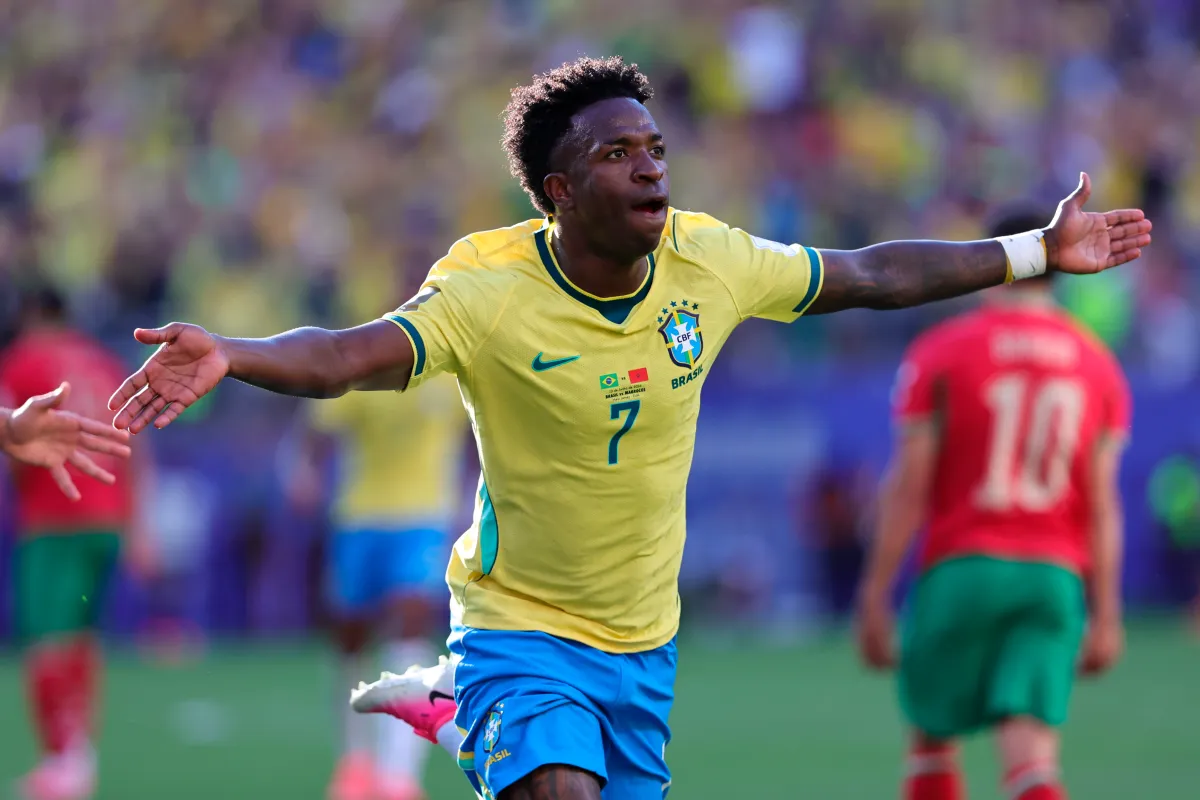
What followed the opening goal was a masterclass in poise and rapid retaliation, orchestrated by a young leader who refused to let his country’s proud legacy matchday record slip away in the New Jersey sun. It took roughly ten agonizing minutes of high-intensity play before Vini Jr. took matters into his own hands, isolating his defender on the left flank with the kind of swagger and confidence that has become his trademark. With a sudden drop of his shoulder and a blinding burst of acceleration, the Real Madrid star bypassed the Moroccan defensive line and unleashed a spectacular, curling effort that bypassed the outstretched arms of the goalkeeper to secure the equalizer. The goal was a work of pure art, a perfect union of athletic power and delicate precision that sent the Brazilian contingent in the stands into a state of absolute euphoria. The match eventually ended in a hard-fought 1-1 draw, with both titan nations walking away with a single, valuable point apiece after ninety minutes of world-class, exhausting football. While a draw was not the ideal three-point start the Brazilian public demanded, the result preserved an extraordinary piece of footballing history: Brazil remains famously unbeaten in their opening matches of the World Cup dating all the way back to 1934, a ninety-two-year testament to their enduring excellence.
This crucial point places Brazil and Morocco in an envious position within Group C, a fascinating four-team section of the tournament that also features the proud footballing nations of Haiti and Scotland. While tournament football is famously unpredictable and ripe with prospective giant-killings, Brazil and Morocco are universally regarded as the heavy, clear-cut favorites to advance out of this group and secure a spot in the knockout rounds. For the neutral observer, Group C promises to be a spectacular showcase of contrasting footballing philosophies, combining the Samba flare of South America, the structured brilliance of North Africa, the physical resilience of the Caribbean, and the passionate, high-tempo spirit of the British Isles. The draw against Morocco serves as a valuable wake-up call for the Seleção, a reminder that the path to a sixth World Cup trophy is paved with tactical discipline and physical endurance rather than just individual brilliance. For head coach Dorival Júnior and his coaching staff, the performance provided a wealth of tactical data, highlighting areas where the midfield transition needs to be tightened and where the defensive line can protect themselves against rapid counter-attacks. There is a sense of calm optimism vibrating through the Brazilian camp, built on the knowledge that the team has successfully negotiated their toughest group-stage fixture and can now focus on building momentum for the challenges that lie ahead.
The journey now moves south down the American eastern seaboard, as Brazil prepares to showcase their iconic brand of football to two iconic, sports-obsessed cities in the coming weeks. Their next destination is the historic city of Philadelphia, where they will take on a resilient Haiti squad at Lincoln Financial Field on June 19, an event that has already captured the imagination of the local, highly diverse sporting community. Following their detour through the birthplace of American democracy, the Canarinho will travel to the tropical warmth of Miami, Florida, to wrap up their group-stage campaign against a notoriously passionate Scotland team at Hard Rock Stadium on June 24. These upcoming fixtures represent much more than just a quest for six points; they are an opportunity for this transitional Brazilian squad to build chemistry, integrate young talents, and fine-tune their offensive engine under the bright lights of the American summer. As the tournament progresses and the stakes grow increasingly higher, the world will watch to see if this group of young superstars can finally break the twenty-four-year curse and secure the elusive “Hexa.” With Vinícius Júnior leading the charge with a smile on his face and fire in his boots, the beautiful game has rarely looked so promising, and the dream of bringing the World Cup trophy back to the streets of Rio de Janeiro and São Paulo has never felt closer to becoming a reality.