

For more than half a century, the collective soul of New York City has been anchored by a quiet, generational yearn—a sports-induced ache passed down from parents to children who had only ever heard mythical, grainy stories of the legendary 1973 championship team led by Walt Frazier and Willis Reed. On Saturday night, that crushing weight of five decades of frustration, near-misses, letdowns, and heartbreak evaporated in a heart-stopping blur of orange and blue. Deep within the hostile environment of the Frost Bank Center in San Antonio, thousands of miles away from the familiar, towering concrete canyons of Manhattan, the New York Knicks fought a desperate, grueling battle in Game 5 of the NBA Finals. Facing a relentless, stubborn San Antonio Spurs squad that refused to go quietly into the night, the Knicks pushed their physical and mental limits to the absolute brink, ultimately securing an agonizingly tight 94 to 90 victory to claim the series four games to one. The final buzzer did far more than just signal the end of a professional basketball game; it shattered a fifty-two-year-old curse that had stubbornly defined the city’s sports identity for a lifetime, unleashing a shockwave of pure, unadulterated ecstasy that traveled instantly back to the five boroughs. For the millions of loyal, long-suffering fans who had proudly worn the team’s colors through embarrassing front-office scandals, painful rebuilding years, and countless seasons of bitter disappointment, this was not just a sports victory—it was a long-overdue moment of profound civic and personal redemption. Families huddled together in cramped apartments wept openly, strangers in local taverns embraced as if they were reunited siblings, and an entire metropolitan area took a collective, disbelieving breath before letting out a thunderous roar of triumph that had been building since the Nixon administration, proving that loyalty, no matter how painful, eventually yields its reward.
Within mere seconds of that historic final whistle, the quiet, cool spring air of New York City was utterly obliterated as the sleeping giant of the metropolis transformed into a pulsing, living, and breathing carnival of pure human joy. From the outermost edges of the Bronx down to the brownstone-lined streets of Brooklyn, people poured out of apartments, bars, and restaurants like water breaching a dam, drawn together by an irresistible, magnetic pull toward the city’s central arteries. Times Square, usually a highly curated, neon-lit conveyor belt designed for tourists, was quickly and completely swallowed by a sea of humanity wearing oversized jerseys, vintage warm-up jackets, and carrying cardboard signs dripping with decades of pent-up emotion. The air in Midtown quickly grew thick with the heavy scent of spilled premium beer, cheap celebratory cigars, and the collective, radiating heat of tens of thousands of bodies jumping in perfect, ecstatic unison. Complete strangers locked eyes and collapsed into emotional hugs under the blinding glare of the massive billboards, chanting the team’s name in a rhythmic, deafening cadence that bounced violently off the facades of historic Broadway theaters. Beneath the asphalt, the subway platforms rumbled not from the movement of the trains, but from the synchronized jumping of ecstatic commuters who turned transit hubs into underground dance halls. Taxi drivers leaned precariously out of their yellow cabs, slamming their hands onto their horns in a chaotic, jazzy symphony that echoed through the gridlock, while local residential neighborhoods saw neighbors who had never spoken a word to one another sharing drinks on stoops. This was a beautiful, overwhelming display of humanity in its loudest, most raw form—a fleeting, magical moment where the typical barriers of urban isolation, socioeconomic divides, and daily stress melted away entirely, replaced by a shared, ecstatic identity that only sports can foster, proving to the world that despite its legendary toughness, the city still possessed a singular, deeply sentimental, beating heart.
This unprecedented explosion of civic pride was quickly mirrored by the city’s political leadership, who sought to capture the historic, almost spiritual magnitude of the moment in words. New York City Mayor Zohran Mamdani took to social media almost immediately, posting a single, highly resonant word on his official account: “History.” It was a succinct but powerful acknowledgment of the decades of disappointment that had preceded this night, a silent nod to the multiple generations of New Yorkers who had lived and died without ever seeing their beloved basketball team lift the Larry O’Brien Trophy again. Governor Kathy Hochul echoed this profound sentiment, releasing a statement expressing that the championship team had “made all New Yorkers so proud,” highlighting how this athletic achievement transcended the traditional boundaries of sports to become an important cultural milestone for the entire Empire State. For politicians and citizens alike, a Knicks championship serves as a rare, highly elusive unifying force in an otherwise deeply fractured and polarized social landscape, offering a brief window of collective happiness that temporarily overshadowed the systemic anxieties of modern urban life. The hard-fought victory became a shining testament to the resilient, never-say-die spirit of the city itself—a physical symbol showing that after years of struggle, mockery, and dark times, perseverance ultimately triumphs, and the grit of a team can perfectly mirror the tough, unyielding character of the people they represent. In a city where local politics is often a battlefield of conflicting interests, the shared joy of a championship brought an unexpected cease-fire. The basketball court at Madison Square Garden has long been referred to as the ‘Mecca of Basketball,’ a sacred space where the sport is treated with a religious devotion. Through these political gestures, the leadership was not just congratulating a sports franchise; they were validating New York’s cultural identity, reestablishing its claim as the center of the basketball universe, and proving that sometimes, a game is the very fabric of a community’s shared social narrative.
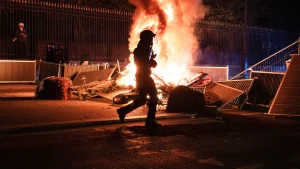
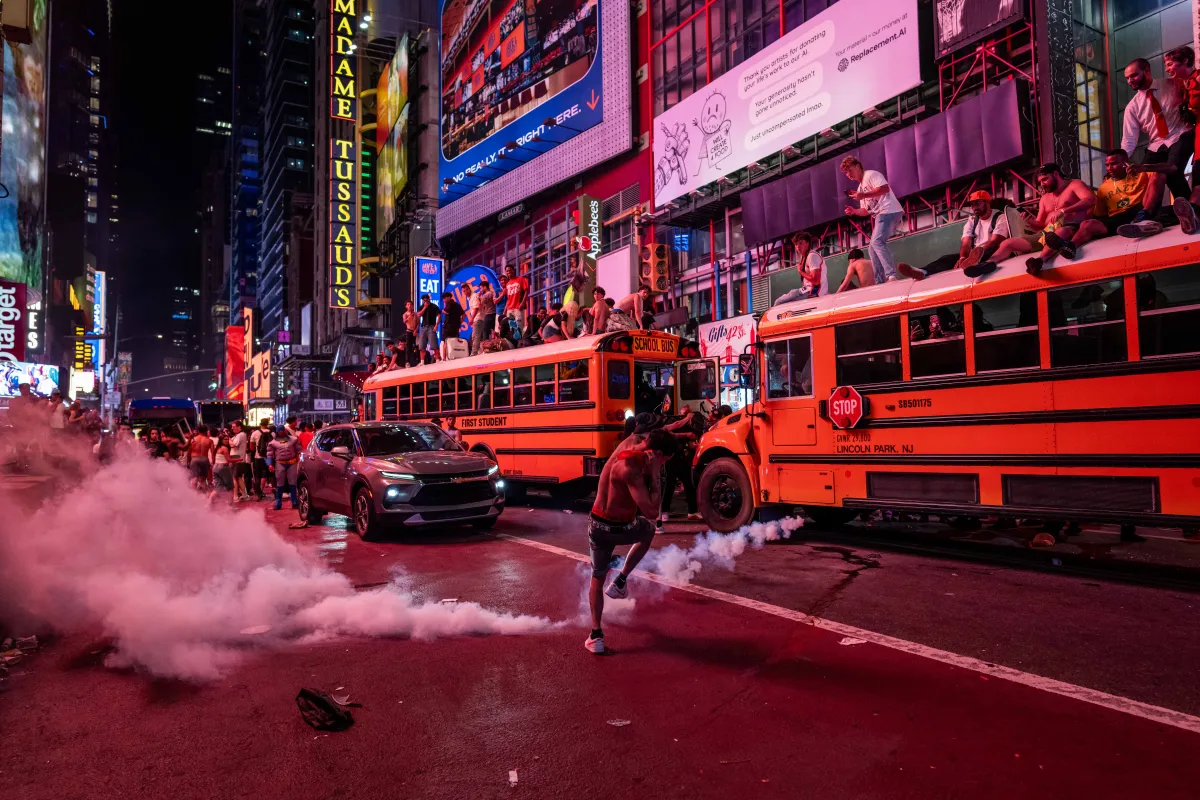
However, as the midnight hour approached and the initial euphoria began to curdle, the intense emotional energy animating the crowded streets began to ferment, shifting from pure, joyful celebration into something far more volatile, unpredictable, and destructive. The overwhelming sheer size of the crowd packed tightly into Times Square created a dangerous pressure cooker of adrenaline and pack mentality, and for some, the thrill of victory morphed into a reckless urge for physical chaos. A convoy of yellow school buses, unfortunately caught in the gridlock of the impromptu victory parade, quickly became the main focal point of a highly dangerous, destructive spectacle. Viral video footage and photographs circulating across various online platforms captured dozens of ecstatic, reckless fans climbing onto the roofs of the vehicles, jumping rhythmically in their heavy boots until the structural metal gave way and the roofs caved in completely. The surrounding crowd, fueled by alcohol and mob mentality, cheered wildly as young men rocked the heavy multi-ton vehicles back and forth in a frantic, coordinated attempt to flip them onto their sides. The situation took a significantly darker turn when pieces of burning clothing were suddenly hurled through the shattered glass windows of one of the trapped buses, quickly igniting a fast-moving fire inside the passenger cabin. As bright orange flames licked at the interior and thick black smoke began to billow heavily into the night sky, portions of the crowd continued to cheer, scream, and film the terrifying destruction on their smartphones, illustrating a deeply troubling psychological shift where the joy of winning became a convenient excuse for lawlessness, leaving many to wonder where the boundary lies between passionate sports fandom and senseless, criminal vandalism. This highlighted the double-edged sword of crowd psychology, where anonymity strips away individual restraint, turning a historic celebration of athletic excellence into a terrifying ordeal of basic survival for bystanders, and showing how easily the thin veneer of civilization can peel back when raw emotion takes over.
The rising tide of physical chaos and property destruction quickly triggered a massive, high-stakes tactical response from emergency services, dramatically shifting the festive atmosphere from a celebration to a tense, dangerous police action. Wailing sirens began to echo relentlessly off the skyscraper walls of Midtown Manhattan as lines of helmeted, riot-gear-clad police officers attempted to disperse the increasingly unruly crowds and establish corridors of basic safety. The tension in the air reached a terrifying fever pitch when frantic, unconfirmed reports began broadcasting over local police scanner feeds, suggesting that a suspected shooting had occurred amidst the dense madness of the Times Square area. While these alarming scanner reports sent waves of terrified onlookers running for safety, creating a chaotic stampede of people trying to escape the immediate area, other sources quickly suggested that the loud, sharp bangs might have actually been heavy-duty, illegal fireworks launched at ground level by overzealous celebrants. Though the New York City Police Department remained highly cautious, refusing to immediately confirm any active shooter scenario to the media, the mere rumor of gun violence cast a cold, chilling shadow over the night’s festivities, serving as a stark reminder of the fragile nature of public safety in dense urban environments. The heavy smell of burning rubber, sulfur from pyrotechnics, and tear gas mingled in the night breeze, creating a sensory landscape that felt more like an active conflict zone than a championship party, illustrating how quickly a dream-come-true can slip into a living nightmare when public order breaks down under the weight of a massive crowd. This delicate dance between freedom and public safety highlighted the immense challenges faced by first responders, caught between allowing citizens to celebrate their historic win and protecting the very city they were sworn to serve, turning a night of triumph into a grueling test of modern urban crisis management.
As the thick smoke slowly cleared and the first soft light of dawn began to paint the littered streets of Manhattan in shades of grey, New York was left to grapple with the complex, deeply bittersweet reality of its historic night. The morning sun gradually revealed a scarred landscape of broken glass, scorched asphalt, abandoned signs, and crushed aluminum cans—the physical, messy hangover of a city that had celebrated too hard, loved too intensely, and burned too bright in its moment of triumph. For many residents and business owners, the extensive property damage and the terrifying flashes of violence would leave a lingering stain on an otherwise miraculous sporting achievement, a sobering reminder of the volatile forces that lie just beneath the surface of concentrated human emotion. Yet, despite the physical damage and the scars on the streets, the underlying, historic truth of Saturday night remained completely unshakable: the curse was finally broken, and the New York Knicks were champions of the basketball world once again. In the quiet cafes, early-morning subway cars, and neighborhood bodegas, New Yorkers traded stories of where they were when the final buzzer sounded, sharing a quiet, powerful bond of survival and ultimate triumph. The road ahead would undoubtedly bring ticker-tape parades, celebratory speeches, and the physical cleaning of the streets, but the vivid memories of this unparalleled night—both the beautiful, soul-stirring unity of the city and the terrifying, destructive excess of the crowd—would be etched into the collective memory of New York forever, serving as a stark reminder that in a city of millions, nothing is ever done in moderation, and when the city finally wins, it does so with a passion capable of shaking the very earth beneath its feet. This duality of human achievement and urban chaos is the true essence of New York, forever intertwined in the concrete. Ultimately, this championship will be remembered not just for the final box score, but for the way it made the city feel—a roaring, untamed giant finally finding its voice after fifty long years of silence.