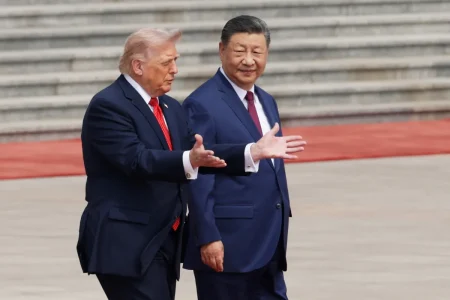






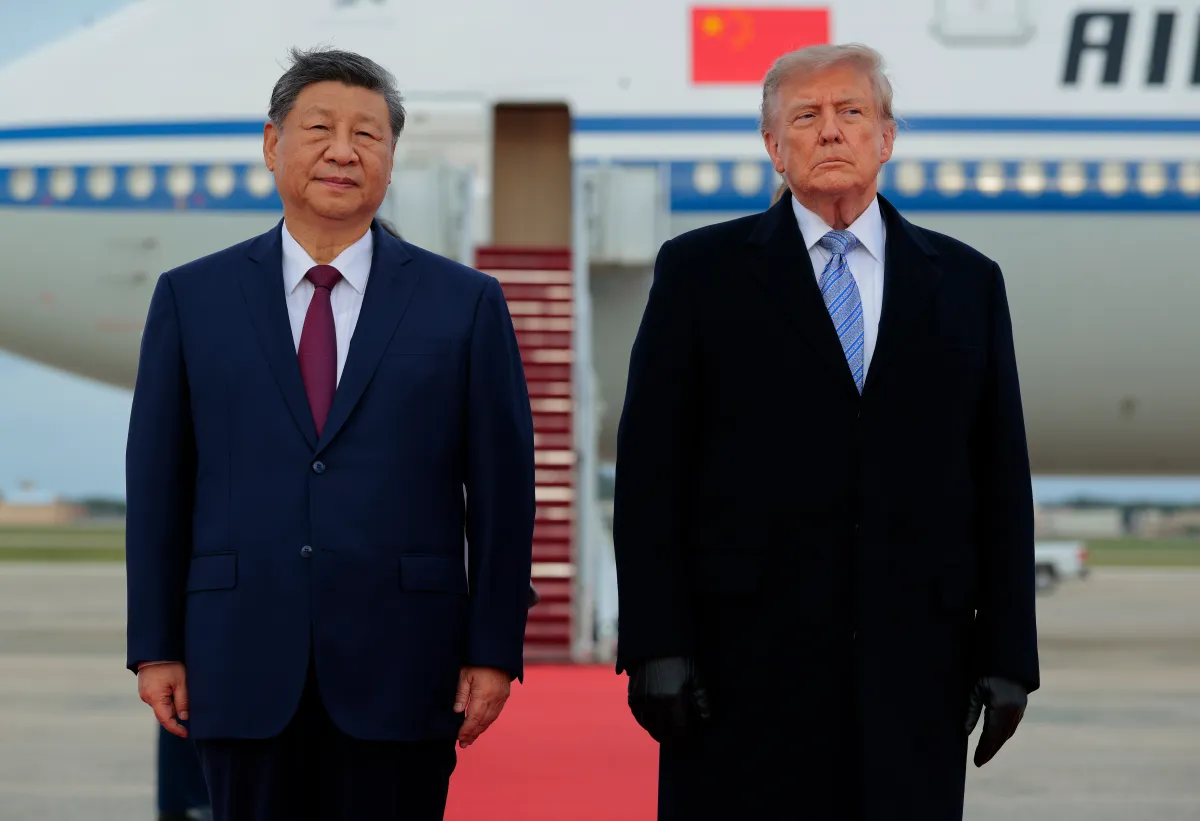
This Friday, Donald Trump and Xi Jinping will stand in the National Archives, among the original words that define America—the Declaration of Independence, the Constitution, the Bill of Rights. It is a stage designed for reverence, a vault of luminous language with dimmed lights and sealed glass cases. But for a Chinese leader with a long memory, the building contains something more useful than the sacred texts of American liberty: proof of a promise. In 1982, the United States and China signed a joint communiqué in which Washington said it intended to reduce arms sales to Taiwan gradually. That sentence sits in the archives of broken promises, and Xi may well recite it aloud to Trump as a polite reminder that the United States does not always keep its word. The visit comes the day after the two leaders hold a formal bilateral meeting beginning at midday, with a packed agenda. Trade is perhaps the biggest item, and the urgency of making a deal has been eased by a newly announced two-month extension of the current truce. But beneath the tariff headlines, two other matters are waiting, and they are, on paper, separate: the Strait of Hormuz and the Taiwan Strait. They are thousands of miles apart, yet at this particular moment in history, they may be tied together by a quiet offer. Each side has something the other wants, and each side knows it. The human stakes could not be higher. In Taiwan, people watch warily as Chinese military aircraft cross the island’s self-declared air defense zone, practice invasion scenarios, and edge ever closer to an island that Beijing claims as its own. Around Hormuz, sailors and oil traders hold their breath as tanker traffic has fallen to roughly ten percent of prewar levels, a collapse that threatens the global economy and the livelihoods of millions. This is not just a diplomatic game. It is about whether people in two faraway places can keep living normal lives.
The shape of the proposal is simple, at least in outline. Xi is expected to press Trump to halt American arms sales to Taiwan, citing that 1982 communiqué in which Washington said it intended to reduce such sales gradually. Reuters has reported, citing anonymous sources briefed on the matter, that China’s request goes beyond the roughly $14 billion arms package that has been on hold for months. Beijing has also reportedly asked Washington to halt deliveries of weapons Taiwan has already ordered. In return, China is offering Trump something he is in acute need of right now: help in dealing with Iran. The idea would be for Beijing to lean on Tehran—perhaps by reducing its purchases of Iranian oil, perhaps by using its diplomatic weight—to bring the Iran war closer to an end and to restore commercial shipping through Hormuz. This is a proposal, not yet an agreement. There is no sign Trump has accepted it. But the fact that it is on the table tells us how much the world has changed. Asian allies are frightened that Trump might soften support for Taiwan in exchange for economic and strategic wins, effectively handing China a victory in the Asia-Pacific. Gulf states, also American partners, are desperate to see the waters off their coasts return to normal. The question is not whether a grand bargain gets struck this week. The question is what each side is willing to trade. For China, Taiwan is a core interest, a matter of national pride and strategic ambition. For America, Hormuz is an economic chokepoint that, if closed, would send oil prices soaring and threaten the recovery of a world already battered by war and inflation. The two straits have become linked in a negotiation that is part real estate, part blackmail, part mutual need. And in such negotiations, the human beings involved are often reduced to bargaining chips.
But there is a wrinkle, and it is a significant one. The 1982 communiqué is not a simple document. When President Ronald Reagan signed it, he also issued a memorandum stating that the quantity and quality of arms sold to Taiwan would be, in his words, “conditioned entirely on the threat posed by the PRC”—that is, the People’s Republic of China. In other words, the promise to reduce arms sales was never unconditional. It depended on Beijing behaving itself. From Washington’s point of view, Beijing has done the opposite. In recent years, China has sent warships and aircraft into the waters and airspace around Taiwan on a regular basis. It has conducted military drills that look like rehearsals for an invasion. It has built up forces along the coast and shown every sign of wanting to intimidate the island into submission. If the threat posed by China has increased—and by any objective measure it has—then the American promise to reduce arms sales loses its moral and legal foundation. The Reagan-era memorandum also sits awkwardly with the Six Assurances, the oral commitments Washington made to Taiwan in the same period, under which the United States has not agreed to consult Beijing before selling weapons to Taipei. So if Trump were to accept China’s offer, he would be ignoring the very logic that justified the original promise. He would be saying that the threat Beijing poses to Taiwan can be set aside because Beijing has agreed to help him with Iran. That is not a legal argument; it is a trade. And Trump, to be fair, has never pretended otherwise. In May, he called the $14 billion arms package “a very good negotiating chip.” That is a remarkable statement from a president talking about the defense of a democracy. But it is also honest. It reveals that under the casino logic of diplomacy, even arms for a vulnerable island can become currency in a larger game. The question is whether he will cash that chip.
Trump’s need is real. He began his war against Iran with characteristic confidence, claiming it would be over in weeks. It is not. Nearly seven months of military and economic coercion have failed to force the Iranian regime to agree to American terms on the nuclear issue or to reopen the Strait of Hormuz. Iran has not won the war, but it has survived. That survival is enough to keep the strait closed and the global economy in pain. And Trump faces midterm elections that, according to many forecasts, will be punishing for his Republican Party, largely because the inflationary impact of his war has made ordinary Americans miserable. He needs a breakthrough. Beijing’s leverage over Iran is substantial. Chinese buyers took more than eighty percent of Iran’s seaborne oil exports last year, providing the regime in Tehran with an essential economic lifeline. Without Chinese money, Tehran would have much less ability to withstand American pressure. But China is not doing this out of charity. Beijing draws roughly half its oil imports from the Middle East, and it too is suffering from the energy blowback of the Iran war. It wants the Strait of Hormuz open. But wanting something and wanting it on Washington’s terms are different things. Beijing might prefer a strait that is open under Iranian rules, with Iran’s government intact and friendly to China, rather than one under American naval dominance. And this exposes the structural flaw in any attempt to link the two issues. An offer costs nothing. An agreement costs credibility. Implementation is where the bill arrives, and it often arrives with hidden charges. The two halves of a bargain are not equally visible to the world. An arms sale to Taiwan is either notified to Congress or it is not. If canceled, Taiwan would make loud noises, and the media would notice. But Chinese pressure on Iran would be private, deniable, and ultimately dependent on decisions made in Tehran, not Beijing. China could say it is doing its best while doing nothing. It could reduce oil purchases temporarily, then quietly resume them. It could encourage Iran to negotiate, then look the other way when Iran refuses. Trump would be left holding a promise that cannot be verified.
There is also a material connection between the two straits, one that Secretary of State Marco Rubio inadvertently highlighted when asked about the stalled Taiwan arms sales. He said every sale is weighed against industrial capacity and the needs of U.S. commanders worldwide. His words were telling: “When we sell something, that means we don’t have it anymore.” He made clear this applies to all buyers, not just Taiwan, and that American forces have ample munitions for their objectives in Iran. Nothing he said indicates that weapons meant for Taiwan have been diverted to the Middle East. But by his logic, a war around one strait consumes resources that might otherwise be available for the other. And he was responding to a question about Taiwan when he made the comment, which suggests the connection is already on the minds of American officials. The administration approved an $11 billion Taiwan package in December—the largest ever—so the United States cannot be accused of abandoning Taiwan completely. But the $14 billion package remains on hold, and weapons already ordered by Taiwan are stuck in a pipeline that moves at the speed of politics. An offer by China to lean on Iran proves neither its willingness nor its ability to deliver what Washington wants. We may not know for certain whether Xi and Trump have made a deal. But there will be signs. Watch the congressional notifications. If the $14 billion package goes to Congress soon after the summit, and if deliveries to Taiwan continue, then either no deal was struck, or Trump chose not to honor it. Watch the oil tankers. Chinese pressure on Iran might show up in reduced purchases, a sudden shift in the Iranian negotiating position, or perhaps even a decision by Tehran to lift its threat to Hormuz as a gesture of goodwill. These are the visible, measurable signs of an invisible bargain. They are less dramatic than a handshake in front of the Archives, but they are the only evidence that matters.
The National Archives is a place of reflection, and there is something almost haunting about the idea of two leaders standing among documents that outlive the people who signed them. The 1982 communiqué is not just paper. It is a record of what the United States once thought it owed to China, and to its own principles. But archives are also repositories of the forgotten. They hold the fine print, the clauses that no one reads, the promises that were made with the unspoken intention of breaking them. What will this Friday’s visit actually mean? Perhaps nothing. Perhaps a photo opportunity. But perhaps it will mark the moment when two leaders looked at the world and decided that the people of Taiwan and the people of Iran were pieces on a board. It is worth remembering what this shuffle means for real lives. In Taiwan, a farmer in Tainan looks up at aircraft that were not there twenty years ago. A grandmother in Taipei watches the news, wondering if her grandchildren will be caught in a war. In Iran, a truck driver in Bandar Abbas waits at a port where ships no longer come. A mother in Tehran buys rice at prices that climb every week, cursing a war she did not choose. And in America, a machinist in Ohio reads about tariffs and tankers and wonders why the world has become so expensive. The grand bargain, if it happens, will be sold as a victory. But it will be recorded somewhere less ceremonial than the National Archives—in congressional notifications, in tanker counts at Hormuz, in the number of Chinese aircraft crossing into Taiwan’s airspace. That is where the truth will live. Not in a presidential library or a state dinner, but in the quiet details of ships and arms and lives. The Archives can show Xi what Washington promised in 1982. But what either leader actually delivers in 2026 will be written in a different ledger, one that keeps score not in fine phrases, but in the fate of people who never signed anything at all.