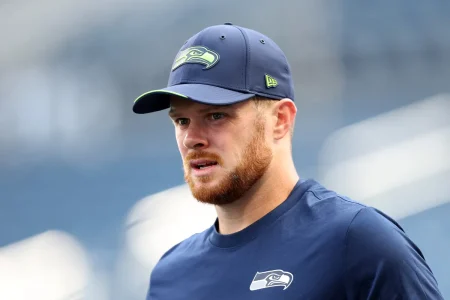






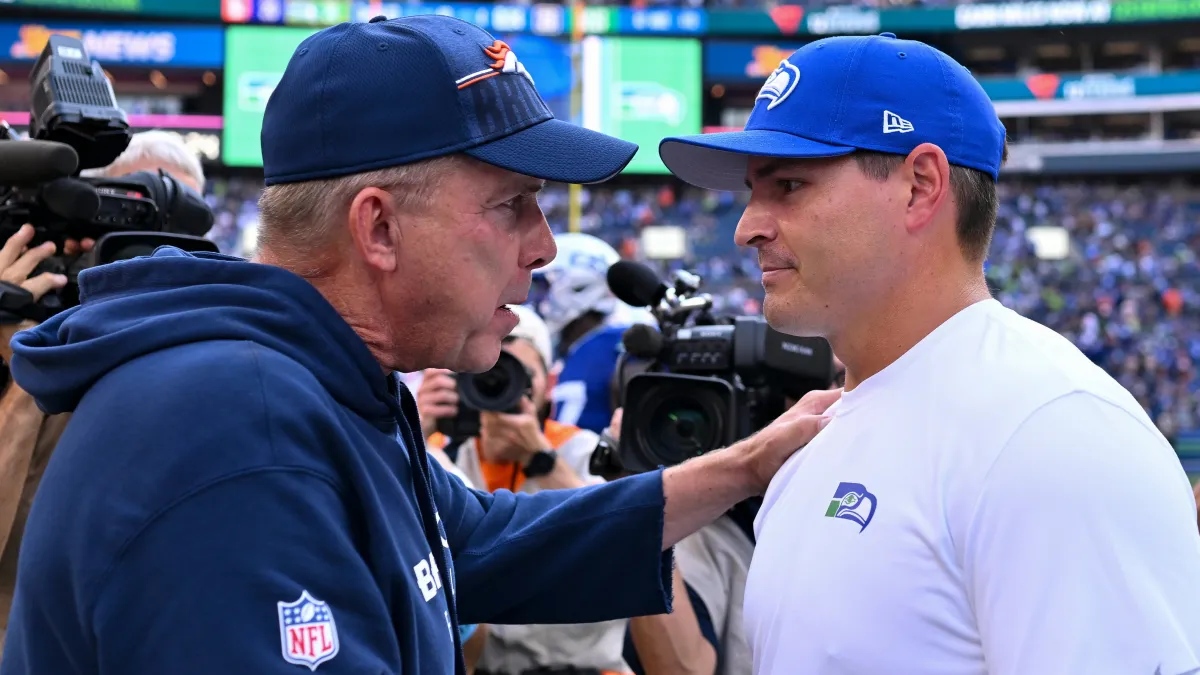
The NFL is a world built on confrontation, but every now and again it offers a moment that feels less like a tactical chess match and more like a awkward conversation between two grown men who have been caught saying something they shouldn’t have. That is precisely what happened when Seattle Seahawks head coach Mike Macdonald sat down with Graham Bensinger for an extended, thoughtful interview — the kind of long-form conversation where coaches are encouraged to be open, reflective, and unguarded. Macdonald, a young coach still establishing his reputation, apparently thought he was speaking in safe confines when he told a story about his counterpart, Denver Broncos head coach Sean Payton. The story involved something that had happened years earlier, a dispute born from the strange and increasingly transparent world of NFL training camps. But what Macdonald didn’t account for was the hot mic, the viral clip, and the way the modern media ecosystem turns offhand remarks into trending news. The result was a minor scandal, a flurry of headlines, and the very public spectacle of a Seahawks coach apologizing to a Broncos coach for a story neither really wanted out in the open. It was all very human, very awkward, and, in the end, very much a typical NFL mess.
The story Macdonald told was a classic football paranoia tale, and in any other era it might have remained behind closed doors. It revolved around the fact that the Seahawks and Broncos were scheduled to face each other in their first game of the season — a time when coaches are desperate for any edge, any clue, any hidden detail that might help their team in Week 1. Training camp is normally a controlled environment, but in today’s world, fans at the sideline film drills, players post short clips on social media, and enterprising coaches can quickly piece together a library of footage that would never have been available in the past. Macdonald admitted that Seattle took roughly one hundred plays from Denver’s training camp and studied them as a way to scout the Broncos’ new schemes and formations. To Macdonald, this was simply the modern reality of the NFL, a gray area where publicly available clips become competitive intelligence. To Sean Payton, however, it was something else entirely. According to Macdonald, Payton “got wind of it, and he lost it,” and the veteran coach responded with fury — a reaction that included a phone call to Seahawks general manager John Schneider in which Payton allegedly threatened to launch a full-scale “Spygate” style accusation, referencing the infamous video scandal that has haunted the Pittsburgh Steelers and, above all, the New England Patriots for years. The Seahawks, unsurprisingly, did not take kindly to that threat, and the back-and-forth escalated into a mutual warning about lawsuits. It was absurd, it was heated, and eventually it was quietly dropped. But the story itself captured everything that makes the NFL equal parts thrilling and ridiculous.
When Macdonald saw his story go viral, he did not hide or make excuses. Instead, he did what any reasonable person would do: he reached out to Payton directly, apologized for the unintended leak, and then faced the media with the kind of candid regret that is surprisingly rare in coach-speak. At his Wednesday press conference, Macdonald explained that the clip was taken from an interview where he’d believed he was speaking off the record, or at least with an understanding that the material would remain unused. “It’s something that I didn’t intend for public use,” he admitted. “But I thought it was the most appropriate thing to reach out to Sean and really just apologize to him for having that end up be public where it wasn’t meant to.” The apology is revealing because it is modest and precise. Macdonald never apologized for the scouting itself, nor for the way he and his staff sought out every possible advantage. In his mind, those one hundred plays were fair game. What he apologized for was breaking the unwritten code between coaches — the idea that certain stories, certain accusations, certain grudges stay within the fraternity. He had exposed Payton, no matter how unintentionally, and in doing so he had violated a sacred trust among men who spend their lives screaming at officials and hiding their playbooks. There is something touching about his embarrassment. He seemed less concerned about his own reputation than about having forced Payton to relive a three-year-old feud in front of millions. In that sense, the apology was less about the NFL and more about basic decency.
Sean Payton, for his part, responded with the weary grace of a man who has been in too many wars to get upset about one more stray bullet. He did not fire back. He did not threaten disciplinary action. He did not escalate the controversy with a carefully crafted insult designed to keep the story alive. Instead, he shrugged, smiled, and made it clear that the whole thing was a non-issue. “We spoke,” Payton said. “He and I are good. Lord knows I’ve been in his position where you’re talking about something — the story is three years ago.” That final line was perhaps the most human moment of the entire saga. Payton knows what it is like to be caught up in controversy, to have words twisted and taken out of context, to feel the weight of public scrutiny pressing down on every mistake. He is one of the most famously combative coaches in the league, a man not known for letting slights go easily. But he also understands that in this business, stories move fast, attention moves faster, and nothing ever stays as important as it seems on the day it erupts. He could have kept the feud alive, he could have turned Macdonald’s apology into a power move, he could have made the young coach grovel a little more. Instead, he reminded everyone why experience matters: because with experience comes the ability to separate the things that matter from the things that merely feel important in the moment. There was no drama, no lingering tension, no complicated reconciliation. Just two coaches who both understand that alright, this happened, and neither of us needs it to mean more than it does.
What makes this story so refreshing is what comes next. Both Payton and Macdonald have claimed, in the days that followed the incident, that they are actually in a better place now than they were before. That may sound like typical public relations language, but in this case it is almost believable. The scandal forced them to communicate, to speak directly about a grievance that had been simmering in silence for years. Macdonald’s apology gave Payton a chance to be magnanimous, and Payton’s magnanimity gave Macdonald a chance to respect the older coach in a way he might not have before. There is something almost old-fashioned about the way they resolved the situation. In an age where rivalries are manufactured, where players and coaches feud on social media, where controversies are engineered for ratings, these two men simply called each other, said their piece, and moved on. They shared a moment of vulnerability and then decided to let it go. There is a lesson in that, not just for the NFL, but for all of us who are forced to navigate difficult relationships and awkward misunderstandings. The professional world often tells us to protect our egos, to hold grudges tight, to show strength through refusing to relent. But Payton and Macdonald demonstrated something different: that strength can also look like forgiveness. The irony is that a story about secretive scouting and threatened lawsuits ended up showing something genuinely genuine — two men who found a way to be human about a very public mistake.
In the end, the whole affair serves as a reminder of the strange environment that NFL coaches inhabit. They live in a world of constant surveillance, where everything they say can be recorded, shared, and weaponized. They are forced to operate under an unwritten set of rules that somehow coexist with intense competition, mutual suspicion, and outright hostility. And yet, despite all that, they are also members of a very small, very exclusive fraternity. They have shared experiences that no one outside their world can truly understand — the sleepless nights, the pressure-cooker Sundays, the petty of the game, the joy of it, the endless grind. That bond is why Payton could forgive Macdonald so easily. It is why Macdonald could apologize without losing face. It is why, even after a story as ridiculous as this one, they can both say they’re fine and actually mean it. There will still be plays to scout, still be games to win, still be rivalries to stoke. The Denver Broncos and the Seattle Seahawks will always be opponents. But Sean Payton and Mike Macdonald have reminded us that underneath the combat gear, underneath the play calls and the press conferences, they are just people who care deeply about a game that is always bigger than any one moment. And in that game, every now and then, the most impressive move is to simply be okay with one another.