


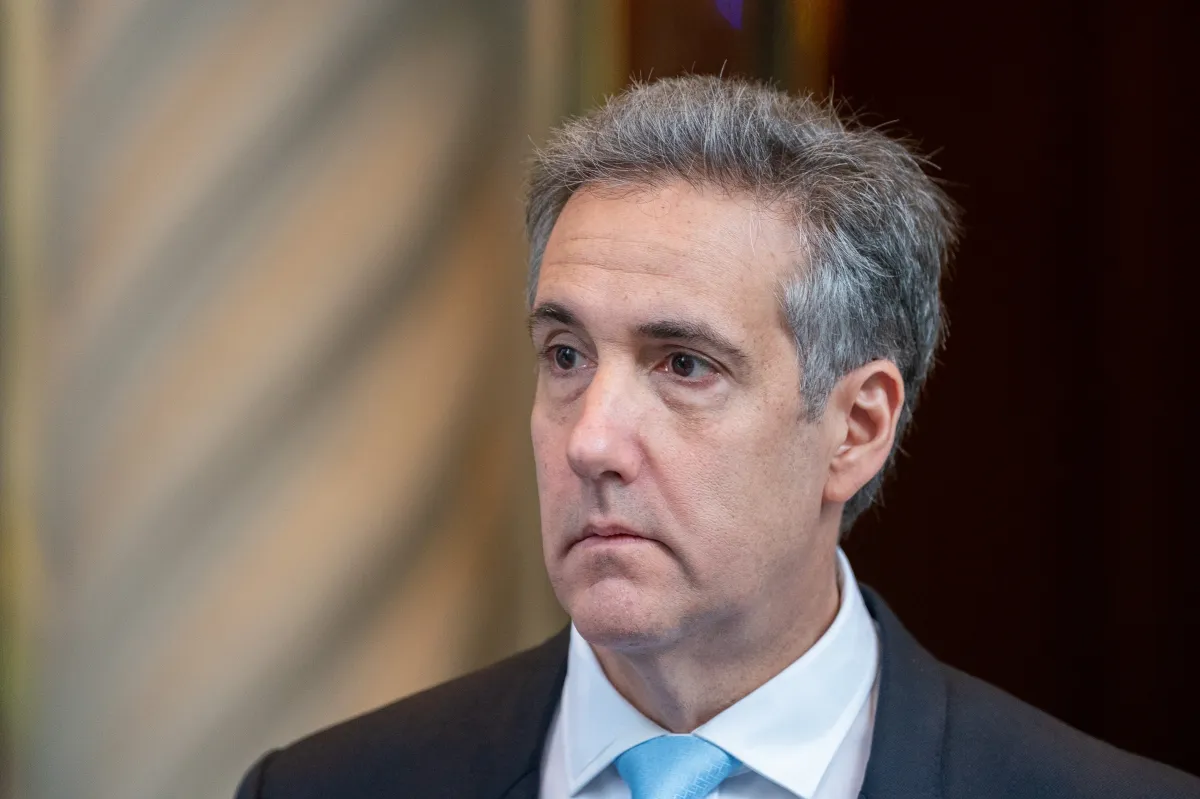
In the grand theater of modern American politics, where long-held alliances routinely fracture under the crushing weight of personal ambition and bitter feuds morph into public spectacles, few relationships have been as dramatic, volatile, and deeply personal as the one between Donald Trump and his former personal attorney, Michael Cohen. For over a decade, these two prominent figures existed in a state of fierce, symbiotic loyalty, with Cohen famously declaring that he would gladly take a bullet for the real estate mogul turned president. That loyalty shattered in the wake of intensive federal investigations, culminating in Cohen’s prison sentence, his subsequent transformation into one of Trump’s most vociferous and damaging public critics, and his star-turn testimony in the high-stakes criminal trials that have dogged the former commander-in-chief. Yet, in a political landscape that consistently defies expectations, a surreal moment of ideological alignment occurred on a quiet Sunday when Trump took to his social media platform, Truth Social, to actively amplify a Substack post written by none other than his former fixer. To the casual observer, this unexpected digital olive branch seemed practically impossible—an apparent glitch in the political matrix where two bitter, long-standing enemies suddenly found themselves standing on the exact same legal and ideological ground. By sharing Cohen’s essay, Trump did far more than merely acknowledge his former confidant’s latest writings; he embraced a deeply shared narrative of victimization, validating Cohen’s personal grievances because they perfectly mirrored his own long-standing complaints about the alleged weaponization of the American justice system. This bizarre convergence illustrates how the bitterest of personal rivalries can be put aside when there is a mutually beneficial narrative to be exploited, highlighting a fascinating chapter in the ongoing battle over political survival, exposing the deeply transactional nature of power in Washington, and showing that yesterday’s enemy can instantly become today’s strategic partner.
The core of this unexpected digital detente lies in Trump’s emphatic endorsement of Cohen’s perspective, an action that served to escalate his already fiery rhetoric against his political opponents. In his characteristically bombastic Truth Social post, Trump expressed his gratitude to Cohen and seized upon the opportunity to launch a sweeping, scorched-earth attack on the Democratic Party, accusing them of subverting federal agencies to persecute political rivals at “levels never seen before” in the history of the nation. In a chilling postscript that captured the attention of political analysts across the country, Trump declared that those responsible for this perceived weaponization “should pay the ultimate price for what they have done!!!” This extreme language, while familiar to followers of Trump’s campaign rallies and late-night social media missives, took on a more potent and complex quality when paired with Cohen’s essay, titled “The Price of Proximity.” By linking directly to an essay written by a man who had spent the last several years trying to dismantle his legacy, Trump effectively weaponized his chief critic’s own words to validate his central political thesis: that the federal government has been transformed into an instrument of partisan warfare. For Trump, the post was not an act of forgiveness or reconciliation, but rather a tactical masterstroke of self-justification. It allowed him to argue that if even his most dedicated enemy agrees that the system is corrupt and vindictive, then his own claims of being the victim of a political “witch hunt” must be indisputably true. This rhetorical maneuver showcases Trump’s unique ability to co-opt adversarial narratives and bend them to his advantage, transforming what could have been a liability into a powerful piece of propaganda designed to rally his base, deepen public distrust in democratic institutions, and demand punitive consequences for his enemies while elevating his legal disputes into a civilizational struggle.
To fully understand why Michael Cohen would write an article that so neatly aligns with Trump’s political agenda, one must examine the deeply personal and agonizing journey Cohen has traversed since his dramatic fall from grace. In his Substack essay, Cohen paints a vivid, sorrowful portrait of a man who believes he has been thoroughly ruined by a vindictive and politically motivated legal system. He describes a sustained, multi-front campaign of destruction that went far beyond his legal prosecution, engulfing his entire existence and eroding his professional standing, his business relationships, and his personal honor. Cohen laments the loss of his hard-earned law license, the collapse of his financial security, the shredding of his reputation in the court of public opinion, and the harrowing experience of serving a federal prison sentence. Crucially, Cohen frames his prosecution—which was tied to campaign finance violations, tax evasion, and lying to Congress, largely stemming from hush-money payments made on Trump’s behalf during the 2016 election—not as a standard consequence of criminal behavior, but as a uniquely targeted political hit job. He argues that he was caught in the crossfire of a toxic war between powerful political factions, ultimately serving as a scapegoat for actions orchestrated by others. “If the Anti-Weaponization Fund genuinely exists to compensate victims of politically motivated investigations,” Cohen wrote with a sense of palpable grievance, “then I believe my experience stands among the clearest examples of why such a fund should exist.” This claim transforms Cohen from a self-confessed criminal and star witness against Trump into a self-styled martyr of the bureaucratic state, presenting his suffering as the ultimate evidence of an unfair and overreaching system that owes him substantial financial and reputational restitution. By casting his downfall in the language of institutional victimhood, Cohen seeks to salvage his legacy and obtain financial compensation, validating the grievances of the very president he previously prosecuted.
At the absolute center of this bizarre convergence is the highly controversial “Anti-Weaponization Fund,” a massive financial initiative valued at approximately $1.8 billion that has recently emerged as a significant flashpoint in Washington. The origins of this behemoth fund are deeply tied to the broader legal warfare surrounding Donald Trump himself, having been established as part of a complex legal settlement stemming from a lawsuit over the unauthorized leaking of Trump’s private tax returns. According to descriptions provided by the Justice Department, the fund was ostensibly designed to serve as a mechanism of redress for individuals who can credibly claim they were targeted, harassed, or financially ruined by politically motivated investigations, malicious prosecutions, or what has increasingly been termed “lawfare.” The mechanics of the fund are as unprecedented as they are controversial, promising not only substantial monetary payouts to offset legal fees and lost income, but also formal, written apologies from the federal government itself—an extraordinary admission of administrative guilt. For supporters of the initiative, the fund represents a necessary and long-overdue check on the unchecked power of federal law enforcement and intelligence agencies, offering a lifeline to citizens who lack the immense resources required to defend themselves against the bottomless coffers of the state. However, critics view the fund with deep suspicion, characterizing it as a highly partisan slush fund designed to reward political loyalists, rewrite the history of legitimate criminal investigations, and dismantle the credibility of the Department of Justice by institutionalizing the narrative that its past actions were corruptly motivated. This tension transforms the fund from a simple pool of settlement money into a highly potent political battlefield, where the very definitions of accountability, state power, and victimization are being actively contested by various factions vying for control over the federal bureaucracy, highlighting just how deeply institutional credibility has eroded as money becomes a weapon to rewrite factual legal histories.
The creation and potential execution of such a massive and legally ambiguous fund have sent shockwaves through the American political and legal establishments, drawing intense scrutiny and raising profound ethical questions from observers across the ideological spectrum. Even within the Republican Party, which historically critiques government overreach, the fund has provoked deep anxiety and open skepticism from prominent conservative lawmakers and legal scholars. Critics point out the staggering lack of transparency and the absence of clear, objective criteria for determining who qualifies as a legitimate “victim” of government weaponization. They warn that without strict oversight, the fund could easily degenerate into a taxpayer-funded tool for political patronage, allowing whoever controls the executive branch to hand out multi-million-dollar rewards and clearinghouse apologies to their disgraced allies, political donors, and key co-conspirators. The legal challenges mounting against the fund reflect a fundamental concern about the separation of powers and the erosion of the rule of law, as opponents argue that using public funds to compensate individuals convicted of actual crimes—even if those crimes are perceived to have political undertones—undermines the entire foundation of the American judicial system. Humanizing this systemic debate reveals a deeper, more troubling reality: that the very existence of the fund signifies a profound collapse of public trust in the impartiality of our nation’s most critical institutions. When citizens can no longer agree on whether a criminal prosecution is an act of justice or an act of political warfare, the social contract itself begins to unravel, leaving behind a cynical landscape where justice is no longer seen as a blind pursuit of truth, but as a transactional prize to be won, bought, or compensated by the faction currently holding the reins of power. This institutional decay turns technical legal debates into existential questions about the legitimacy of democracy in the public eye.
Ultimately, this extraordinary moment of alignment between Donald Trump and Michael Cohen serves as a compelling and highly ironic case study in the nature of modern political survival and the transactional reality of Washington power dynamics. Here are two men whose bitter personal warfare has played out on the global stage for years, with Cohen dedicating his post-prison life to exposing Trump’s alleged misdeeds, and Trump repeatedly lambasting Cohen as a liar, a rat, and a disgraced felon. Yet, the moment their individual interests intersected around the promise of a $1.8 billion fund, the personal hatred was temporarily set aside in favor of mutual opportunism. For Cohen, endorsing the fund was an opportunity to seek financial redemption and cast himself as an innocent victim of a broken system; for Trump, amplifying Cohen’s endorsement was a golden opportunity to prove that even his fiercest detractor agrees that the government has been weaponized against its citizens. This convergence highlights a broader, deeply human truth about our current political moment: that in the arena of high-stakes politics, personal animosity is secondary to the preservation of self-interest and the power of a shared grievance. As the legal battles over the anti-weaponization fund continue to unfold in the halls of Washington, the bizarre alliance between the former president and his ex-fixer will stand as a testament to an era where the lines between friend and foe, victim and perpetrator, truth and fiction have become so entirely blurred that even the bitterest of enemies can find common ground in the shared pursuit of vindication, restitution, and political survival at any cost. This strange chapter reminds us that in the theater of modern leadership, alliances are rarely written in stone, but are instead constantly redrawn on the shifting sands of political utility, rendering the terms of loyalty entirely temporary and deeply transactional.