


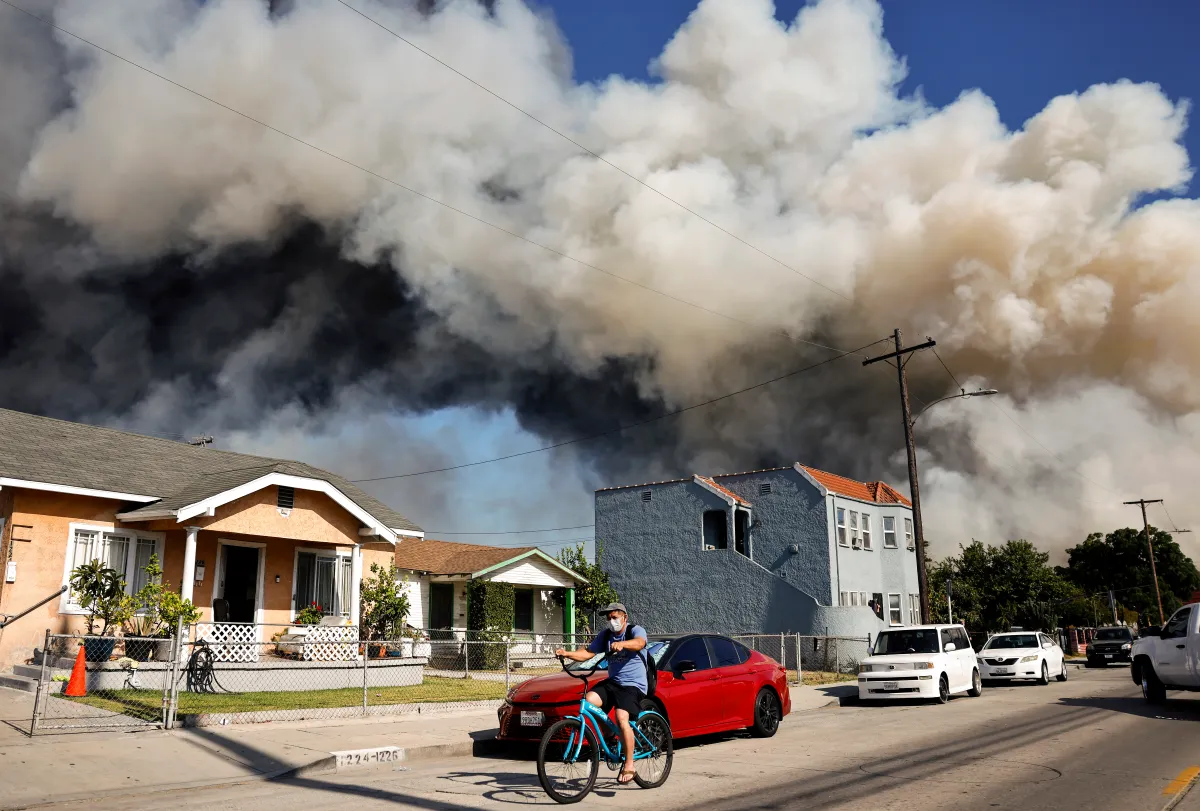
For days, a heavy, acrid blanket of smoke has hung over the Eastside of Los Angeles, transforming the vibrant neighborhood of Boyle Heights into a designated disaster zone and leaving thousands of residents deeply concerned for their health and safety. What began on Wednesday afternoon as a localized industrial fire at a cold-storage warehouse at 1400 S. Los Palos Street has steadily mutated into a protracted environmental and public health crisis. The fire quickly escalated, breaching critical utility lines and blanketing surrounding neighborhoods in a persistent, toxic fog that prompted Governor Gavin Newsom and Los Angeles Mayor Karen Bass to officially declare states of emergency over the weekend. This official designation unlocks vital state and local resources, but for the families living in the immediate shadow of the smoldering facility, the disaster is measured not in policy declarations, but in the stinging of their eyes, the tightness in their chests, and the inescapable scent of burning plastic and decaying organic matter that has seeped into their living rooms.
The emotional and physical toll on the Boyle Heights community has been profound, highlighting the historic vulnerabilities of a working-class neighborhood that has long borne the brunt of industrial pollution. As the smoke continues to drift across freeway corridors and residential pockets, local leaders have voiced the collective anxiety of an exhausted populace who feel trapped inside their own homes. Councilmember Ysabel Jurado, who represents the affected area, gave voice to these fears, emphasizing that this is far more than a routine firefighting operation; it is a direct disruption to the human fabric of the community. For days, families have navigated strict shelter-in-place advisories, unable to let their children play outside, walk to local parks, or even open their windows for a breath of fresh air. In response, city and community organizations have mobilized to distribute high-grade N95 and P100 respirators, along with residential air purifiers, to help families combat the hazardous, microscopic particles settling over their streets, cars, and playgrounds, highlighting a stark reality where clean air has temporarily become a commodity delivered in emergency boxes.
The mystery surrounding how the fire ignited in the first place has only added to the neighborhood’s frustration, especially as details emerge suggesting this disaster might have been entirely preventable. While fire investigators cannot safely enter the unstable structure to pinpoint the official cause, the building’s tenant-operator, Lineage Logistics, has pointed to rooftop solar panel testing being conducted by subcontractors as the likely origin. The revelation has struck a painful nerve with locals, as this exact same solar-paneled roof caught fire just months earlier in August 2024. During that previous incident, firefighters were able to contain the flames within an hour, preventing any major injuries or widespread panic. The catastrophic failure of the systems on the exact same roof just a few months later raises urgent, unsettling questions about industrial oversight, contractor accountability, and the safety protocols of placing massive, high-voltage green energy infrastructures atop heavily insulated commercial facilities nestled so close to densely populated urban residential zones.
On the front lines of this grueling battle are the men and women of the Los Angeles Fire Department, who are facing one of the most mechanically complex and physically demanding structural fires in the city’s recent history. Fire chiefs have described a meticulously coordinated, high-stakes chess match against an invisible enemy, with crews working in continuous, exhausting shifts around the clock to cool localized hot spots buried deep beneath tons of collapsed concrete, metal roofing, and heavy solar panel debris. Because the structural integrity of the 500,000-square-foot facility has been severely compromised, firefighters cannot safely enter the building’s interior, forcing them to rely on massive aerial water drops from LAFD helicopters and specialized remote equipment to douse the flames from above. Los Angeles County Fire Chief Jon O’Brien has praised the profound bravery and stamina of the crews executing this high-risk mission, while soberly warning the public that because of the deep-seated pockets of heat trapped within the wreckage, active firefighting operations are expected to continue dragging on for the foreseeable future.
The operational challenges have been severely compounded by an array of hazardous materials that initially threatened to turn the warehouse into an active chemical weapon. In the early hours of the blaze, a ruptured high-pressure ammonia line—crucial for industrial refrigeration but highly toxic to human lungs—triggered a series of terrifying, localized explosions that forced firefighters to temporarily fall back and delay their direct assault on the flames. While specialized hazardous materials teams have since celebrated the successful, complete extraction of the remaining bulk ammonia tanks from the site, other invisible threats persist in the air. The massive freezer walls of the warehouse are packed with dense thermal polyurethane foam, which, when burned, releases highly noxious gases and particulate matter into the atmosphere, prompting a multi-day “particle pollution advisory” and forcing health authorities to warn residents that the air they breathe contains dangerous compounds that go far beyond standard wood smoke.
As the physical flames are slowly subdued, a new, stomach-churning biohazard clock is ticking inside the ruined, dark facility, which currently houses roughly 45,000 tons of frozen meats and various food products. With the facility’s massive refrigeration systems entirely destroyed and the autumn heat lingering, this immense mountain of food is rapidly warming, thawing, and beginning to rot, presenting what LAFD Chief Jamie Moore has described as the next major logistical and environmental challenge. The decomposition of tens of thousands of tons of meat threatens to produce overpowering odors, attract pests, and create liquid biological runoff, necessitating a massive, highly coordinated hazardous waste cleanup operation. Additionally, while crews managed to successfully extract around 60 industrial forklifts powered by volatile lithium-ion batteries, the larger energy-storage batteries connected to the rooftop solar array still require careful monitoring. As Boyle Heights residents look toward a long, uncertain road to recovery, this disaster serves as a sobering reminder of the complex human and environmental costs that occur when heavy industry, green technology, and urban neighborhoods collide.