


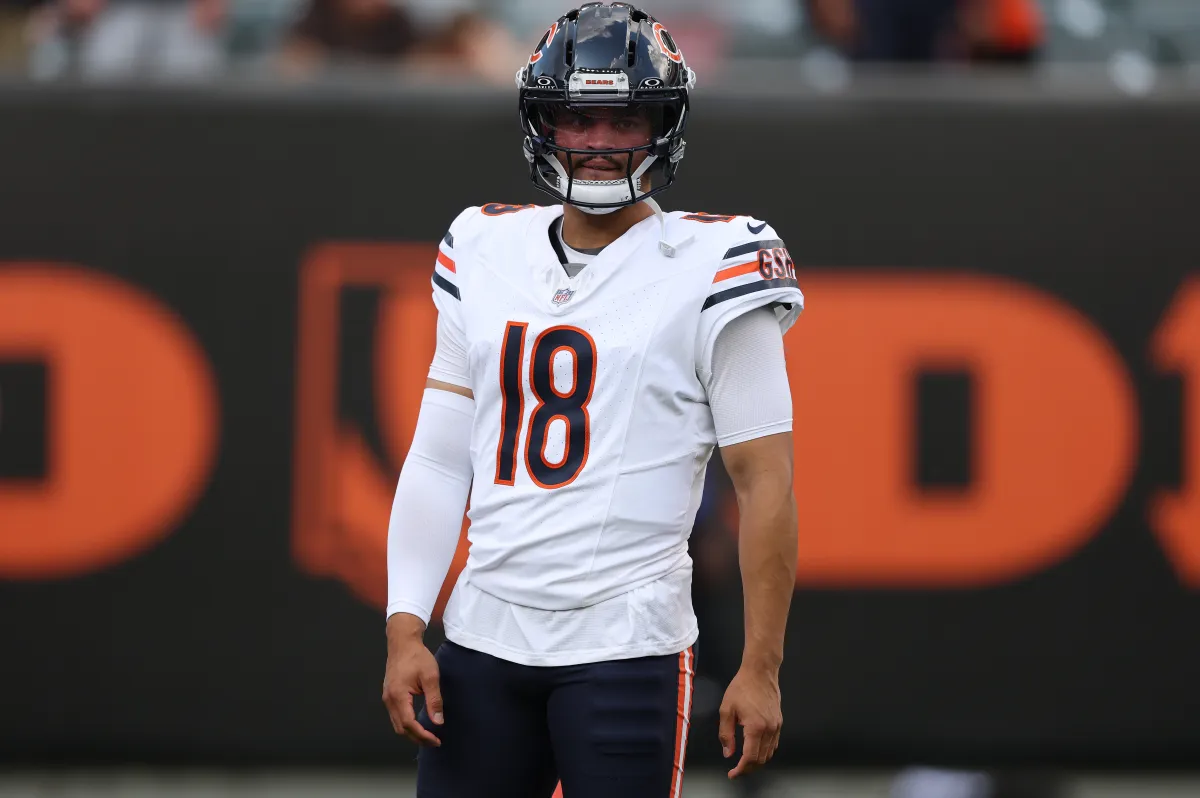
The sun beat down on the practice fields in Nashville, baking the turf and creating a heat haze that shimmered above the helmets of two NFL franchises locked in a spirited, physical joint practice. The Tennessee Titans and Chicago Bears had come together on a Thursday morning, not merely to run routine drills, but to forge a competitive edge for their upcoming preseason clash. The air was thick with the sharp barks of offensive coordinators, the rhythmic thud of shoulder pads colliding, and the electric hum of anticipation. For the Bears, this session was a critical checkpoint. Their young quarterback, Caleb Williams, was the center of attention, as he had been since the moment he was drafted. He was not just the face of the franchise; he was the embodiment of its hopes, its future, and its burning desire to return to the mountaintop of the NFL. As Williams stepped onto the field, his movements were fluid, his passes crisp, and his command of the huddle evident. He went through his progressions with a veteran’s patience, dissecting Tennessee’s defense. He threaded a needle over the middle, dropped a perfect deep ball into the bucket, and later displayed his renowned escapability, slipping out of what looked like a sure sack to scramble for a first down. It was, by all accounts, another solid practice—a continuation of a stellar offseason that had everyone in the Bears organization buzzing. But it wasn’t just the Chicago coaches who were impressed. Across the field, a familiar face in the coaching ranks was watching. Robert Saleh, the Titans’ head coach, stood with his arms crossed, his intense gaze fixed on the young signal-caller. Saleh, known for his defensive genius, was witnessing a masterclass in quarterback play, and he found himself nodding in silent approval.
As the practice session wound down, with players jogging off to cool down and position coaches packing up their clipboards, Saleh took a moment to address the assembled media. There was a buzz in the air, and reporters quickly crowded around the Titans’ head coach, desperate for a soundbite. Saleh did not disappoint. With a wry smile, he leaned forward and offered the ultimate compliment to the opposing quarterback. He called Caleb Williams a “modern day Russell Wilson.” The comparison was weighty, invoking the name of a Super Bowl-winning, future Hall of Fame signal-caller who made his name on a similar blend of raw talent, athleticism, and an almost supernatural ability to escape collapsing pockets. But Saleh wasn’t just pointing at Williams’s physical tools. He delved deeper, citing the ability to perform “in the clutch.” He elaborated on how Williams, much like Wilson in his prime, possesses a calm demeanor in the most frantic moments. When the game is on the line, when the defense knows a pass is coming, and when the pressure is at its peak, these types of quarterbacks elevate. They don’t flinch. They scan the field with icy resolve, buying time with their legs, and delivering strikes that decide the outcome. According to NFL reporter Turron Davenport, who was on the sidelines, Saleh noted that Williams’s football IQ and his intuitive feel for the pocket were uniquely reminiscent of Wilson. He marveled at how Williams could turn a broken play into a massive gain, and how he never seems to force a throw, trusting his instincts to find the open man. For a defensive-minded coach like Saleh to hand out such a comparison is not done lightly. It was a testament to the raw, unpolished yet rapidly refining greatness that Williams was showcasing. The quote rippled through the media landscape, adding another layer of hype to a player who had already been labeled a generational talent.
Saleh’s words were far from hyperbole, as the numbers from the previous season paint a stark picture of Williams’s clutch pedigree. In 2025, Williams recorded a staggering six fourth-quarter comebacks and game-winning drives, a figure that trailed only the phenomenal Bo Nix of the Denver Broncos, who had seven. To put that in perspective, those numbers denote a quarterback who not only keeps his team in games but actively wills them to victory when hope seems dimmest. The most defining moment of that stellar season came in the Wild Card round of the playoffs. Facing the division-rival Green Bay Packers, Chicago found themselves looking down an 18-point deficit in the fourth quarter. The stadium was silent, the Packers’ fans were euphoric, and the season seemed destined for a tragic, heartbreaking end. But then, the Williams show began. He stood tall in the collapsing pocket, absorbing hits that would have broken lesser men. He scrambled for crucial yards, climbed the pocket to avoid pressure, and fired laser-like passes to his receivers in tight windows. It was a masterpiece of improvisation and precision. He threw touchdown after touchdown, converting on 4th downs with the poise of a veteran, and orchestrated a miraculous comeback that left the Packers defense dazed and confused. The final drive was a clinic in late-game execution. Williams audibled at the line, checked into the perfect play, and found his receiver in the back corner of the end zone as time expired, sending the Chicago sideline into pandemonium. That game was not just a victory; it was a declaration. It announced to the NFL that Caleb Williams had arrived as a fearsome, clutch playmaker, capable of single-handedly altering the course of a game, and it cemented his reputation as the man who would wear the crown when the game hung in the balance.
With that electrifying playoff performance fresh in their minds, Williams and the Bears are riding a wave of immense positive momentum into the 2026 campaign. The front office made no secret of their ambition. Earlier this year, Ben Johnson, the newly appointed head coach of the Chicago Bears, made headlines with a bold, unapologetic proclamation: he aspired to field “the best offense in NFL history.” Johnson, who has a reputation as a brilliant offensive mind, is constructing a system designed specifically to maximize Williams’s unique skill set. The scheme is expected to feature plenty of motion, spread concepts, and intricate route combinations that will put defenses in a bind. Johnson’s vision hinges on Williams’s ability to process information quickly and to make explosive plays both from the pocket and on the move. The addition of key playmakers in the offseason—whether through the draft or free agency—has added layers of weaponry around the quarterback. The offensive line was reinforced to give Williams more clean pockets, while the skill positions were stocked with speed and size. The sheer ambition of Johnson’s goal is enough to raise eyebrows, but listening to Williams speak about it, there is a palpable confidence. He embraces the challenge, viewing it not as pressure, but as an opportunity to etch his name into the record books. The connection between player and coach is electric, with daily film sessions turning into passionate debates about defensive coverages. The Bears are no longer a team just hoping to compete; they are a team building a juggernaut, and Williams is the driving force behind that construction. The 2025 statistics, the dramatic comeback, and Saleh’s glowing praise have all coalesced into a perfect storm of expectation that has Chicago fans dreaming of Super Bowls.
All of this building anticipation will come to a head in the very first game of the 2026 regular season. The Bears will open their schedule with a Week 1 matchup against the Carolina Panthers on Sept. 13. This game is more than just a season opener; it is a statement of intent. It is the first tangible look at the “Johnson-Williams” offense against a real, hungry defense that has been scheming all offseason. The Panthers, coming off their own rebuilding process, will be looking to play spoiler and derail the Bears’ championship train before it even leaves the station. The atmosphere at Soldier Field will be electric, a sea of navy blue and orange, with fireworks scheduled and a primetime national audience tuning in. For Williams, it is the first chance to validate all the hype that has been heaped upon him. He will step onto the field, feeling the weight of the franchise, the praise from opposing coaches like Saleh, and the lofty ambitions of his own head coach. He will also face the unrelenting pressure of the Panthers’ defensive line, who will undoubtedly try to disrupt his rhythm early. But if the past two seasons have taught us anything, it is that Williams thrives in the chaos. He does not buckle under the weight; he lifts it. The game plan will likely feature a mix of quick throws to neutralize the pass rush, mixed in with deep shots downfield to test the Panthers’ secondary. As Sept. 13 approaches, the analysts will break down every matchup, every personnel grouping, and every tendency. But ultimately, it will come down to the quarterback wearing the Chicago uniform. And in him, they have a player who has already proven he can do the impossible.
Beyond the stats, the comparisons, and the lofty goals, there is a human story unfolding in Chicago. Caleb Williams is not just a quarterback; he is a young man who has shouldered massive expectations since he was a teenager, and he has met them with grace and relentless work ethic. The comparison to Russell Wilson, while flattering, is also a reminder of the legacy Williams is chasing. He wants to win championships, not just individual accolades. He wants to be remembered as a leader who galvanized a city, who turned a franchise around, and who brought the Lombardi Trophy back to Chicago. During the joint practice, as he chatted with young fans on the sideline after the session, signing autographs with a warm smile, you could see the humility beneath the superstar veneer. He understands that the journey is long and filled with pitfalls. He spoke to the media about the importance of staying connected with his teammates, of weathering the storms of a grueling season, and of enjoying the process rather than just the outcome. The Titans’ coach saw the football player; the fans see the superstar; but the teammates see the person who never stops grinding, who is the first one in the building and the last one to leave. As the Bears gear up for the Panthers, and as the 2026 season promises to be a rollercoaster ride, one thing is certain: Caleb Williams has embraced his destiny. The praise from Robert Saleh will fuel his confidence, the memories of the Packers comeback will steel his resolve, and the vision of Ben Johnson will guide his execution. All that is left is to play the game. On Sept. 13, when the ball is kicked off, the narrative will finally shift from potential to reality. And if the past is any indication, the NFL should be prepared for a spectacular show, led by the man who is indeed the modern-day reference for clutch, for escapability, and for sheer will to win. The era of the Chicago Bears has arrived, and at its heart stands a quarterback who refuses to be ordinary.