




The modern professional golf landscape is often criticized for its clinical, statistics-driven nature, where players can sometimes resemble fine-tuned machines rather than flesh-and-blood athletes. Yet, when the sun began to dip below the horizon on Saturday evening at TPC Craig Ranch during the third round of the CJ Cup Byron Nelson, the air was thick not with algorithms, but with raw, unadulterated human drama. At the center of this swirling theatrical display sits South Korea’s Si Woo Kim, who holds a tense, two-shot lead at an astonishing 21-under par heading into Sunday’s highly anticipated final round. For Kim, this tournament has been a masterclass in maintaining composure while the rest of the field breathes down his neck, hoping for even a momentary lapse in his concentration. The pristine, manicured fairways of McKinney, Texas, have played incredibly soft and forgiving all week, transforming the course into a high-stakes birdiefest where standing still is equivalent to falling behind. Maintaining a lead in such an environment requires a rare blend of psychological stoicism and aggressive execution, as a two-shot cushion can evaporate in the span of a single hole. As the galleries swelled and the cheers echoed across the par-sevens, the stage was officially set for a dramatic Sunday showdown that promises to test the absolute limits of human nerve, skill, and emotional endurance, reminding everyone why we watch this beautiful, agonizing game.
To understand the magnitude of Si Woo Kim’s position, one must look at the sheer volatility of his journey over the last forty-eight hours, which perfectly highlights the erratic emotional spectrum of elite-level golf. On Friday, Kim captured lightning in a bottle, carding a breathtaking, career-defining 11-under-par round that essentially dismantled the course and established him as the man to beat. It was a day where every bounce went his way, every putt found the center of the cup, and the game seemed ridiculously, almost unfairly, simple. However, the true test of a champion rarely lies in the moments of effortless perfection; rather, it is found in the grueling aftermath, when the ecstasy of a historic round fades and the cold reality of protecting a lead sets in. On Saturday, Kim showed a different, perhaps even more impressive side of his athletic character by grinding out a steady 3-under-par round. On a day when the course was yielding low scores to anyone willing to take risks, Kim had to battle his own expectations, resisting the urge to force the issue while watching his competitors chip away at his lead. This transition from the flamboyant, unrestrained golf of Friday to the disciplined, highly calculated strategy of Saturday is a testament to Kim’s growth as a competitor. He has evolved from a volatile teenage prodigy who once won the Players Championship at just twenty-one years old into a seasoned, battle-hardened veteran who understands that golf trophies are won with patience just as much as they are won with spectacular shot-making.
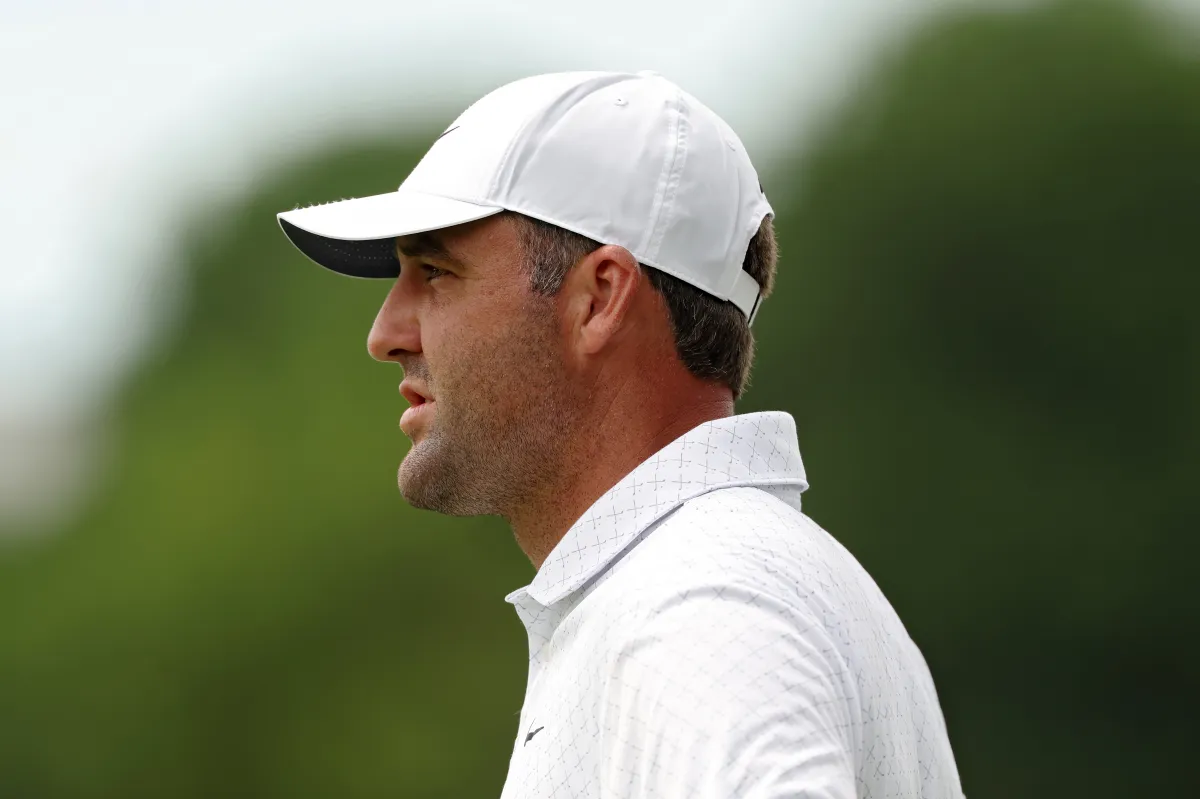
Hovering ominously just behind the South Korean leader is none other than Scottie Scheffler, the local hero and defending champion whose presence alone is enough to make any frontrunner feel a sudden chill. Scheffler, who has taken the golfing world by storm with his relentless consistency and nonchalant brilliance, carded a clinical 6-under-par round on Saturday to position himself in what will likely be the final pairing on Sunday. This puts Scheffler on the absolute precipice of a rare and deeply prestigious slice of golf history, one that speaks directly to his era-defining dominance. According to the PGA Tour, if Scheffler manages to hunt down Kim and claim the trophy on Sunday, he will become the first player since Tiger Woods in 2007 to successfully defend a tournament championship after winning the previous year’s iteration by eight strokes or more. Woods achieved this monumental feat at the WGC-Workday Championship at The Concession, a milestone that has since stood as a testament to the near-impossible task of backing up a historical blowout with another victory. To put Scheffler’s past performance into perspective, his historic eight-stroke victory at last year’s Byron Nelson was not merely a personal best; it was the second-largest margin of victory in the tournament’s long and illustrious history, trailing only the legendary Sam Snead’s mythical ten-shot win back in 1957. Watching Scheffler navigate the course with his characteristic foot-sliding swing and unshakeable poker face, one gets the sense that we are witnessing a player operating in a completely different mental atmosphere, free from the self-doubt that plagues ordinary mortals.
Should Scheffler pull off this historic comeback on Sunday, it would also secure the fourth successful title defense of his rapidly expanding career, putting him in a stratosphere reserved only for the game’s immortal legends. He has already proven his unique ability to conquer familiar territory by repeating as champion at some of the PGA Tour’s most prestigious venues, including the iconic Players Championship at TPC Sawgrass, the chaotic and energetic WM Phoenix Open, and Jack Nicklaus’s crown jewel, the Memorial Tournament. This remarkable track record of defending titles reveals something profound about Scheffler’s psychology: he is a player who thrives under the pressure of expectation, refusing to let the weight of past success anchor his current ambitions. While many athletes experience a natural competitive hangover after a major victory, Scheffler seems to treat past triumphs merely as proof of concept, returning to the scene of his greatest moments with a renewed hunger rather than complacency. His pursuit of Tiger Woods’ 2007 blueprint is not just a statistical anomaly; it is a living demonstration of modern golf’s highest standard of excellence. For the thousands of fans lining the fairways in Texas, Scheffler represents the ultimate hometown favorite—a quiet, family-first individual who transforms into an absolute assassin once he steps inside the ropes, making his chase of Si Woo Kim the defining narrative of the weekend.
Yet, this tournament is far from a two-man match play event, as the leaderboard is crowded with elite talent hungry for their own moment of glory. Tied with Scheffler in second place is Wyndham Clark, the reigning U.S. Open champion who has rapidly developed a reputation as a fearless big-game hunter. Clark possesses an aggressive, athletic style of play that can easily dismantle a course like TPC Craig Ranch when his putter heats up, and his presence alongside Scheffler in the chase pack creates a highly volatile dynamic for the final round. Additionally, a trio of immensely talented golfers sits tied for fourth place at 17-under par, lurking just four shots back and fully poised to capitalize on any mistakes made by the lead groups. In a sport where a four-shot deficit can be made up in the span of three holes, these chasers represent a constant, invisible pressure weighing on the minds of Kim, Scheffler, and Clark. The human element of this pursuit is fascinating; it is a high-speed game of chicken where the leader must decide whether to play defensively to protect their margin or continue attacking pins to keep pace with the inevitable flurry of birdies behind them. Every swing on Sunday will be microscopic, analyzed by millions of viewers who understand that the difference between a life-changing victory and a disappointing runner-up finish often boils down to a single blade of grass or an unexpected gust of wind.
Ultimately, Sunday at the CJ Cup Byron Nelson is shaping up to be a beautiful celebration of everything that makes golf the most psychologically punishing and rewarding sport on earth. It is a canvas where different human stories collide: Si Woo Kim’s quest to prove that his brilliant, explosive talent can withstand the ultimate pressure; Scottie Scheffler’s date with destiny as he attempts to walk in the historical footsteps of Tiger Woods; and Wyndham Clark’s desire to assert himself as the premier closer of his generation. As these athletes make their final preparations, checking their yardage books and visualizing their targets, they are acutely aware of the ghosts of the past that hover over this tournament, from the elegant legacy of Byron Nelson himself to the legendary scoring feats of Sam Snead. When the final pairing finally steps onto the first tee, the statistics, the history books, and the technical talk of launch monitors will fade into the background, leaving only the quiet, intense reality of human competition. It is a drama written in real-time under the hot Texas sun—a test of who can keep their heart rate the lowest, who can trust their swing when their hands are shaking, and who can summon the courage to seize glory in front of a roaring crowd. No matter who walks away with the trophy, the journey to the eighteenth green promises to be a thrilling, deeply human spectacle that will live long in the memory of golf fans worldwide.