





When Katelynn Smoot looks back at old family videos of her daughter Lilah captured before her life-altering diagnosis, the images stir a complex mixture of profound gratitude and sharp heartbreak. They serve as a poignant, digital time capsule of a lost era—a time when Lilah was simply a happy, carefree toddler, her bright eyes and easy smiles untainted by the complex world of pediatric oncology. The transition from that picture-perfect, normal life to the terrifying reality of life-threatening illness happened with a shocking, disorienting speed that still leaves her family breathless. It began on a day that was supposed to be defined solely by celebration and new beginnings, a day meant to be one of the happiest milestones in the Smoot family’s history. Katelynn and her husband, Tyler, were settled in their local hospital room, eagerly anticipating the birth of their new son, William. But as Katelynn endured the physical and emotional threshold of labor, an unsuspected, silent emergency was unfolding miles away at home. Unbeknownst to the expectant parents, Lilah suddenly suffered a severe, unprovoked seizure around eight o’clock that morning while under the watchful care of her doting grandmother. Rushed by ambulance to the emergency room in a flurry of panic and flashing lights, the medical team quickly ordered an urgent CT scan to peer inside the toddler’s head. What they discovered was a dark, shadow-like mass resting within the delicate tissues of her brain. Back at the birth hospital, Katelynn had successfully delivered baby William, wrapping him in her arms and basking in the brief, beautiful glow of new motherhood. The devastating news of her daughter’s condition remained withheld until about noon, when their pediatrician gently stepped into the hospital room with a solemn expression, waiting until doctors had a clearer understanding of what had triggered Lilah’s sudden neurological crisis.
The agonizing realities of the situation unfolded rapidly as Lilah was transferred to a nearby specialized children’s hospital, a transition that required a brief, tearful detour to her mother’s hospital room so the toddler could meet her brand-new baby brother, William, for the very first time. Underneath the joy of that sibling introduction lay an undercurrent of mounting dread; Katelynn, still physically recovering from childbirth, was thrust into a state of profound psychological shock. In her heart, she had never imagined that her energetic, seemingly picture-healthy toddler was harboring a life-threatening illness, as Lilah had shown absolutely no clinical symptoms, physical developmental delays, or classic signs of a brain tumor prior to that fateful morning. Once admitted to the pediatric oncology ward, an advanced MRI scan confirmed their worst fears: the mass in Lilah’s brain was an incredibly aggressive, fast-growing tumor that required immediate, highly precise surgical intervention. Just one week after her first seizure, the tiny girl was wheeled into a cold operating room for a grueling, high-stakes three-hour brain surgery to resect the tumor. The subsequent pathology results delivered a devastating blow, confirming that the growth was malignant. Soon after, the family received a formal diagnosis of an atypical teratoid rhabdoid tumor, commonly referred to as ATRT. This incredibly rare, exceptionally aggressive, and rapidly multiplying cancer of the central nervous system usually targets very young children and carries a devastating prognosis. The medical team laid out the cold, terrifying statistics: with an immediate and highly intense regiment of aggressive treatment, Lilah had a mere fifty percent chance of survival. Without it, her chances plummeted to less than one percent, leaving her parents with no real choice but to brace themselves and immediately initiate an intensive medical campaign to save her life.
What followed this grim prognosis was an incredibly brutal, physically taxing, and emotionally draining chapter of medical treatment that tested the absolute limits of Lilah’s little body and pushed her family to the brink of absolute despair. Her comprehensive therapy plan was an aggressive, multi-front onslaught designed to eradicate the rapidly dividing cancer cells before they could spread further through her central nervous system. This regimen consisted of five consecutive rounds of intense chemotherapy, three of which were exceptionally high-dose treatments that functionally wiped out her bone marrow, requiring complex autologous stem cell transplants to rescue and rebuild her severely depleted immune system. This chemical warfare was immediately followed by a grueling six-week course of daily, highly precise proton radiation therapy targeted directly at her primary brain tumor site. Throughout this relentless cycle of toxic therapies, the family existed in a state of perpetual, agonizing tension, as doctors were required to perform comprehensive diagnostic scans at the completion of each major treatment phase. The stakes of these periodic evaluations were unimaginably high: if the scans revealed even a microscopic hint of tumor regrowth or treatment resistance, the curative protocol would immediately be halted, and Lilah would be transitioned directly to comfort-oriented palliative or pediatric hospice care. In the darkest, most terrifying moments of this journey, Katelynn credits the overwhelming, unconditional support of their local community as the saving grace that kept their family anchored. Their close-knit home town mobilized in a beautiful, sweeping display of solidarity, organizing a continuous meal train for several weeks, hosting multiple local fundraisers, and placing supportive signs in the windows of local businesses to share Lilah’s brave battle with the community. This vast, compassionate network of love, prayer, and practical encouragement provided an invaluable emotional buffer, ensuring that even when confined to the sterile, highly isolated world of the oncology ward, the Smoots never felt abandoned.
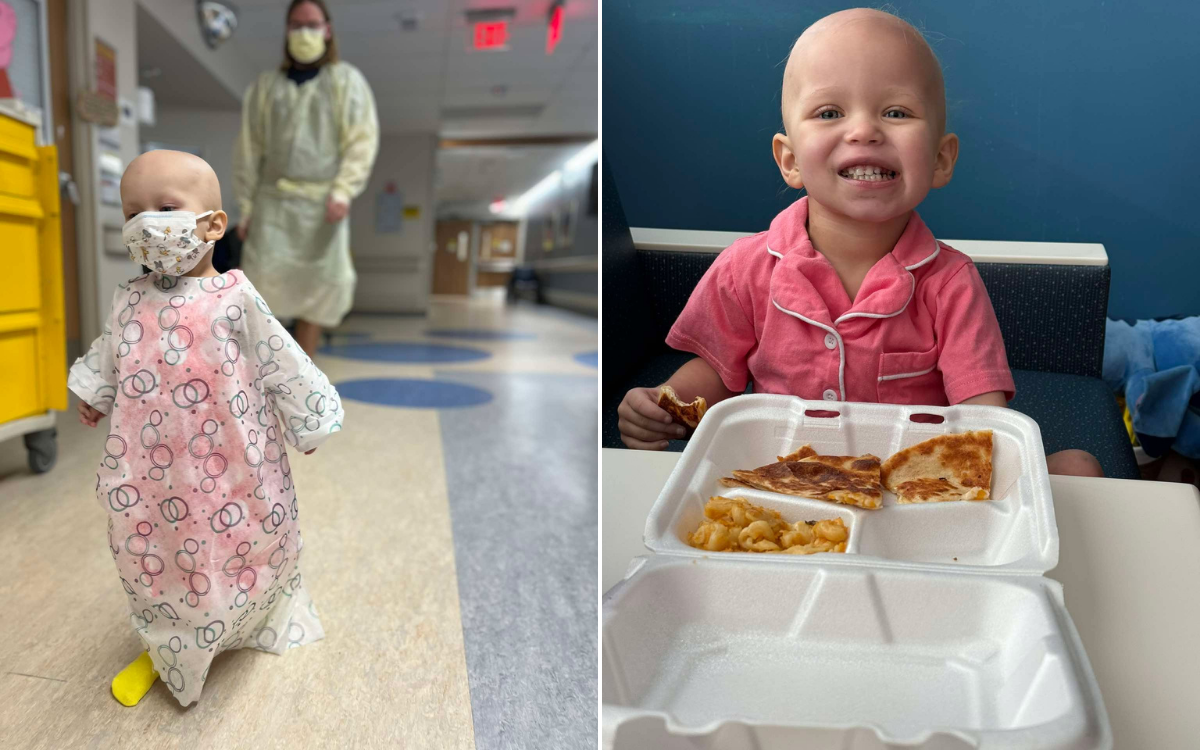
Despite the terrifying machinery, the constant alarms of infusion pumps, and the daily physical discomforts of her cancer treatments, it was Lilah’s own radiant, unbreakable spirit that served as the primary beacon of hope and strength for her weary parents. Described by her mother as a child completely full of inner light, Lilah possessed a unique, magnetic joy that naturally uplifted everyone who entered her presence, turning sterile patient rooms into places of spontaneous laughter. Watching her undergo such a traumatic physical transformation—going from a vibrant, perfectly healthy toddler to an exhausted pediatric oncology patient within the span of just two short months—was an incredibly devastating experience for Katelynn and Tyler to witness and process. Yet, as the long weeks stretched into months, the unfamiliar, high-stress rhythm of hospital life gradually transformed into a predictable routine, and the specialized pediatric medical staff transitioned from sterile clinicians into a deeply beloved family who celebrated every small victory alongside them. The hospital ward, once viewed by the terrified parents as a cold, frightening place of disease and trauma, slowly began to feel like a safe, supportive extension of their own home. Even on some of her hardest days of active chemotherapy, Lilah’s natural toddler curiosity and desire for play frequently triumphed over her physical exhaustion. She spent countless hours engaged in normal developmental activities, climbing on pediatric play structures, running down the corridors while trailing her IV pole, molding colorful shapes out of Play-Doh, and coloring beautiful pictures for her favorite nurses. Her genuine love for dancing, singing, and laughing filled the hallways with an infectious, healing energy, proving to her family that while cancer could attack her body, it could never diminish the joyful essence of her soul.
In total, Lilah’s grueling medical journey encompassed nine long months of intense, highly aggressive clinical intervention, finally reaching its formal and highly anticipated conclusion in November 2025. In the anxious, hopeful months that have followed her final treatment session, she has successfully undergone three comprehensive follow-up imaging scans, and her family has received the incredibly beautiful, deeply emotional news that there is currently absolutely no evidence of disease left in her central nervous system. While this clean bill of status is cause for immense celebration, the family must navigate the complex, lingering psychological shadow of cancer survivorship with extreme caution, as Lilah will continue to require comprehensive MRI monitoring every three months for the foreseeable future. This regular clinical surveillance is a vital but highly stressful necessity, given the exceptionally dangerous and aggressive biological nature of atypical teratoid rhabdoid tumors. As Katelynn poignantly explains, the vast majority of young children diagnosed with ATRT who experience a clinical relapse will unfortunately do so within the first two critical years following the completion of their primary treatment. Consequently, even though Lilah has successfully rung the symbolic clinic bell and returned to the comfort of her own home, her parents live with the quiet, humbling understanding that they are not yet entirely out of the woods. This persistent, underlying threat of recurrence introduces a unique form of chronic anxiety known to many cancer families as scanxiety—a heavy emotional dread that naturally builds in the weeks leading up to each quarterly hospital appointment. However, rather than allowing this fear to paralyze their daily lives, the Smoot family has resolved to face each day with courage, choosing to focus their energy on the beauty of the present moment.
At every single follow-up appointment, Lilah’s dedicated pediatric oncologist leaves the family with the exact same piece of liberating, profound advice: “Go home and make memories.” This beautifully simple directive has become the official guiding philosophy for the Smoots as they actively reclaim the precious childhood that cancer temporarily stole from their beautiful daughter, providing comfort during times of deep uncertainty. They have thrown themselves wholeheartedly into creating a lifetime of joyful experiences, taking Lilah on a series of wonderful adventures that have expanded her world far beyond sterile hospital clinic walls. She has spent magic-filled days exploring bustling regional theme parks, spent meaningful time bonding on the field with the supportive University of Pennsylvania football team, and cheered enthusiastically from the high stands at energetic Philadelphia Flyers professional hockey games, bringing immense joy to a household that has already endured so much testing pain. She regularly enjoys uninterrupted playtime with her loving extended family, has bonded with fellow brave ATRT survivors who intimately understand her unique journey, and recently returned from a magical, life-affirming Make-A-Wish trip to Orlando, Florida, where she experienced the pure wonder of Disney World and Universal Studios. By sharing Lilah’s remarkable story of survival with the public, Katelynn hopes to raise critical awareness for pediatric cancer research, emphasizing that this devastating illness is far more prevalent than most people care to recognize, as they seek to raise vital funds for lifesaving clinical trials. She deeply wants other parents to understand that childhood cancer does not discriminate; it can happen to absolutely anyone, transforming a healthy family life into a battle for survival in the blink of an eye. Her daughter’s brave journey serves as an incredibly powerful, deeply humanizing reminder to cherish the fleeting beauty of the present moment, hug loved ones tightly, and let go of trivial everyday worries that pale in comparison, reminding us all of what truly matters in this temporary life. Ultimately, Lilah’s triumphant story stands as a brilliant, enduring testament to the power of unconditional family love, unwavering community support, and the truly unbreakable spirit of a little girl who absolutely refused to let a dark shadow in her brain dim her beautiful, radiant inner light.