





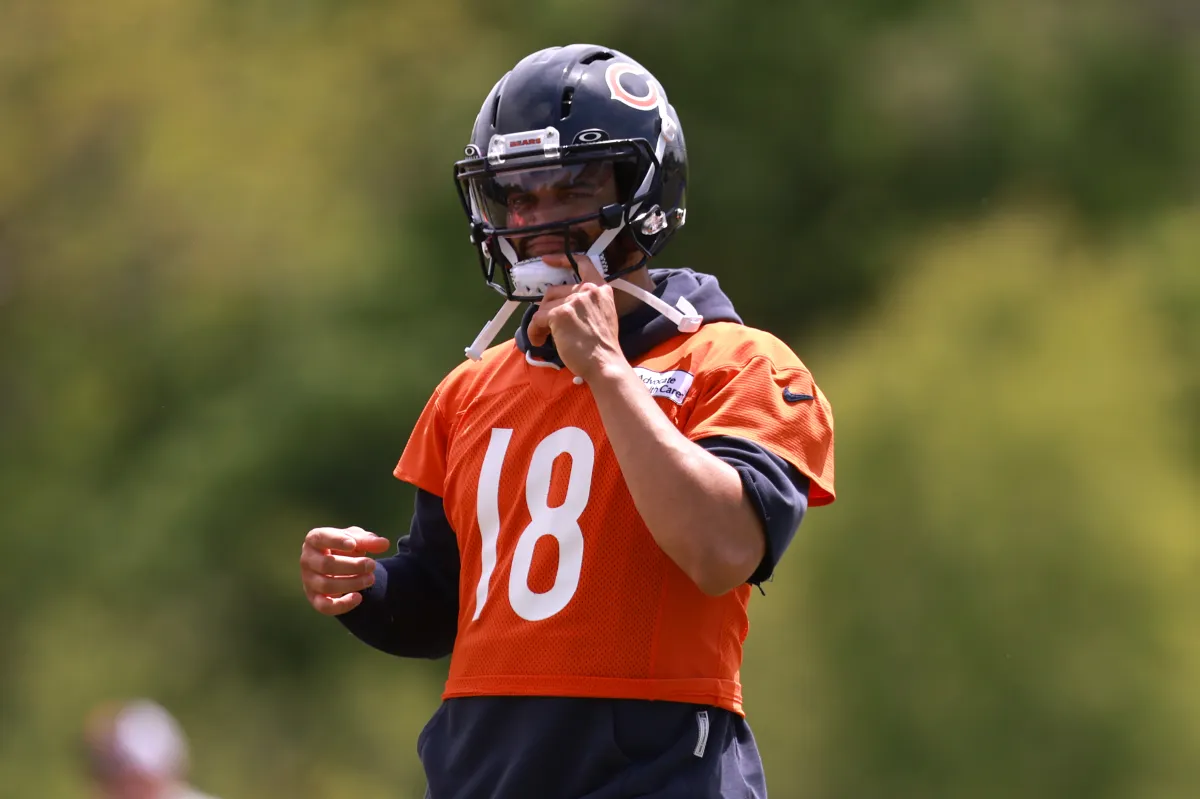
The rich, storied history of the Chicago Bears has long been anchored by legendary, bone-crushing defenses and iconic running backs, but the modern football landscape demands an entirely different breed of hero under center—a reality that young quarterback Caleb Williams is redefining with every snap. Entering just his third season in the National Football League, the charismatic signal-caller has already achieved a monumental milestone that many veterans chase for their entire careers: landing the highly coveted cover spot of Madden NFL 27. This digital coronation is a massive testament to his rapid rise to super-stardom, cementing his position as one of the most exciting, dynamic, and marketable faces in all of professional sports. However, behind the glitz and glamour of virtual video game advertisements and prime-time marketing campaigns lies a fierce, unyielding competitive drive that prevents Williams from simply resting on his laurels. Affectionately nicknamed the “Iceman” for his remarkably cool demeanor under the most intense defensive pressure, Williams has set his sights on an even more exclusive virtual honor: joining the legendary “Madden 99 Club.” This ultra-exclusive football fraternity, officially revealed to the public on an energetic Monday, is reserved solely for the absolute pinnacle of active athletic talent, featuring players who have earned a perfect ninety-nine overall rating from the video game franchise’s notoriously stingy statistical adjusters. For this upcoming virtual season, only six elite players across the entire league managed to secure this perfect score, a select group that includes established veteran quarterback superstars like Josh Allen of the Buffalo Bills and Matthew Stafford of the Los Angeles Rams. For a hyper-competitive athlete like Williams, being named the cover star while missing out on the game’s highest rating is both a massive honor and a burning motivator, reminding him that he still has a final, crucial mountain to climb before the football world recognizes him as the undisputed king of the gridiron.
During a highly engaging, candid, and lighthearted appearance on the popular sports television program “Up and Adams,” hosted by the charismatic Kay Adams, Williams opened up about his virtual rating aspirations with the characteristic confidence and deep self-awareness that have defined his early career. When Adams asked him about the specific football milestones he needs to reach for his virtual counterpart to finally cross that legendary threshold and secure a perfect ninety-nine score, Williams laid out a highly practical, execution-focused blueprint. Rather than deflecting the question with cliches, he analyzed his playstyle with surgical precision, confidently asserting that if he simply focuses on elevating his overall completion percentage, the dynamic database rating system will have no choice but to rocket him into the game’s elite tier. Showing a deep, mature understanding of his own habits under center, he emphasized his natural ability to protect the physical football from opposing defenders, declaring with absolute certainty that he strikes a balance between risk and reward, proudly stating that he is “not a pick guy.” To Williams, the mathematical formula for quarterbacking supremacy is surprisingly straightforward: maintain his incredibly disciplined turnover habits, throw a few more touchdowns in key red-zone situations, and most importantly, consistently execute the high-efficiency, short-to-intermediate throws that keep the chains moving forward. By prioritizing what he refers to as “easy completions”—the short slants, quick screens, and checkdowns that modern defensive schemes often concede to prevent the deep play—his passing efficiency will naturally skyrocket, creating a highly efficient offensive rhythm that will force the electronic ratings adjusters to finally bestow upon him the ultimate rating. This analytical approach highlights a player who understands that greatness in the modern NFL is not just about making the flashy, highlight-reel circus throws, but about mastering the mundane, high-percentage elements of the position that slowly wear opposing defenses down over four quarters.
Looking closely at the cold, hard statistics of his highly publicized sophomore campaign, one can easily see why the young Chicago quarterback is focusing so intensely on his passing efficiency as the primary metric for his personal and professional development. While leading the Bears through a truly spectacular, narrative-defying regular season that captured the imaginations of sports fans across the country and culminated in a hard-fought playoff run, Williams saw his statistical completion percentage experience a noticeable sophomore dip. After completing a highly respectable sixty-two point five percent of his passes during his rookie year, that number slid down to fifty-eight point one percent during his second season under center. However, this minor statistical regression in objective accuracy did not prevent him from showcasing his immense arm talent, leadership skills, and clutch playmaking ability, as he fell just eighty yards shy of the coveted four-thousand-yard milestone while throwing twenty-seven touchdowns against a remarkably disciplined seven interceptions. This highly impressive ratio of touchdowns to turnovers perfectly aligns with his self-described identity as a careful, calculating passer who refuses to gift-wrap game-changing opportunities to opposing defensive coordinators. As he prepares to enter his highly anticipated third year in the league, the developmental challenge for the young quarterback is remarkably clear: he must find a way to successfully marry his spectacular, field-stretching deep shots with the rhythmic, high-completion efficiency that distinguishes elite pocket-passing legends from volatile, high-turnover gunslingers. By focusing on his footwork in the pocket, developing a quicker internal clock, and taking what the defense gives him, he can easily raise that completion rate back above sixty-two percent, transforming the Chicago passing game into a highly efficient, unstoppable offensive machine that can easily control the tempo of any game.
Fortunately for Williams, his journey toward statistical perfection and tactical mastery on the field does not have to be traversed alone, as his development is being carefully nurtured within an incredibly stable and highly supportive coaching environment. The upcoming season marks his second consecutive year operating under the offensive guidance of head coach Ben Johnson, a brilliant, innovative football mind whose creative schematics have allowed the young quarterback’s natural playmaking instincts to truly flourish on Sundays. This continuity is a rare luxury in today’s micro-managed NFL, where coaching staffs are constantly shuffled, forcing young signal-callers to learn entirely new playbooks year after year. The profound bond of mutual respect, shared ambition, and open communication between the mastermind play-caller and his franchise quarterback was perfectly illustrated by a heartfelt, private exchange they shared right before the onset of the offseason program. As Williams prepared to leave the team facilities for a well-deserved period of rest, Coach Johnson pulled him aside to ask a simple, humble, yet deeply profound question: “Is there anything you need from me to be better for you?” Without missing a single beat, the passionate young quarterback gave a response that perfectly encapsulated his relentless work ethic and insatiable desire for greatness, simply telling his head coach, “Nope, just keep pushing me.” This brief, powerful dialogue speaks volumes about the incredible culture of real accountability and continuous improvement they have established in the Chicago locker room, proving that Williams does not want to be coddled or protected by his coaching staff. Instead, he actively craves the constructive, hard-nosed friction, demanding standards, and relentless pressure that force young, highly skilled athletes to shed their mechanical flaws and adapt to become legendary, championship-carrying leaders of men.
To help Williams actualize his ambitious offensive goals and systematically inflate his completion percentage, the Chicago Bears front office has worked tirelessly behind the scenes, surrounding him with a young, dynamic, and incredibly versatile group of offensive playmakers. Although the franchise made a massive, high-profile business decision by trading away star wide receiver DJ Moore this past offseason—a high-stakes move that initially shocked the passionate, loyal fanbase—the metaphorical cupboard is far from bare in the Windy City. The offense is poised to lean heavily on the explosive growth of emerging young stars like dynamic, route-running receivers Luther Burden III and Rome Odunze, who have already shown incredible chemistry with Williams, alongside the highly reliable, field-stretching capability of athletic tight end Colston Loveland. Furthermore, the front office injected fresh, highly motivated talent into the passing game through the NFL draft, onboarding highly touted Stanford tight end Sam Roush to provide a reliable, physical security blanket in the middle of the field, as well as explosive LSU wide receiver Zavion Thomas to add game-changing vertical speed. This masterfully constructed ensemble of deep-threat pass-catchers and reliable intermediate routers gives Williams a highly diverse array of physical archetypes to distribute the ball to, ranging from big-bodied possession targets who excel at making contested catches in traffic, to agile, lightning-quick route-runners who easily create yards of separation on quick slants. With such a robust, talented, and incredibly hungry supporting cast at his disposal, the historically familiar Chicago excuse of having a lack of reliable downfield targets is completely off the table, and the operational burden now falls squarely on the shoulders of the young quarterback to deliver the ball in stride and let his playmakers work.
As the highly anticipated NFL regular season looms on the horizon, the entire sports world is eagerly waiting to see whether Caleb Williams and the Chicago Bears can capture lightning in a bottle for a second consecutive year or if they will face the hurdles of heightened expectations. Their truly magical, narrative-defying playoff run last season, which saw them defy all external predictions to come within striking distance of the prestigious NFC Championship Game, has set a brand-new, incredibly high standard of success for this historic franchise. Fans and seasoned football analysts alike are locked in a fierce debate over whether this young squad will build upon this incredible momentum to establish themselves as legitimate, long-term Super Bowl contenders, or if they will suffer a slight regression under the crushing weight of heightened expectations and a much tougher schedule. While absolute certainty is a luxury that mock drafts and preseason predictions can never truly provide, one thing remains pressure-tested and undeniably clear: the unique combination of raw physical talent, mental fortitude, and fierce determination possessed by Williams makes the Bears one of the most compelling, must-watch teams in the entire league. Whether or not he ultimately secures that elusive perfect ninety-nine rating in the virtual world of Madden, the real-life football magic that the “Iceman” is currently cooking up in Chicago promises to deliver an unforgettable, high-stakes spectacle that will keep football enthusiasts thoroughly entertained for years to come. Ultimately, it is this relentless personal pursuit of perfection, both under the bright stadium lights and on the virtual screen, that cements Williams as a truly unique modern athlete destined to leave an indelible, lasting legacy on the game.