






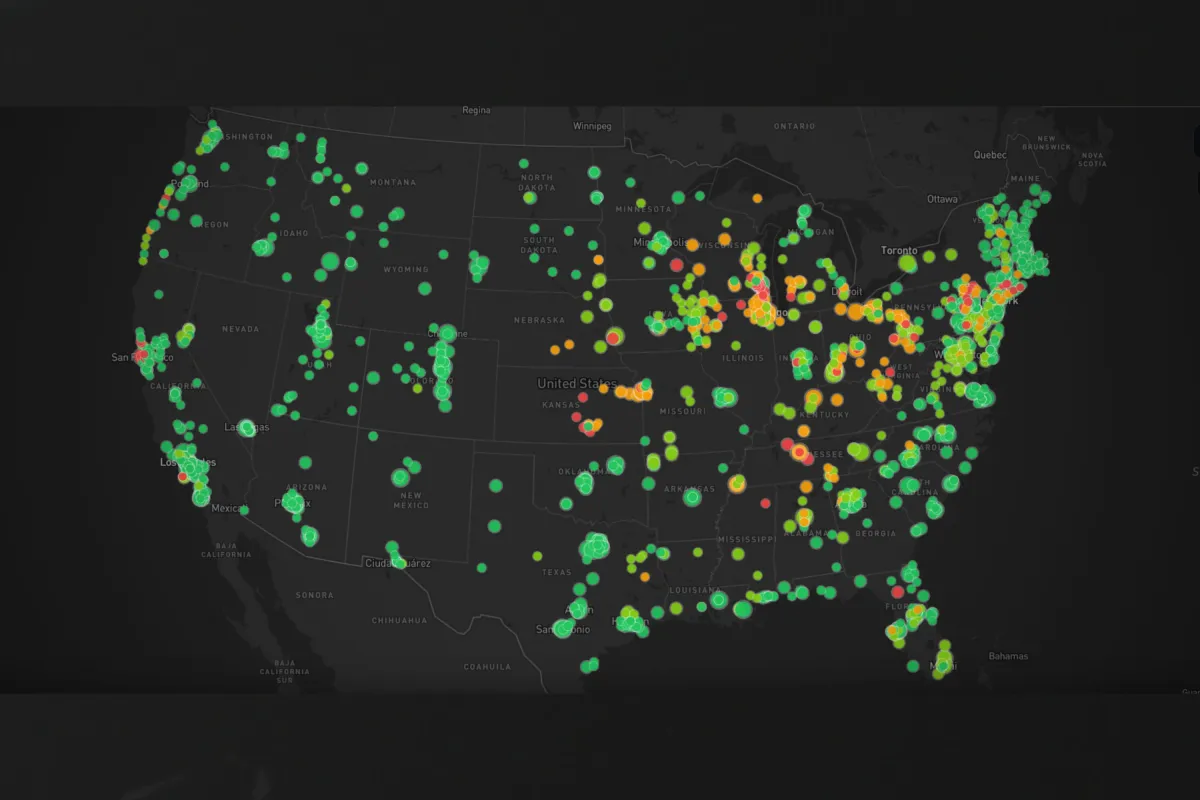
As millions of Americans prep their lawn chairs and sparklers for Independence Day, there is always one uninvited guest that can ruin the festivities: the weather. To take the guesswork out of the holiday, Tomorrow.io has rolled out an interactive forecast map tracking more than 2,000 major fireworks displays across the United States. This tool is highly relevant to the public, given that nearly half of all American adults regularly attend professional shows, while roughly a third prefer to light their own. The clever tracker analyzes localized conditions like storm risks, cloud ceiling heights, smoke dispersion, fire hazards, and even the exact minute of darkness to help families plan their perfect viewing spots.
Behind the scenes of this project is Cole Swain, a senior vice president at Tomorrow.io, who explains that evaluating fireworks weather is surprisingly complex. It is not just about avoiding a sudden cloudburst; organizers and viewers must consider whether low-hanging clouds will swallow up high-flying shells, or if lingering smoke will settle into a thick, blinding haze. Moreover, with intense summer heat waves parching vegetation across regions like Colorado, Swain reminds us that every firework is essentially a small fire launched into the sky. Understanding localized wind patterns and fire risks is therefore crucial, not only for catching a beautiful show but also for ensuring public safety in dry, wildfire-prone areas.
Looking at some of the nation’s biggest celebrations, the forecast brings mostly excellent news for East Coast spectators. In New York City, the iconic Macy’s 4th of July Fireworks are fully on track, with clear, crisp skies promised for a bright and unobstructed show. It is a similarly smooth story up north for the Boston Pops Fireworks Spectacular, where forecasters expect absolutely zero atmospheric interference, allowing the vivid colors to pop brilliantly over the Charles River. Meanwhile, the nation’s capital is also looking at a green light; the “A Capitol Fourth” celebration in Washington, D.C., faces very low cancellation risks, guaranteeing a sharp and patriotic display against the night sky.
The outlook is slightly more tense, however, for music and fireworks lovers heading to Nashville’s “Let Freedom Sing!” event. Meteorologists warn that active summer weather is creeping dangerously close to the Music City, meaning the showtime window is under threat, and spectators should prepare for potential delays or sudden cancellations. The silver lining is that if the storms do hold off, the atmospheric conditions behind them will be incredibly clean, making the pyrotechnics look extraordinarily punchy and vivid against a pitch-black canvas. As the holiday approaches, local organizers are keeping a very close eye on the encroaching radar.
Stepping back to look at the broader national picture, AccuWeather forecasters warn that a massive heat dome is anchoring itself across much of the central and eastern U.S., dragging temperatures well above seasonal norms. As the holiday weekend stretches on, the most punishing and dangerous heat will migration toward the northern Rockies and the interior West, escalating wildfire risks. Concurrently, a sprawling band of stormy weather is projected to stretch all the way from Colorado and New Mexico, cutting across the Deep South to Florida, and creeping northward up the Atlantic Seaboard.
To add to the atmospheric drama, meteorologists are also keeping a watchful eye on potential tropical developments near the southern Atlantic and Gulf coasts, which could bring heavy downpours. Holiday travelers and backyard party hosts are urged to stay vigilant, pack plenty of water to combat the stifling heat, and check localized apps before lighting their fuses. While the map promises breathtaking, clear-sky views for millions of Americans, it also serves as a vital reminder that a safe and spectacular Fourth of July always starts with keeping one eye on the sky.