





Long before Larry Warsh became an influential figure in the contemporary art world, he was an inquisitive child who understood the world through the quiet, tactile hum of physical objects. His journey into the obsessive, lifelong pursuit of collecting did not begin in sterile, white-walled galleries, but rather in the warm, cluttered spaces of his youth, guided by a deep-seated curiosity about how human history and emotion get trapped inside the things we make. It was his uncle who first blew open the doors to this vast horizon, taking a young twelve-year-old Warsh on weekend pilgrimages to bustling New York auction houses and prestigious galleries. To a young boy, these trips were not about monetary valuation or social status; they were intoxicating masterclasses in history, taste, and the inexplicable energy that radiates from a curated object. Warsh quickly developed an insatiable appetite for looking, a habit of the mind and eye that led him to collect everything from intricate antique silver to humble baseball cards, treating each finding as a fragment of a larger puzzle. This early, intuitive training prepared him for a life of looking ahead of the curve, trusting a visceral gut feeling that would eventually position him at the center of the cultural explosion of late-twentieth-century New York. Decades later, this same instinct has come full circle with his latest passionately driven project as the co-editor of Keith Haring in 3D. This groundbreaking art book was conceptualized to accompany a monumental, long-overdue exhibition at the Crystal Bridges Museum of American Art in Bentonville, Arkansas, scheduled to run from June 6, 2026, to January 25, 2027. Through this project, Warsh seeks to challenge the mainstream narrative of an artist we all think we know, arguing passionately that despite Keith Haring being one of the most recognizable, ubiquitously printed visual icons of our era, his true spatial genius and complex relationship with three-dimensional space remain deeply misunderstood and overlooked.
This effort to recontextualize Haring’s genius is deeply rooted in Warsh’s own memories of the early 1980s, a golden era when he moved to a home near New York’s bustling Astor Place and found himself swept into a cultural tempest. The downtown scene of that era was not an organized art movement but a living, breathing, beautifully chaotic ecosystem of raw creative energy where the boundaries between public streets, underground nightclubs, local shops, and elite gallery spaces completely melted away. At the heart of this electric, historical moment was a legendary triumvirate of creative spirits: Keith Haring, Jean-Michel Basquiat, and Kenny Scharf, whose deep friendships, physical proximity, and friendly competitive rivalries formed a powerful artistic current. Warsh recalls this period with a striking, cinematic clarity, remembering a communal spark that felt entirely unique to that specific time and place. It was a dense, collaborative universe populated not just by the famous trio, but by an extraordinary constellation of visionaries like the graffiti pioneer Futura, the mythmaker Rammellzee, the brilliant photographer Tseng Kwong Chi, and the sharp-tongued critic Rene Ricard. They all drifted through the same smoke-filled rooms, danced at the same late-night clubs, and displayed their rawest experiments on the walls of Patti Astor’s pioneering Fun Gallery. Within this dense, overlapping network, artistic creation was a conversational, daily survival act rather than a commercial career strategy. Warsh’s current work with the Crystal Bridges exhibition aims to lift Haring’s three-dimensional sculptures, painted objects, and public installations out of the sterile vacuum of modern art history and plop them right back into the warm, sticky, collaborative downtown network that originally birthed them. By doing so, he illustrates that Haring’s three-dimensional work was never a trivial side project or an eccentric detour from his famous paintings and chalk-drawn subway advertisements, but was actually the physical embodiment of the vibrant community and urban pavement that cradled his entire life.
To truly appreciate Haring’s work, one must understand that he possessed an unparalleled, almost spiritual understanding of scale and social responsibility, viewing his art not as a luxury commodity for the wealthy elite but as an act of radical democratic communication. Haring held deep convictions that art belonged to everyone, believing that visual language should be encountered in motion—integrated seamlessly into the daily commuter’s rush, displayed on street corners, worn on human bodies, and felt in the active rhythm of public life. This democratization of the creative spirit found its absolute pinnacle in 1986 with the opening of his iconic Pop Shop at 292 Lafayette Street, a brilliantly designed retail space where his graphic, bold patterns ran up the walls and across affordable consumer products. Far from being a cynical capitulation to corporate commercialism, the Pop Shop was an extension of his legendary, illegal subway chalk drawings, designed to bypass traditional art-world gatekeepers and put his designs directly into the hands of ordinary people, children, and passing strangers. In Warsh’s view, this bold embrace of commerce connects Haring to an illustrious, courageous lineage of masters like Andy Warhol and Salvador Dalí, who realized that using commercial channels could expand the reach and social impact of an artist’s vision without diluting its political or emotional power. Haring himself wrote of how these commercial endeavors were engineered to foster widespread public participation, allowing his unique vocabulary of lines and characters to go out into the world and live a life of its own in the hands of the public. Today, Warsh carries the heavy, joyful responsibility of this stewardship, advocating for books, public installations, and commercial collaborations that keep Haring’s active, communicates-to-all spirit alive, ensuring that his art continues to shake hands with new, younger generations who may never step foot inside a traditional museum.
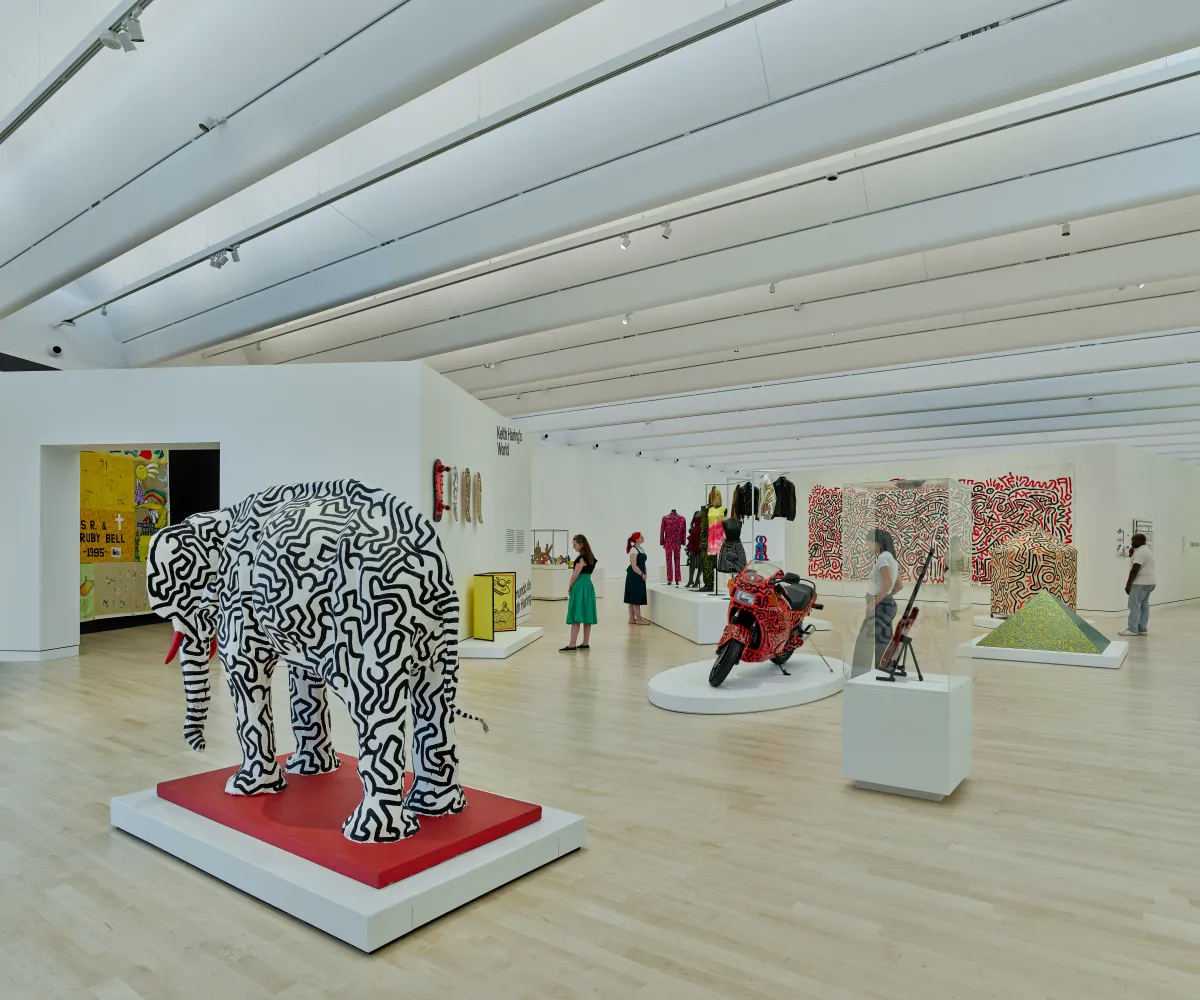
This democratic philosophy of accessibility was tied directly to a highly pragmatic, deeply resourceful approach to physical materials that defined Haring’s early career in New York. In those lean, formative years, canvas was often an unaffordable luxury, but rather than letting material scarcity halt his relentless momentum, Haring turned the entire physical city into his canvas. He painted on whatever was readily available around him, transforming discarded urban debris and everyday household appliances into vibrant, three-dimensional surfaces ripe for artistic invention. In this way, ordinary refrigerators, heavy wooden doors, discarded window frames, metal shelves, and rusty street signs were elevated from domestic junk into complex, sculptural stories. The upcoming Crystal Bridges exhibition masterfully highlights this tactile evolutionary step, showing how his fluid, immensely fast graphic line could effortlessly adapt to the weight, curve, and bulk of physical, three-dimensional surfaces without losing a single ounce of its rhythmic speed, street-level wit, or spontaneous energy. For Haring, there was absolutely no distinction to be made between the medium he chose and the frantic momentum of his creative impulse; he was fueled by an unstoppable urge to create and saw an infinite playground of possibility in the trash and treasures of his immediate surroundings. By bringing together these painted appliances alongside his skateboards, masks, custom-painted motorcycles, and even a completely transformed 1963 Buick Special, the Bentonville showcase proves that three-dimensional creation was not a late-career phase but a central, foundational pulse of his genius. These objects are physical evidence of an artist who refused to let his imagination be confined by the flat, safe boundaries of a two-dimensional rectangular frame.
The actual experience of visiting this major retrospective at the Crystal Bridges Museum of American Art promises to be a deeply visceral, physically immersive encounter that will permanently alter how modern audiences perceive Haring’s legacy. As visitors wander through the beautifully designed, spacious galleries in Bentonville, Arkansas, they are confronted with a breathtaking array of large-scale outdoor sculptures, painted steel totems, clothing, and bulky boomboxes that demand physical interaction. The exhibition forces the viewer’s body to move, tilt, and respond to the physical weight and scale of Haring’s lines as they leap off the flat wall and wrap themselves around three-dimensional space. By focusing specifically on these three-dimensional achievements, the show successfully argues for a much broader, richer, and more physically expansive understanding of an artist who has for too long been pigeonholed as a creator of flat, graphic posters and two-dimensional murals. This curation shows that Haring’s creative mind was constantly calculating depth, volume, and bodily interaction, designing pieces that did not just ask to be looked at passively, but actively occupied, disrupted, and enriched the environments they were placed in. For Warsh, the true payoff of Keith Haring in 3D is not merely the historical recovery of forgotten or overlooked pieces of art, but the dramatic unveiling of a much stranger, bolder, and more physically ambitious version of Keith Haring than public memory usually allows. It presents an artist who was constantly pushing past conventional boundaries, hungry to see how far his iconic, dancing human figures and barking dogs could stretch when molded out of heavy steel, cast in plaster, or painted on the metal hoods of roaring automobiles.
Ultimately, any true attempt to humanize the towering figure of Keith Haring must return to the profound, overwhelming spirit of personal generosity that stood at the absolute center of both his artistic career and his brief, beautiful life. Warsh speaks of Haring not just as an innovative art-world disruptor, but as an extraordinarily giving, warm-hearted human being who moved through an often harsh and cynical world with a radical, open-hearted vulnerability. So many of the physical, three-dimensional works displayed in modern museum retrospectives have been painstakingly sourced from his close friends because Haring had a beautiful habit of simply giving his masterpieces away as tokens of love, solidarity, and joy. This spirit of boundless generosity was later institutionalized through his foundation, which continues to provide vital funding for children’s educational programs and organizations dedicated to the fight against the devastating HIV/AIDS epidemic that tragically cut his own life short at the age of thirty-one. Haring was a man who lived his life in active service of others, painting large-scale cheerful murals on the walls of children’s hospitals, donating highly valuable works to activist benefit auctions, and treating every human interaction as an opportunity to spark joy and connection. The Crystal Bridges exhibition, in its essence, stands as a monument to this beautiful philosophy of giving, showing that his physical sculptures and his warm, giving heart were entirely inseparable from one another. By showing us a fuller, three-dimensional portrait of his life, his friendships, and his revolutionary spatial art, Warsh’s project reminds us that Haring’s true legacy is not just a collection of iconic symbols, but a timeless, open-hearted invitation to participate fully, generously, and joyfully in the shared experience of being human.