





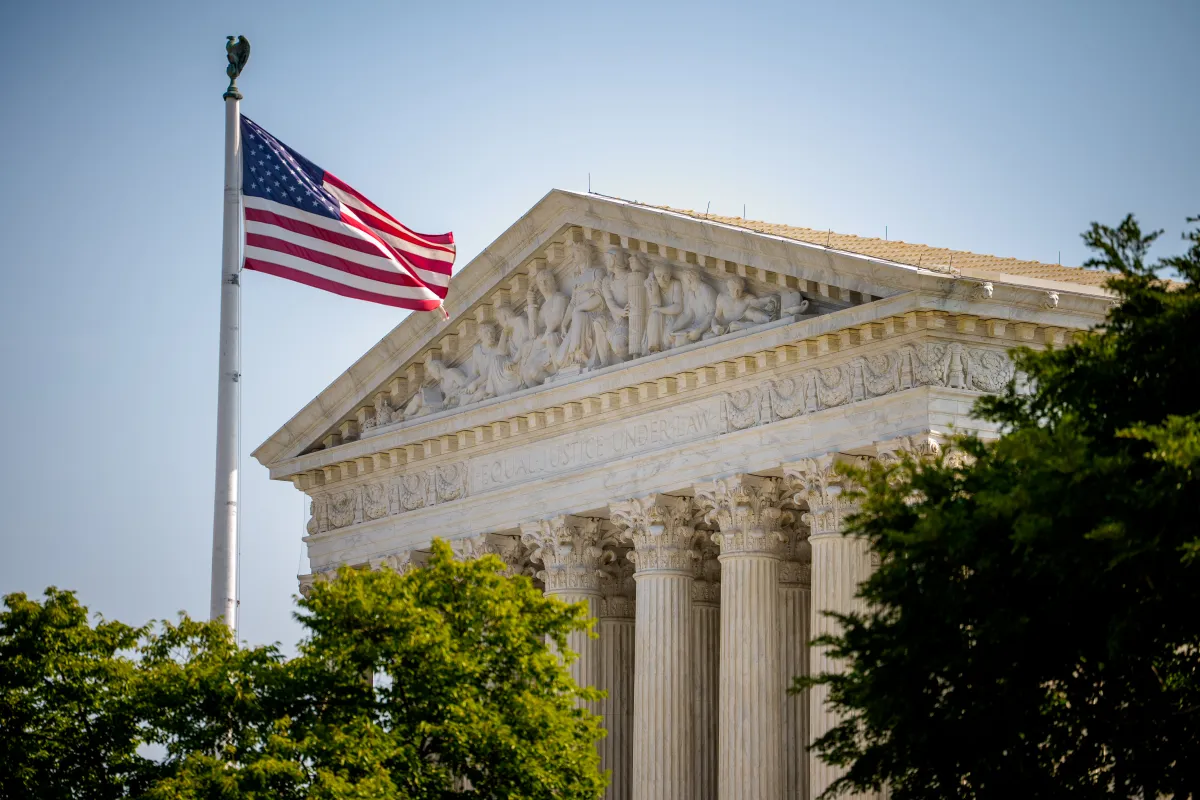
Few election-law fights this year have carried the real-world weight of Missouri’s redistricting battle, and Tuesday’s Supreme Court order only deepened its significance. The United States Supreme Court denied an emergency appeal from Missouri state leaders who had asked to keep a Trump-backed congressional map in place for the November midterm elections—a map that the state had already used in its August primary, when roughly 1.2 million Missourians had cast ballots. Instead, the Missouri Supreme Court’s earlier decision now stands: the state must use the congressional map enacted in2022, not the newer one passed by the legislature last September and pushed for by President Donald Trump. The ruling, issued by Justice Brett Kavanaugh without a full written opinion, means Missouri must somehow unwind an election season already in motion. In her emergency application, Missouri Attorney General Catherine L. Hanaway warned that a “federal-election-administration disaster is unfolding in Missouri,” arguing it was far too late to shift districts after ballots had been cast, campaign infrastructures built, and candidates selected under the new lines. For months, congress and campaign workers had treated the new map as the ground truth. Voters had learned newly drawn precincts, candidates had rented offices and bought digital ads based on the boundaries, and county clerks had programmed voting machines to accept ballots under those rules. Now, with a stroke from a state supreme court and a refusal from the U.S. Supreme Court, that foundation was pulled away. The nation’s highest court wasn’t moved by the state’s plea of administrative chaos, and the decision leaves a cloud of uncertainty over Missouri’s congressional races—with candidates, parties, and ordinary voters all trying to understand what happens next.
.
The stakes are not merely local. Missouri’s case has become one of the most closely watched election-law cases of the cycle because it forces courts to confront a question they generally hate to answer: How late is too late to change the rules? The dispute raises broader questions about whether judges can redraw congressional maps after primaries have already been held, and whether voters who participated in those primaries under one set of district lines can constitutionally be shifted into different districts for the general election. The U.S. Constitution gives states the power to set the “Times, Places and Manner” of congressional elections, with Congress retaining authority to alter such regulations. But nowhere does it offer a simple calendar for when litigation must end and ballots must become final. In her appeal to the Supreme Court, Hanaway described what she saw as a looming administrative nightmare: election officials have deadlines, printing contracts, military and overseas ballot mailings, early-voting schedules—all of which assume districts are fixed long before November. To switch maps now, she argued, is to throw a working election system into chaos. The fact that Kavanaugh denied the bid keeps the Missouri Supreme Court’s injunction in place, but it does not necessarily resolve the underlying legal merits. It simply means, for now, that the state must proceed with the 2022 map while courts sort out whether the legislature’s newer map was lawfully enacted at all. That kind of in-between posture is unsettling for anyone who believes elections should be settled, predictable affairs. It leaves Missourians to wonder whether they will cast ballots under one set of congressional lines only to have their votes counted, or challenged, under another. And it invites further litigation in the days ahead, as lawyers search for any remaining procedural avenue to reopen the question.
.
Beyond Missouri, the case could have implications for election disputes nationwide, because other states—blue and red alike—are watching closely and may seek to alter their own congressional maps through litigation, referenda, or legislative do-overs. If Missouri courts can throw out a map after a primary election has been conducted under it, what stops similar challenges elsewhere? What does that mean for voters who moved, candidates who filed, and parties that spent millions assuming certain boundaries? The Missouri affair is a warning about what can happen when redistricting, a process already soaked in partisan tension, collides with direct democracy and judicial review. Some legal experts see this as a necessary check on gerrymandering, a way to prevent lawmakers from drawing mapsthat cannot withstand scrutiny. Others see it as a dangerous destabilizing force, one that undermines public confidence by treating district lines as provisional until the last possible moment. The Supreme Court has often been reluctant to insert itself into partisan redistricting fights, treating them as political questions better resolved by state governments and voters. Tuesday’s denial keeps that posture, but it also leaves a patchwork of state-level rulings thatica can diverge sharply. In a polarized era, when control of the U.S. House can turn on a handful of seats, thet Missouri case is not just a local quarrel over map lines. It is a test of whether the country can administer its elections in an orderly way when every step ofr the redistricting process is contested.
.
How did Missouri get here? The story begins in September 2025, when the Missouri legislature approved House Bill1, a measure that replaced the congressional map the state had enacted in2022. The bill passed comfortably in both chambers, a notable feat at a time when redistricting often splits along partisan lines. It was then signed into law by Republican Governor Michael Kehoe, giving the new map official status. Crucially, the new map was not drawn just by statehouse insiders; it had the backing of President Donald Trump, who had pushed for its adoption. That political sponsorship made the map a national symbol as much as a state one, and it ensured that litigation over the measure would draw attention well beyond Missouri’s borders. When the state used the new map during its August 2026 primary elections, more than a million Missourians experienced it directly. They voted in new congressional districts, nominated candidates under its lines, and believed they were participating it a settled system. Campaigns spent money, volunteers knocked on doors, and local parties organized around the new geography. All of that activity now appears tied to a map that courts have said cannot be used in November. The sudden reversal landed like a thunderbolt. Voters who cast ballots in August may find themselves assigned to different congressional districts in the general election, potentially represented by different candidates than they expected. Candidates who won primaries under one set of district lines might discover their district has shifted, putting them in worse political positionor even pitting them against another incumbent. For ordinary Missourians, the change can feel less like legal nuance and more like the ground shifting beneath their feet—especially those who took time to research races, attend forums, and cast informed votes in August.
.
.
The legal battle behind this whiplash began almost immediately after the legislature adopted the map. An activist group called People Not Politicians, led by Richard von Glahn, launched a referendum campaign seeking to place the plan before voters statewide. The group’s name captured its argument: ordinary citizens, not self-interested politicians, should decide how congressional districts are drawn. That referendum effort quickly expanded into a series of lawsuits challenging whether Missouri’s referendum process couldeven be used against congressional redistricting legislation. The state’s lawyers argued that redistricting is a core legislative function, not the kind of ordinary statute subject to popular veto by referendum. Opponents countered that Missouri’s constitution gives voters a broad right to reject laws they dislike, and that drawing political boundaries to benefit incumbents is precisely the kind of self-dealing the referendum power was meant to check. During the months of litigation, Missouri courts repeatedly left the map in place while the legal questions were pending. State officials would later emphasize that those decisions led election administrators, candidates, and voters to rely on the map throughout the entire primary cycle. People filed candidacies, changed addresses, volunteered for campaigns, and requested absentee ballots—all under the assumption that the new districts were valid. Then, on September ️3, the Missouri Supreme Court reversed a lower court ruling and issued an injunction prohibiting Missouri officials from implementing or using House Bill1. The court indicated that the state should instead use the congressional map enacted in2022. The language was blunt: the new map could not be used, period. That order threw Missouri’s election calendar into turmoil. Suddenly, congressional candidates who had won nomination under HB1 faced the possibility of running in unfamiliar territory. Voters who had expected to cast ballots for certain incumbents or newcomers might no longer be in their districts. Local election officials, already preparing fall ballots, had to stop and consider whether to scramble to reprogram machines, reprint sample ballots, and notify voters of new districts—all in a matter of weeks.
.
What happens now is far from clear, and that uncertainty itself is part of the human toll ofthis case. The Supreme Court’s denial does not mean the Missouri Supreme Court was right or wrong on the law; it means only that, for now, the state must implement the court-ordered injunction. State officials could pursue further emergency filings, but Tuesday’s ruling was a significant setback. Election administrators now face a brutal, time-consuming task: they must pivot from the HB1 map to the 2022 map with little time before ballots must be finalized for November. County clerks must determine which precincts fall into which congressional districts under the old lines, notify voters whose district assignment changed, update polling place materials, and ensure that every voter receives a ballot listing the correct candidates. For voters, the impact can be disorienting. Someone who voted in August under the new map may now be placed in a different district for the general election; their choice for Congress might suddenly be someone else entirely. Candidates who won primaries may face an electorate they did not campaign for, while losers under the old map? Perhaps no one anticipated that the courts would intervene so late. The case also underscores how fragile American election administration has become, especially when redistricting battles spill into courtrooms and remain unresolved until the last minute. Missourians did not ask to become test subjects for constitutional theories about referenda, gerrymandering, and judicial timing—but they are living through it anyway. And because control of Congress is at stake, the effects will be felt far beyond the state’s borders. Other states, parties, interest groups, and ordinary citizens will study this episode for years, hoping to learn how to prevent such chaos—or how to use it to their advantage. Newsweek has reached out to the Missouri Secretary of State for comment, but no immediate response was available at the time of reporting. This is a breaking news story, and updates are expected in the hours and days ahead. Until then, Missourians can only wait, watch their mailboxes, and wonder exactly which district they will call home when they finally vote in November