





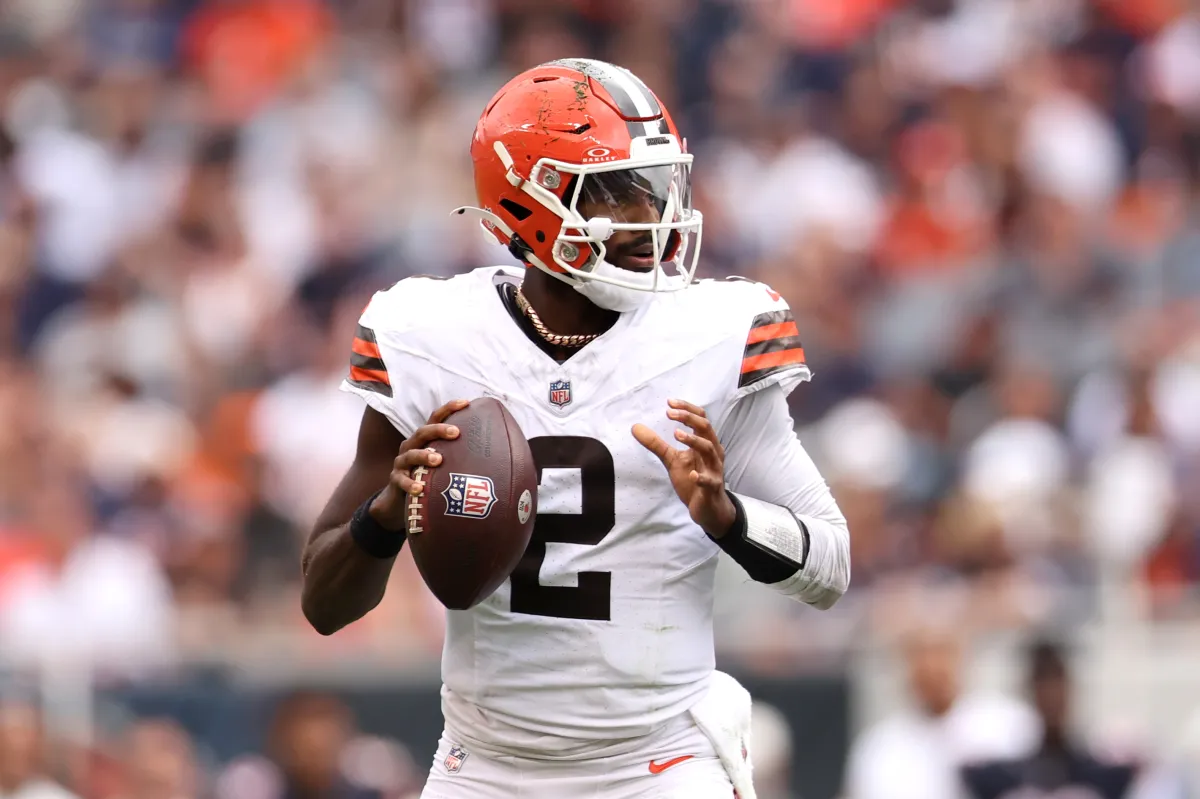
On the Sunday afternoon when NFL rosters shrink from ninety players down to fifty-three, the Cleveland Browns made a quiet but telling decision: they did not touch their quarterback room. In a league where teams often trim extra arms to fill holes elsewhere, Cleveland chose to keep every healthy quarterback they had, and that choice sent a message far beyond the simple mechanics of a roster sheet. The Browns are preparing to start Deshaun Watson in Week 1 against the Jacksonville Jaguars, and Watson will take the first-team reps in practice. Behind him, the depth chart is a strange and emotional thing: Shedeur Sanders, the young quarterback who arrived in Cleveland with a spotlight so bright it could burn through concrete, is set to split scout-team reps with rookie Taylen Green, while Dillon Gabriel watches from injured reserve after a back injury suffered in the preseason game against the New England Patriots. There is no glamour in those scout-team reps. There is no crowd, no cameras, no chance to prove yourself against the first-team defense. It is work. It is grinding. It is the kind of invisible labor that can either make a quarterback humble or make him bitter, and for Sanders, it has already become the subject of national debate.
The decision to keep all three quarterbacks is not simply a practical move; it is a reflection of the strange place the Browns occupy in the league’s imagination. Deshaun Watson is the starter, and everyone knows it. His contract, his history, and the Browns’ public commitment to him all point in one direction. But there is something fragile about that commitment, and keeping Sanders around suggests the organization wants a safety net, even if they refuse to call it that. For Watson, the pressure is enormous. He is returning from injury and controversy, and every mistake he makes will be amplified. For Sanders, the pressure is different. He was not drafted to sit quietly. He was not drafted to be a secret. His name alone carries weight, partly because of his father’s legacy, partly because of his own college career, and partly because so many people in the media have already decided that he deserves better than this. The Browns may see him as a developmental project, a young quarterback who needs time to learn a pro-style offense and adapt to the speed of the NFL. But to the outside world, particularly to sports analysts who have watched him dominate at lower levels, the situation looks like a waste of talent, a strange imprisonment of a player who should be given a chance to play. And so the quarterback room in Cleveland has become a room full of ghosts: Watson carrying the weight of expectation, Sanders carrying the weight of what could have been, Green carrying the weight of being overlooked, and Gabriel carrying the weight of an injury that came at the worst possible time.
Sports analyst Skip Bayless, never one to stay quiet when there is a story to be told, made his feelings clear in a post on X. His words were not measured. They were raw, emotional, and full of frustration. “It’s just so sad,” he wrote, describing Sanders as “imprisoned” in Cleveland. Bayless said he wanted the Browns to cut Sanders, to set him free, to let him find a new home where somebody actually likes him. “I was afraid to say it when he was coming out but I actually like him,” Bayless said, as though admitting a secret he had been holding in his chest. He insisted that there is someone out there who genuinely believes in Sanders, someone who would embrace him as a franchise quarterback rather than treat him as a backup project. “I know it. I believe it with all my heart and soul,” he added. The language is dramatic, even for Bayless, but it captures something real about the way this situation feels to many observers. There is a sense of injustice in watching a talented young quarterback get buried on a depth chart, especially when the quarterback ahead of him is not universally embraced. Bayless’s comments are not just about Sanders; they are about the broader feeling that the Browns made a decision about Sanders before he ever had a real chance to prove himself. It is the feeling that he was drafted for publicity, for jersey sales, for the buzz he would bring to a franchise desperate for attention. And now, with the attention secured, the football side of the operation has pushed him aside.
The tension became even sharper when Bayless pointed to Browns head coach Todd Monken’s praise of Dillon Gabriel. Monken described Gabriel as someone who can operate his offense, someone who gets what the Browns want to do, someone who understands the system. That sounds like a compliment, but in the context of the quarterback battle, it felt like a subtle dismissal of Sanders. Bayless interpreted it as a shot, a way of saying that Sanders does not understand the offense, that Sanders is not the kind of quarterback Monken values. Whether Monken meant it that way or not, the perception is real. There is a long history in football of young quarterbacks being judged not just on their talent but on their ability to fit into a coach’s specific system. Sanders came from a college background that was built around his strengths, around his ability to improvise and make plays with his arm and his legs. The NFL is different. The NFL demands structure, timing, and discipline. Coaches like Monken want quarterbacks who can process information quickly, who can read defenses and adjust at the line of scrimmage, who can execute the game plan exactly as designed. Sanders may have the raw talent to be a great quarterback, but if he has not yet learned to play within Monken’s framework, he is going to be on the scout team, no matter how many jerseys he sells. That is the brutal reality of professional football. It does not care about hype. It does not care about name recognition. It cares about production, about fit, about whether a quarterback can make the throws and the decisions that the offense requires. And so the question becomes whether Sanders will ever get the chance to show that he can do those things, or whether the Browns have already written him off as a project who will never be anything more.
There is a chance, of course, that the narrative will change. Football is a game of injuries and surprises, and no one knows that better than the Browns. If Watson struggles, if the offense stalls, if the team starts losing, the calls for Sanders will grow louder. Fans will want to see the young quarterback, the one with the famous name and the flashy style. The media will demand answers. And at some point, the coaching staff may have no choice but to give Sanders an opportunity to start. That opportunity, if it comes, will be everything. It will be the moment Sanders has been waiting for, the moment he can change the narrative, prove that the doubters were wrong, and show the world that he is not just a name but a player. But it will also be a moment of enormous pressure. If he fails, if he looks unprepared, if he struggles against defenses that are faster and smarter than anything he saw in college, then the narrative will harden. The Browns will say they were right to bring him along slowly. The analysts will say he was overrated. The opportunity will disappear as quickly as it came. And if he succeeds, if he shows flashes of brilliance, then everything changes. He will have earned a future somewhere, whether that future is in Cleveland or elsewhere. But until that moment comes, he is stuck. He is a backup quarterback running scout-team plays against the defense, trying to learn an offense that may never be his, waiting for a chance that may never come. It is a lonely place to be, especially for someone who has spent his entire life being celebrated, being told he was special, being treated like the future of the sport.
In the end, the story of Shedeur Sanders in Cleveland is not just a story about football. It is a story about hope and frustration, about talent and timing, about the gap between what we expect and what we get. It is a story about a young man who has been judged before he ever took a snap, praised and criticized in the same breath, lifted up and torn down by the same voices. Skip Bayless called it sad, and in many ways, it is. There is something sad about seeing a player with so much promise reduced to a footnote on a depth chart. There is something sad about the way we, as fans and analysts, consume quarterbacks as if they were products, measuring their worth in stats and wins rather than in human terms. But there is also something hopeful in the situation, because football has a way of writing its own stories. Sanders is still young. He still has time. He still has the talent that made people believe in him in the first place. Whether he ever becomes the starter in Cleveland or ends up somewhere else, whether he succeeds or fails, his journey is far from over. The Browns have made their choice, at least for now, and that choice is Watson. But the season is long, the games are unpredictable, and the quarterback room in Cleveland is full of uncertainty. All Sanders can do is keep working, keep waiting, and keep believing that somewhere out there, someone really does like him, just as Bayless said. And maybe, when the moment finally comes, he will be ready to prove that the belief was not misplaced. For more on the Browns and the NFL, head to Newsweek Sports.