

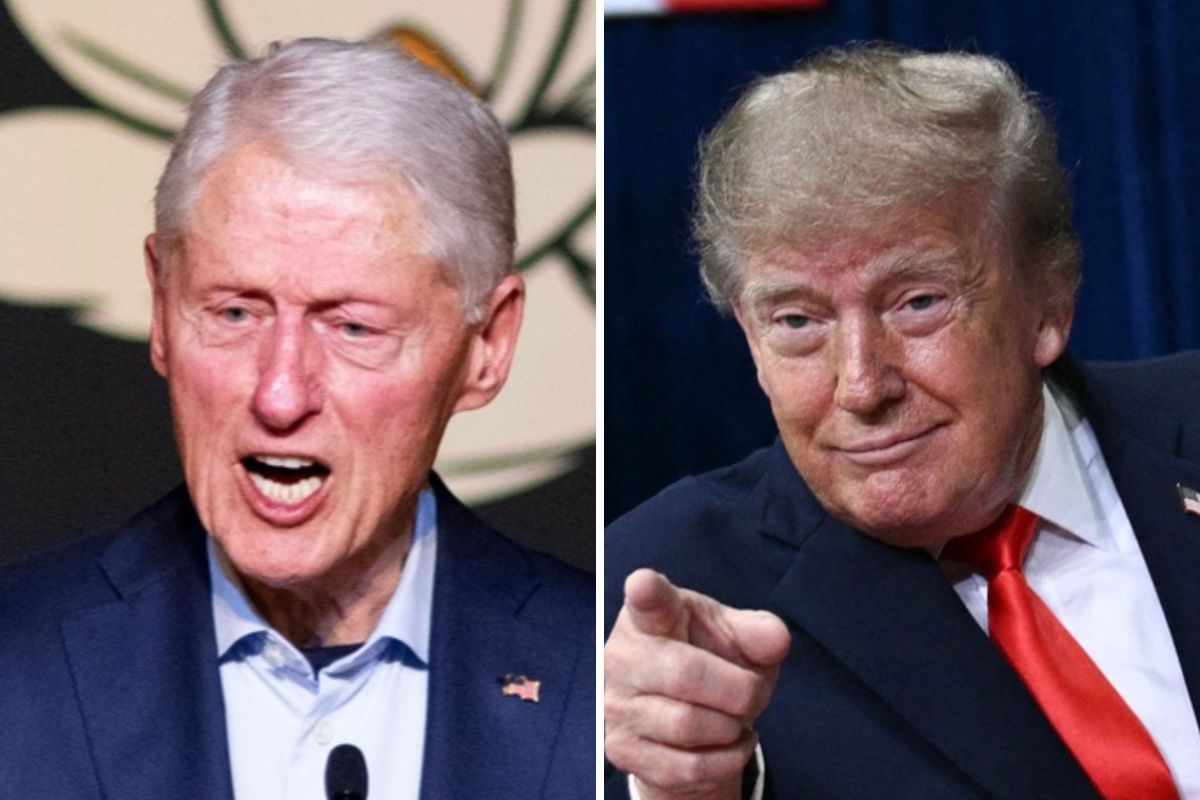
Four days before the midterm elections, the country’s political heavyweight champions were out on the road, trading blows in different time zones but in the same desperate race for momentum. President Donald Trump held a fiery rally at the Ocean Center in Daytona Beach, Florida, while former President Bill Clinton made his way to Tupelo, Mississippi, to boost Scott Colom, a longshot Democratic Senate candidate hoping to pull off an upset in deeply red territory. These were not just routine campaign stops; they were strategic deployments of the two parties’ most recognizable personalities, sent into battlegrounds and tough neighborhoods alike to energize supporters and, ideally, pull a few undecided voters across the line. For Republicans, the midterms are a test of whether Trump can keep his grip on Congress and continue reshaping Washington in his image. For Democrats, the goal is simpler but enormously consequential: flip at least one chamber and choke off the president’s ability to move freely for the final two years of his term. The dueling rallies also captured the larger drama of American politics right now—the gap between grand, arena-sized spectacles and smaller, more intimate gatherings, between the politics of grievance and the politics of persuasion. In Daytona, the crowd was so loud and thick that just getting inside felt like an achievement. In Tupelo, the atmosphere was more like a community theater performance, with people packed into a modest venue because they believed something historic might just be possible. Both events carried the same message: this election matters, and every vote counts.
The difference in crowd size at the two rallies was impossible to ignore, and it quickly became part of the story itself. According to The Daytona Beach News-Journal, Trump’s event drew a capacity crowd of more than 9,000 people, and the Ocean Center, which has room for about 9,300, looked full to the brim. Photos and videos shared by conservative outlets showed packed seating on all sides of the podium, with supporters squeezed in and waving flags as the president spoke. Right Side Broadcasting Network posted a video with the caption: “THE MAINSTREAM MEDIA WON’T SHOW YOU THIS! ABSOLUTELY PACKED arena in Daytona Beach, Florida, as THOUSANDS of American patriots turn out for President Trump! The energy is UNREAL!” Trump supporter Benny Johnson also chimed in from the arena, saying that despite the media’s claims that “MAGA is dead,” the rally was “PACKED to the rafters.” Conservative commentator Eric Daugherty claimed there were still thousands of people waiting outside after the venue reached capacity. Newsweek could not independently verify those numbers, but the visual evidence alone was striking. Clinton’s rally in Tupelo was a different kind of scene altogether. Mississippi Today reported that roughly 400 people attended, which nearly matched the Link Center’s capacity of about 400, with additional overflow space available for 100 more. A local reporter noted that Clinton, famous for once shaking every hand in the room, worked the crowd after a wide-ranging speech that criticized the Trump administration and boosted Colom. In video from the event, Clinton stood on a theater-style stage in front of a large Mississippi flag, flanked by American flags, and one supporter held up a sign reading “Mississippi Forward.” The contrast was stark: Trump’s rally was an enormous, raucous political concert, while Clinton’s looked like an old-fashioned town hall gathering, warm and a little scrappy. But both events were fueled by the same thing—hope, fear, and the belief that the next few days could change the direction of the country.
Trump’s speech in Daytona was vintage Trump, blending self-congratulation, grievance, and apocalyptic warnings into a single sensory experience. He accused the media of deliberately ignoring his crowd sizes, saying, “They never like mentioning crowd size because crowd size means success and they, the fake news, do not want us to succeed.” For Trump, the size of a rally has always been more than a logistical detail—it’s a proof of vitality, a scoreboard that he insists the press refuses to show. He called Tuesday’s elections “the most important midterm elections ever” and framed the decision before voters in stark, almost existential terms. He said he was campaigning to “stop America-hating communists from taking over the United States Congress.” That kind of language is familiar to anyone who has followed Trump’s rallies, but it still lands with force in a packed arena. There is something almost theatrical about the way Trump works a crowd: he reads their energy, feeds off it, and gives it back to them in larger and larger waves. He knows that many of his supporters have driven hours, waited in line, and squeezed into the stands because they want to feel like part of something bigger than themselves. In Daytona, they got exactly that. The president’s remarks were part victory lap, part warning, part rallying cry, and he made it clear that he sees the midterms as a referendum on his own leadership. In his telling, a Republican loss would not be a normal political setback—it would be an invasion of the country by hostile forces. The crowd responded with deafening approval, because that is what they came to hear. They did not come to hear nuance or compromise; they came to hear that the fight is real and that they are on the right side of it.
Clinton’s message in Mississippi was almost the exact opposite in tone, though no less passionate. He was there to support Scott Colom, a Democratic candidate facing long odds in a Republican stronghold, and Clinton made the case with the kind of personal, conversational storytelling that defined his own political career. “I’m supporting Scott because he will honestly give you his opinion, and if you disagree, he’ll have a conversation with you. And if you can change his mind, he’ll change his mind,” Clinton said. That line was a subtle jab at the rigidity of party politics and a reminder of a more deliberative style, but it was also a genuine pitch for Colom as someone willing to listen. Then came the line that seemed to capture the entire Democratic strategy in this race: “You can’t put MAGA first. You have to put Mississippi first.” It was a direct appeal to local loyalty over national partisan identity, an attempt to convince voters that a Democrat could be more attentive to their everyday needs than a national party line. Colom himself echoed that message, focusing on the cost of living and the broken promises he says ordinary people have endured. “They were promised lower grocery prices. That’s what I’m going to fight for,” he said. “You were promised no more endless wars. I’m going to give you no more endless wars.” That language is aimed squarely at working-class voters who may have supported Trump in previous elections but are now feeling the squeeze of inflation and international conflict. Clinton’s presence gave the event a sense of historical weight, as if the heavyweight champion of a previous era was stepping into the ring one more time to prove that the old skills still work. He worked the room, shook hands, made eye contact, and reminded everyone in that modest venue that politics is still about connecting with people, one at a time.
The debate over rally attendance became a story in itself in the final days of the campaign, and both sides have been weaponizing crowd sizes as proof of who is truly winning. On Thursday, Texas Democratic Senate hopeful James Talarico told CNN that his Republican rival Ken Paxton was “canceling rallies because nobody is showing up.” Paxton’s team had canceled a scheduled rally in El Paso on November 5, citing scheduling and logistics, but Talarico’s mocking tone reflected a growing trend: having a packed house is treated as evidence of ethical and political superiority. Trump, who has long been obsessed with crowd sizes, has also taken aim at former President Barack Obama’s rally attendance. At a rally in Perry, Georgia, on October 24, Trump said, “You know I saw Barack Hussein Obama was in Michigan and the place was empty. And they were saying, ‘Oh this is a large crowd coming, the people are trickling through.’ They don’t talk about my crowds, they never talk about them.” That comment drew criticism because of Trump’s use of Obama’s full middle name, which critics have long seen as a way to make the former president seem foreign and threatening. Obama’s Michigan rally was held at Cass Technical High School, with a gymnasium capacity of around 3,000 people and room for roughly 4,300 including overflow areas, and photographs showed a strong turnout, with reports of an overflow crowd. But in the strange world of campaign optics, the facts matter less than the narrative. Crowd size has become a kind of psychological warfare in American politics. It is not just about who can draw more people; it is about who can claim momentum, energy, and inevitability. And in the final days before an election, that claim can influence undecided voters, shape media coverage, and fire up activists who want to feel like they are backing a winner.
Behind the dueling rallies and the crowd-size arguments lies a deeper struggle over what the next two years will look like. Democrats are hoping to flip both chambers of Congress, a move that would dramatically impede Trump’s freedom of action and force him to deal with a hostile legislative branch. Republicans, meanwhile, are fighting to preserve their majorities and hand Trump a historic mandate. A Clinton spokesperson summed up the Democratic framing in one sharp quote: “President Clinton was making the case for Scott Colom. Trump was making excuses for senseless wars and nonsensical tariffs that leave Americans paying more for gas and groceries. President Clinton was on offense. Trump was on defense. That’s the story.” That is an oversimplification, of course, but it captures the emotional stakes of the moment. Republicans see Trump’s rallies as proof that the movement is alive and growing; Democrats see them as loud distractions from real-world pain. Both sides are trying to mobilize their voters, but they are speaking to different parts of the American soul. Trump’s message is about rescue and revenge—saving the country from enemies within and settling scores with those who doubt him. Clinton’s message is about repair and partnership—finding common ground and delivering practical results. In the end, the voters in Florida and Mississippi, and millions like them across the country, will decide which vision prevails. They will walk into polling places Tuesday carrying the weight of their own worries: gas prices, grocery bills, wars abroad, and the sense that the system is not working for them. The rallies may be loud and theatrical, but the voting booth is quiet. What happens in that moment will determine whether Trump spends the next two years charging ahead or fighting for his political life—and whether Democrats can turn their energy into actual power. For now, the biggest names in American politics have done all they can do. The rest is up to the people.