

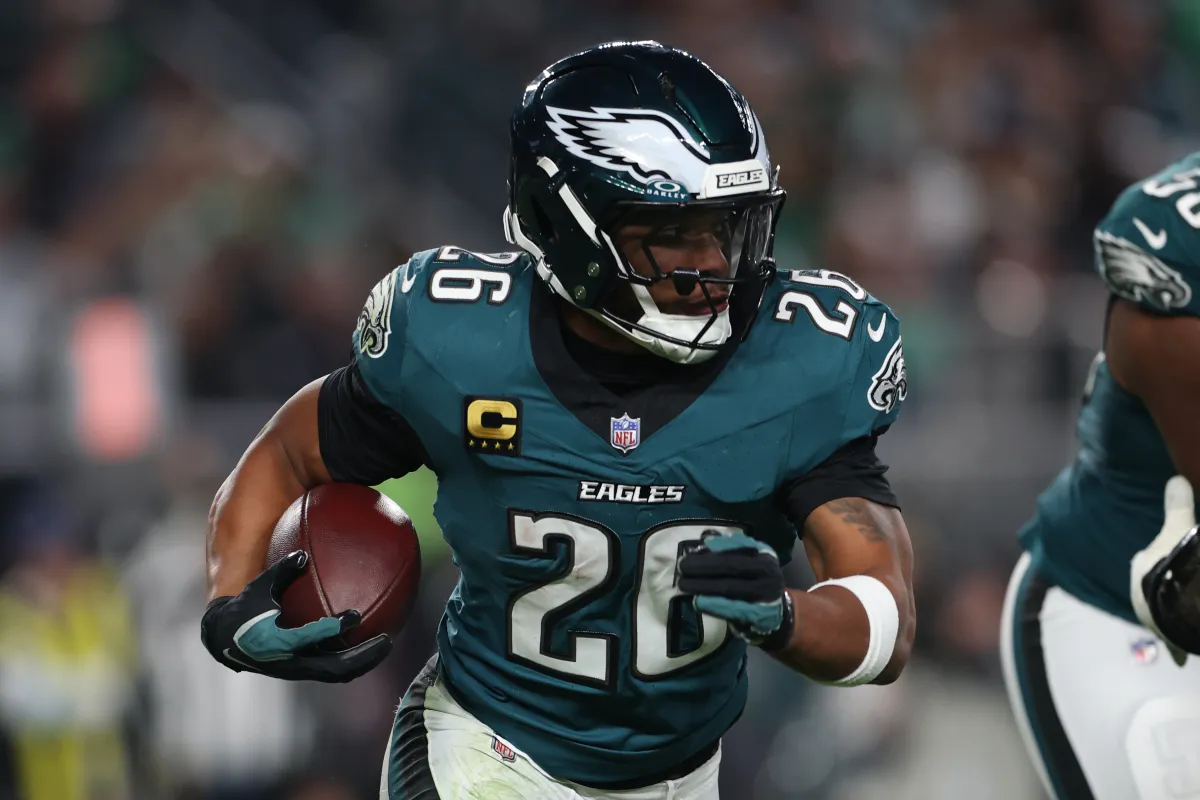
The crisp, electric atmosphere of a “Monday Night Football” clash between the Philadelphia Eagles and the Dallas Cowboys always carries a weight that transcends the regular season, a primal rivalry that pulses through the veins of the NFC East. For Eagles fans, the return of Saquon Barkley to the lineup felt like a beacon of hope, a chance to reignite a sputtering offense and snap a disheartening losing streak. The roar of the crowd when he took his first handoff was a mixture of relief and unbridled anticipation, a collective exhale that perhaps the season’s tide was about to turn. Yet, as the game unfolded, that hope became a taut, agonizing thread. Barkley, clearly battling the lingering effects of a hamstring injury that had sidelined him for two games, fought with immense grit, even punching in a touchdown that briefly made the night feel magical. But the joy was short-lived. By the fourth quarter, he was not on the field, but on the sideline, wrapped in the solitude of an athlete’s frustration, watching his team crumble to a 38-21 defeat. The loss felt like more than just another tally in the loss column; it was a painful reminder of how fragile a team’s fortunes can be, especially when its most potent weapon is reduced to a spectator, his body betraying him once again.
The saga of Saquon Barkley’s night is a story of resilience shadowed by physical vulnerability. It began with promise, as he pushed through the hamstring tightness that had restricted him in practice, determined to be there for his team in a primetime showcase. His first-quarter carries showed flashes of the elusiveness that made him a star, but then came a telling moment—a slight hitch in his stride after an early rushing play, a subtle grimace that spoke volumes to the trained eye watching from the press box. Despite the obvious discomfort, the star running back refused to yield, a testament to his warrior mentality. He played through the pain, churning his legs for tough yards and culminating his first half with a touchdown that had the home crowd on its feet, chanting his name. That score felt like a vindication, a reward for his sheer willpower. However, the physical toll proved insurmountable. Sometime in the third quarter, it wasn’t the hamstring that betrayed him, but a nagging back issue that forced the coaching staff to make the difficult decision to keep him out of the entire fourth quarter. Now, his status for the upcoming Sunday night game against the Washington Commanders is shrouded in doubt, as the team’s injury report lists him with both a hamstring and back injury. This uncertainty casts a long shadow over a team that is already limping badly, leaving fans to hold their breath and refresh their phones until the next official update, praying that their star can defy the odds yet again.
The Eagles’ running back room has become a veritable MAS*H unit, a situation that would test the depth of any roster and expose the fragility of even the best-laid plans. The unfortunate cascade began with Barkley’s own setbacks, but the news worsened in the fourth quarter of the Dallas game when backup Dameon Pierce went down with an injury that subsequently placed him on injured reserve. This was compounded by the already-existing absences of Tank Bigsby and Will Shipley, both of whom had been on injured reserve since earlier this month. In a matter of days, a position group that once boasted a tantalizing mix of power and speed has been whittled down to a skeletal crew. Head coach Nick Sirianni, fielding questions on Friday, tried to project calm and confidence, a coach’s tightrope act between acknowledging reality and instilling belief. “We’ll see at the end of this, and so, guys are having a good week of preparation. Feel good about that room. Obviously, we’ve been, you know, beat up in that room with injuries,” he said, pausing, as if searching for the right words to bridge the gap between concern and optimism. “But I feel good about the guys that we have.” It was a speech filled with deliberate pauses and carefully chosen words, but underneath it lay the undeniable truth that they are now one misstep away from having to use a wide receiver or practice squad call-up in a critical NFC East battle.
In the midst of this crisis, two names have emerged from the shadows—Elijah Mitchell and Jaydon Blue—each representing a different kind of hope and a potential lifeline for a team in dire straits. Sirianni spoke with genuine fondness about Mitchell, recalling his promise during training camp before he got “dinged up.” Mitchell’s resume boasts a solid NFL pedigree: a fourth-year veteran drafted by the San Francisco 49ers, where he compiled 1,523 rushing yards and nine touchdowns over 27 regular-season games, with an additional eight postseason appearances. His experience in a Shanahan-style zone running scheme is invaluable, even if he hasn’t played a full season since his rookie year due to various ailments. After a stint with the New England Patriots that never materialized, he signed with the Eagles in the spring, was released in August, and only two weeks ago was brought back to the practice squad. He’s played in just one game this season, carrying the ball three times for 11 yards—meager numbers, but they hint at a readiness. Then there’s Jaydon Blue, a polarizing figure who was a fifth-round pick by the Cowboys in 2025, playing only five games for Dallas last season before he was let go. He’s now on his second stint with the Eagles’ active roster, yet he has yet to take a single snap for Philadelphia. Sirianni’s voice brightened when he mentioned Blue: “Always liked Jaydon [Blue] and the things he can do, watching him coming out of Texas.” He speaks of potential, of speed, of an explosive quality that could break a big play at any moment. But potential and theory are not the same as production, and for a team mired in a five-game losing streak, the margin for error is zero. These two backs carry not just the ball, but the weight of a fan base’s fading hope, expected to step up when no one else can.
Yet, the running back dilemma is merely a symptom of a larger, more systemic malaise that has engulfed the Philadelphia Eagles. The team is on a five-game losing skid, a slide that has transformed a once-promising season into an exercise in survival. The injuries have not been contained to the backfield; they have struck at the very heart of the offense. Quarterback Jalen Hurts, who has been the face of this franchise, is dealing with a serious diagnosis of deep vein thrombosis in his leg and bilateral pulmonary emboli in his lungs—a frightening health scare that goes beyond football and threatens his very well-being. The team has not yet ruled him out for Sunday, but the images of him on the sideline, looking more like a spectator than a leader, have been stark. Moreover, key receivers DeVonta Smith and Dontayvion Wicks have both missed games, leaving a young and inexperienced group to fill the void. The offense, once a high-flying machine, has become stilted, disjointed, and predictable. There is a palpable sense of frustration in the locker room, the kind that gnaws at a team’s identity and makes every practice feel like a referendum on the coaches’ and players’ abilities. Sirianni, in his Friday press conference, didn’t just talk about running backs; he talked about the character of the men in the room, their “grittiness,” and their determination to “rip it.” It is a coach’s most reliable trope—emphasizing toughness over talent—but in a season where talent is so depleted, it has become a desperate plea.
Now, all eyes turn to the immediate future: a “Sunday Night Football” showdown against the Washington Commanders, a team that is itself a study in dysfunction and injury. The Commanders have also been erratic, dealing with their own slew of physical setbacks and inconsistent quarterback play, making this matchup less a clash of titans and more a battle for survival between two wounded giants. Both teams trail the Cowboys and the New York Giants in the NFC East standings, and this game feels like a potential season-defining moment. For the Eagles, a loss would effectively place them in a near-insurmountable hole, mathematically and psychologically. The football world will be watching not just for the score, but for the resilience of a team that has lost its star runner, its starting signal-caller may be medically compromised, and its receiving corps is on crutches. Yet, within the bleakness, there is a glimmer of something human: the refusal to quit, the adage “next man up” being tested to its absolute limit. Elijah Mitchell and Jaydon Blue are the embodiment of that phrase now, their hearts pounding as they prepare for the most significant moment of their careers. They may not be Saquon Barkley, but they carry the same burden—the hopes of a city that loves its Eagles with an almost irrational passion. As Sunday night approaches, the story becomes less about X’s and O’s and more about spirit, about whether a group of backups can summon the collective will to overcome the odds. In a season that has tested the faith of the most loyal fans, the game against Washington is not just about football; it’s about character, perseverance, and the profound truth that sometimes, the most heroic performances come from those we least expect.