


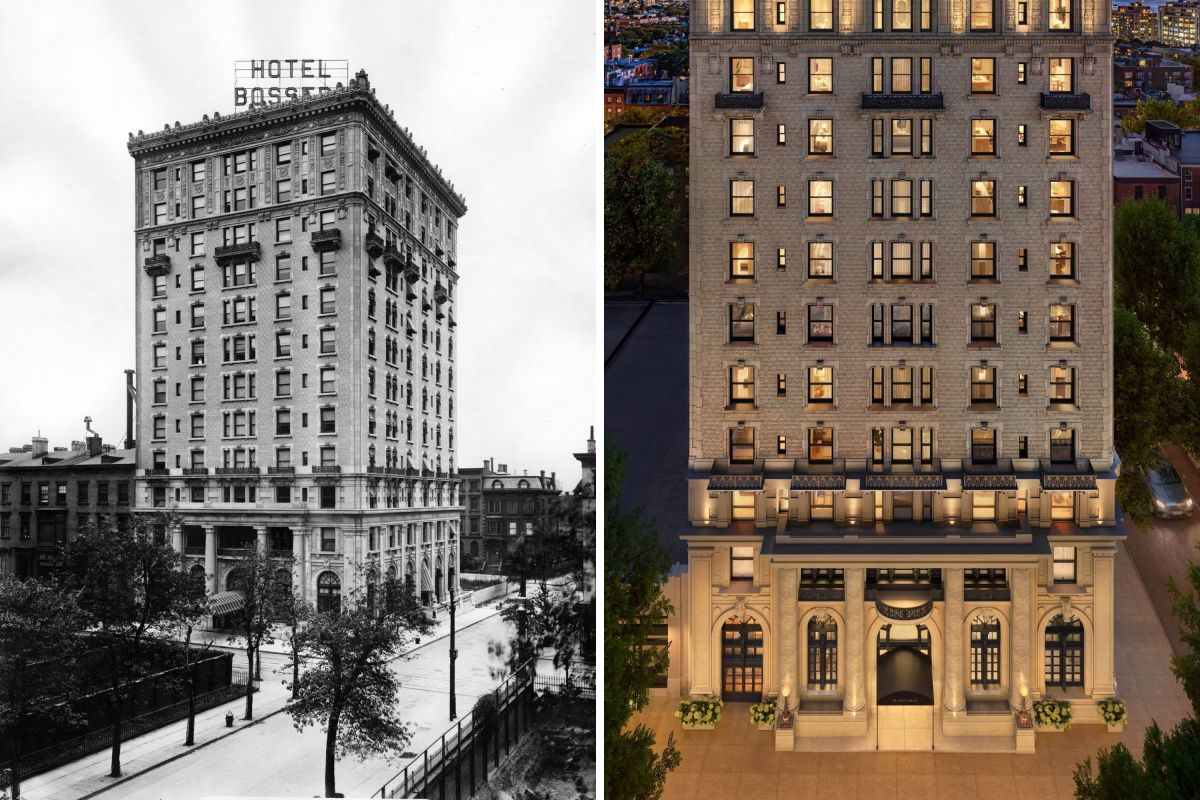
In Brooklyn Heights, a neighborhood that feels like a quiet, tree-lined step out of another century, one of its most storied buildings is about to begin a new life. The Hotel Bossert, a grand old dame perched at 98 Montague Street, has watched over the borough for more than a hundred years, through decades of change and countless chapters of city life. Now it is being reimagined as the Ritz-Carlton Residences, Brooklyn Heights, marking the luxury brand’s first arrival in the borough. The project, led by developer SomeraRoad in partnership with Marriott International, will transform the landmark hotel into private luxury condominiums. Construction is expected to begin later this year, with completion projected for 2029. The setting is significant, too. Brooklyn Heights is often called America’s first suburb, a neighborhood cherished for its rows of 19th-century architecture and cobblestone charm. In 1965, the Landmarks Preservation Commission described the area as “a remarkable example of stylistic development rarely found in any American City,” and that same year it was designated a National Historic Landmark and the city’s first historic district. The Bossert was born in 1909, an Italian Renaissance Revival building built for Brooklyn in the same spirit as the Waldorf-Astoria or the Plaza in Manhattan. It was not just a hotel; it was a civic anchor, a place of pride and memory. The building’s architecture—its patterned brick, carved stone, and intricate ironwork—has always given it a sense of permanence and dignity. For many, the Bossert is more than a building. It is a symbol of Brooklyn’s history, and the decision to transform it into homes, rather than tear it down or let it decay, feels like a thoughtful next chapter in a long and meaningful story.
The architectural bones of the Bossert are what make the project so sensitive. Its defining features include the original geometric pattern brick façade, a sculpted granite and limestone base, ornate terra-cotta cornice and window details, arched double-height windows, intricate cast-iron railings, and keystones carved with lion’s heads. These are not just decorative flourishes; they are the physical traces of a bygone era of craftsmanship. The team behind the conversion says these elements will be meticulously restored, preserving the building’s historic character while giving it a modern purpose. Ian Ross, the founder and managing principal of SomeraRoad, described the project as an effort to “thoughtfully restore” the property while creating a residential experience that honors the Bossert’s legacy and celebrates the enduring appeal of Brooklyn Heights. That is no small task. New luxury residences must feel comfortable, private, and contemporary, while the building’s public-facing identity remains intact. But the Bossert has one advantage that makes the transformation feel less like a break from the past and more like a return to its roots. As Brooklyn real estate agent Jessica Peters of Douglas Elliman points out, the original building was conceived as an “apartment hotel”—a place built to be lived in, rather than just stayed in. A hotel visit is fleeting; a home is a life. In that sense, converting the Bossert into residences is a kind of homecoming. The developers are also making sure the building does not become a gated enclave. The ground floor is expected to include a public restaurant from Union Square Hospitality Group, founded by celebrated restaurateur Danny Meyer. That means visitors will still be able to walk through the historic doors, sit down for a meal, and feel the atmosphere of a place that has been part of Brooklyn’s collective memory for over a century. It is a delicate balance between preserving a landmark and allowing it to evolve, but the project seems designed to do both.
The arrival of the Ritz-Carlton name in Brooklyn is itself a sign of how much the borough has changed. For decades, Brooklyn was the overlooked sibling across the river, a place of old-world charm and creative energy, but rarely the destination for global luxury brands. That has shifted dramatically in recent years. Chanel and Hermès have opened brick-and-mortar stores in Williamsburg, and high-end hotels like the William Vale and the Wythe Hotel have helped redefine the borough’s image. Williamsburg, once the epicenter of Brooklyn’s bohemian and edgy identity, has been shedding some of that rough-around-the-edges character as new developments like Williamsburg Wharf rise along the waterfront. Some worry that this wave of luxury and gentrification will dull the very authenticity that made these neighborhoods so appealing in the first place. But the Bossert conversion is different. It is not new construction; it is a reimagining of something that already exists. It is an attempt to take a beloved historic landmark and give it a relevant place in the modern city. The Ritz-Carlton Residences will undoubtedly bring new residents with financial means to Brooklyn Heights. It will change the way the building is used, and it will add another layer to the neighborhood’s ongoing evolution. Yet the goal is not to erase the past. It is to write a new chapter in it. The surrounding streets, with their brownstones and quiet gardens, will remain much as they have been for generations. The Bossert’s façade will still greet passersby with the same dignified presence it has always had. What changes is what happens behind those walls—and in a city like New York, such evolution is not only inevitable, but necessary.
Beyond the local story, the Bossert’s conversion is part of a broader movement in architecture and real estate known as adaptive reuse. The United States has an aging building stock, with roughly 125 million buildings across the country. According to the American Institute of Architects, about half of those buildings are at least 50 years old. Many of them no longer serve the purposes they were designed for. They sit empty, underused, or in slow decline. Demolishing them and building from scratch is wasteful, both financially and environmentally. Research cited by the AIA shows that reusing an existing building can avoid 50 to 75 percent of the carbon emissions that would be generated by new construction. In an era of climate urgency, that is a powerful argument. Gordon Gill, the architect behind the Jeddah Tower in Saudi Arabia, told Newsweek that the future of architecture is not necessarily about building higher. It is about rethinking what we already have. “It’s the existing building stock you have to keep your eye on,” he said. “Refreshing that stock and keeping them relevant, part of the sustainability legacy.” The Bossert is far from alone in this movement. In Manhattan, the iconic Flatiron Building, one of the city’s most beloved landmarks, is also undergoing a residential transformation. These projects share a common idea: that the greenest building is often the one that already exists. They preserve not just facades, but memories. They reduce waste, save materials, and keep neighborhoods vibrant by filling old structures with new life. The Bossert is a perfect candidate for this kind of treatment. Its architecture is irreplaceable, its location is extraordinary, and its emotional significance is profound. Tearing it down would be unthinkable. Letting it decay would be a shame. Transforming it with care is a way of honoring both where Brooklyn has been and where it is going.
Those who know the building best see the project as a natural evolution. Kevin Draper, the founder of NY Historical Tours, told Newsweek that when the Hotel Bossert opened in 1909, it was for Brooklyn what the Waldorf-Astoria or the Plaza was for Manhattan. He believes the conversion will restore and protect the exterior of a significant Brooklyn landmark. Peters, the real estate agent, calls the project a “full-circle moment.” Because the building was originally an apartment hotel, designed for long-term living rather than short-term stays, the conversion may be more straightforward than one might expect. The layout, the plumbing, the flow of the spaces—all were conceived with residential life in mind. Still, converting a landmark building is never simple. There are strict regulations, careful review processes, and high expectations from a public that cares deeply about the building’s fate. The team includes architects, designers, and preservation experts working together to make sure the building’s character is not just protected, but enhanced. Peters also emphasizes the importance of adaptive reuse for cities, noting that these projects help treasured landmarks remain part of the urban fabric. She is philosophical about the changes ahead. “Progress is unstoppable, especially in a city that never sleeps,” she said. “Needs change with the times, and when older structures struggle to find purpose, a thoughtful conversion is also the best path to preservation.” That sentiment captures the delicate balance at the heart of this project. A landmark can be preserved in amber, but that risks turning it into a museum piece, disconnected from the living city around it. Or it can be allowed to grow and change, taking on new roles while retaining its heritage. The Bossert is choosing the latter path. The building will remain, still standing in its place of honor on Montague Street, but it will also become something new: a home for people, a destination for diners, and a symbol of a city that knows how to respect its history while embracing its future.
In the end, the story of the Hotel Bossert is the story of New York itself. It is a city built on layers, where each generation adds to the work of those who came before. The Bossert was once a gleaming new hotel, a symbol of Brooklyn’s confidence and ambition. In its prime, it was a cultural hub, a gathering place for the community and a destination for visitors from around the world. Then, like many grand old hotels, it fell on hard times. It changed hands, adapted to new circumstances, and struggled to find a role in a shifting market. Now it is poised for another transformation. This time, it will be a place of residence, a sanctuary for a new generation of Brooklynites, with a restaurant on the ground floor to keep the public connected. It is tempting to think of preservation as the act of freezing a building in time, but the Bossert’s conversion suggests something more meaningful: preservation can also be an act of imagination. It is about keeping a structure alive, useful, and loved. It is about treating the past not as a burden, but as a foundation. When the Ritz-Carlton Residences open their doors in 2029, the building will have been restored to its former glory. The lion’s heads will still stare down from the keystones. The brickwork will still glow with the warm patterns that have been there since 1909. But there will also be new lights in the windows, new footsteps on the stairs, and new stories unfolding inside. The building will have changed, as all living things do. But it will still be the Bossert—a landmark of Brooklyn, a witness to a century, and now a home for the future. In that way, it is a reminder that the best way to honor a great building is not to look at it from behind a rope, but to let it live.