



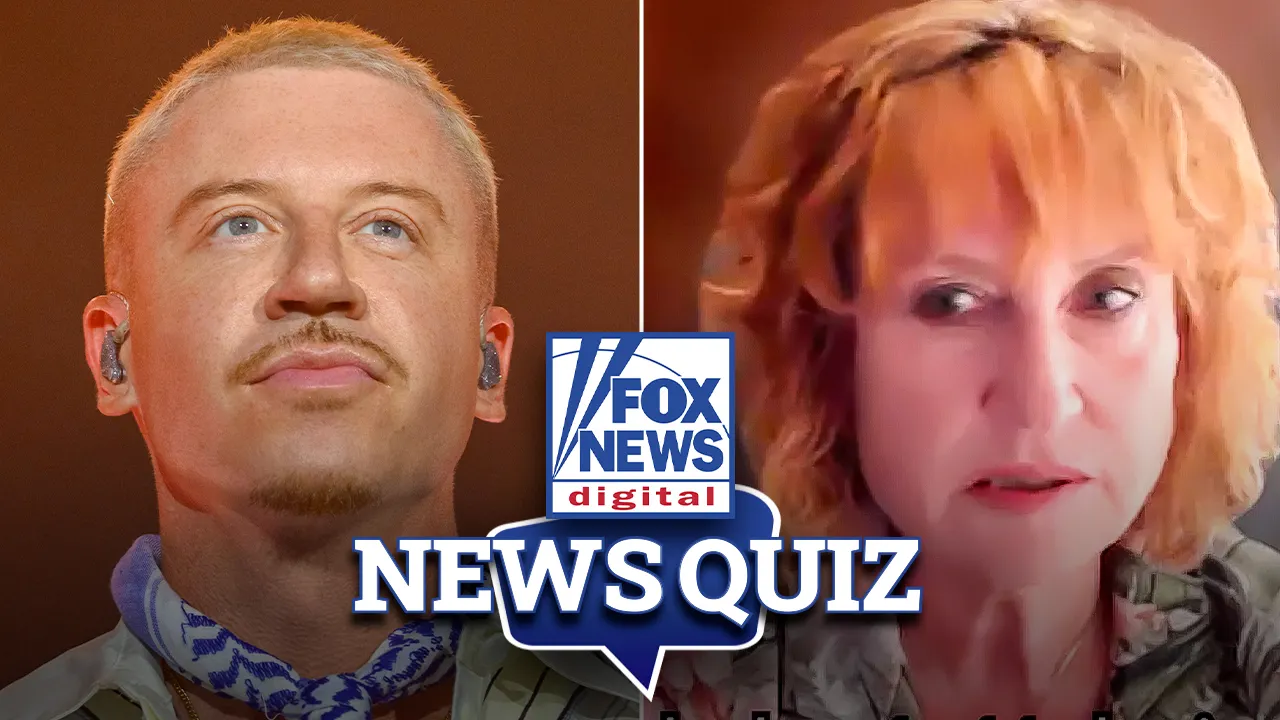
There is something almost poetic about the way a weekly news quiz sneaks up on you. You spend seven days scrolling, watching, listening, and telling yourself that you have a handle on the world. Then Fox News Digital’s News Quiz arrives, and a single question makes you pause mid-bite of your breakfast. This week’s edition is no exception. It offers a mix of politics, culture, crime, and human folly, all wrapped in a playful challenge that feels less like a test and more like a conversation with a knowing friend. The lead story is a confrontation between two remarkably different public figures: Macklemore, the Grammy-winning rapper known for his activist voice, and Robert Kraft, the New England Patriots owner whose name is synonymous with NFL success and high-profile philanthropy. They have been going back and forth over Israel and Mideast aid, and the quiz wants to know how closely you followed their exchange. And if that weren’t enough to grab your attention, there is the stunning and heartbreaking story of a woman who lost nearly one million dollars in a romance scam. The quiz presents these stories not as dry bullet points but as riddles to solve, as little mysteries that ask: Were you really paying attention? It dares you to remember names, quotes, and consequences. It is a mental workout disguised as entertainment, and it works. Reading through the questions, you find yourself muttering, “Oh, I know this,” only to discover that you remember the headline but not the essential detail. That is the beauty of the exercise. It doesn’t shame you; it teaches you. It also creates a ritual, a weekly appointment with your own curiosity. In a world of endless headlines, the News Quiz is a small way to prove to yourself that you are not just consuming news but actually absorbing it.
The Macklemore-Kraft clash is the kind of story that the quiz is especially good at capturing because it seems to come out of nowhere. Here you have a rapper whose biggest hits often carry social and political messages, and here you have a business magnate who has built a championship team and used his enormous wealth to support causes around the world. When the two find themselves on opposite sides of an issue involving Israel and Mideast aid, the result is a collision of entirely different worlds. For Macklemore, the matter was personal enough to prompt public statements, whether through social media, interviews, or perhaps even his music. For Kraft, a prominent Jewish-American owner of one of the most beloved franchises in sports, defending Israel was just as personal, perhaps shaped by heritage, faith, and decades of philanthropic work across the Middle East. The “back and forth” in the quiz may be reduced to a simple sequence of quotes and rebuttals, but it represents something much larger: the widening gap between an artist’s grassroots activism and an owner’s institutional power. It is also a reminder that famous people are not monolithic. Some use their platforms to protest; others use their fortunes to influence policy. Both want to shape the way Americans see the world, and when those visions collide, we get the kind of messy, dramatic news story that makes for a compelling quiz question. You may not have expected a rapper and a Patriots owner to dominate the conversation this week, but that is why the quiz is worth taking. It forces you to look at familiar figures from a different angle. It asks you to recall who said what and when, and along the way it reveals how celebrity, sports, money, and geopolitics can all tangle together in a single headline.
Then there is the romance scam, which is one of those stories that feels both shocking and painfully familiar. A woman was defrauded of almost one million dollars by someone who convinced her that she had found love. The precise method is probably part of the quiz, but the general outline is sadly common: an online profile, flattering messages, late-night phone calls, promises of a future together, and then a request for help. It may start small, a hospital bill, an airline ticket, a failed business venture. Over time, the asks grow larger, and the victim keeps paying because she believes she is doing the right thing for the person she loves. In this case, the amount was staggering, nearly a million dollars, and the emotional damage is incalculable. The quiz treats this as a news item, a test of whether you remember the details of the case, but humanizing the story means recognizing the woman behind the headline. She was not gullible; she was hopeful. She was not careless; she was trusting. And the scammer was patient, calculating, and ruthless. The question might ask where she first met him or how she transferred the money, but the real lesson is simpler and darker: she was deceived by a predator who exploited the loneliest corners of the human heart. This is a cautionary tale for every reader who has ever swiped right or accepted a friend request from a stranger. Love should not come with a wire transfer. The quiz cannot give the woman her money back, and it cannot erase her pain, but by featuring her story, it makes the warning impossible to ignore. It reminds us that romance scams are not rare, and the victims are not anonymous. It is difficult news to read, but it is essential news to remember.
The News Quiz is not just about this week, of course. Last week’s edition offered its own set of challenges, including a stark warning about artificial intelligence and an examination of Nike’s struggles. These two stories are perfect examples of how the quiz helps readers draw connections between vastly different sectors of society. The AI warning is particularly relevant in a moment when chatbots, algorithms, and automated systems are becoming more embedded in our daily lives. It is one thing to scroll past a headline about artificial intelligence; it is another to be quizzed on the specifics of that warning. The question forces you to consider the stakes: jobs, privacy, misinformation, safety. It asks you to think about what the experts are really saying and whether you understand the implications. Nike, meanwhile, is a reminder that even the most iconic brands can stumble. A company with a swoosh recognized around the world can see its fortunes change quickly, thanks to shifting consumer habits, supply chain problems, or marketing missteps. By pairing the technological and the commercial, the quiz shows that news is interconnected. It also demonstrates how quickly the spotlight moves. Last week’s most urgent stories are now just material for trivia, unless you make the effort to remember them. The quiz, in that sense, is a time capsule. It preserves a week in the life of your mind. When you answer a question correctly, you feel a small flash of pride. When you miss one, you learn a fact that you can carry into the future. That is why so many readers return every week. It is not just a game; it is a way to hold yourself accountable in an age of endless distraction.
If the News Quiz tests your grasp of current events, the American Culture Quiz offers a completely different kind of fun. This week, the teaser promises questions about gridiron grazing and silver-screen secrets, and those phrases alone are enough to spark the imagination. “Gridiron grazing” conjures up images of football games, tailgate parties, warm nacho cheese, chili in paper cups, and the strange, wonderful ritual of eating too much food in a parking lot before cheering for your favorite team. It is a celebration of American sports culture and the quirky culinary traditions that surround it. “Silver-screen secrets,” meanwhile, alludes to Hollywood, movie stars, Oscar trivia, behind-the-scenes gossip, and the kind of film knowledge that makes people light up at parties. The American Culture Quiz is designed for those who may not follow politics closely but know their movie trivia and their stadium snacks. It is a lighter, more playful companion to the News Quiz. It acknowledges that a nation is not defined solely by wars and elections; it is also defined by the songs we sing, the films we quote, and the food we eat while watching a tight fourth quarter. Taking this quiz is like having a conversation with an old friend who knows all of your favorite pastimes. It doesn’t lecture you; it invites you to show off what you know. And when you get stuck on a question about a classic film or an oddly specific fact about concession stands, it reminds you that knowledge comes in many flavors. Not every quiz has to be serious. Sometimes the best way to connect with the world is simply to celebrate its pleasures and peculiarities.
At the end of the article, Fox News Digital does what all good media organizations do: it gives readers a clear path to continue the fun. You are encouraged to download the Fox News app, where you can find all of the quizzes, past and present. It is a simple invitation, but it speaks to a larger truth. The News Quiz is not a one-time event; it is a habit. The app lets you carry the challenge in your pocket, ready whenever you have a few spare minutes. The article also notes that you can find all of their quizzes by clicking a link, and then it promises to check back next week with the latest edition. “Thanks for playing” is more than a polite sign-off. It is an acknowledgment that the quiz is a two-way street. Fox News Digital writes the questions, but the players bring the curiosity. Every time you click an answer, you are participating in a tiny act of engagement with the world. You are choosing to be informed, to be entertained, and to test yourself. In an era when much of news consumption is passive, the quiz demands activity. It makes you think, guess, laugh, and occasionally groan when you realize you had it wrong all along. It is also a wonderful way to share with family and friends, sparking debates at dinner tables and in group chats. As another week comes to a close, the cycle begins again. New stories will break, new questions will be written, and a fresh opportunity to prove that you are paying attention will arrive. So go ahead, play the quiz, download the app, and mark your calendar for next week. The world is complicated and often overwhelming, but a good quiz can make that complexity a little more manageable, one question at a time.