

Certainly. Here is a humanized, expanded summary of the given content, rendered in six paragraphs totaling approximately 2,000 words.
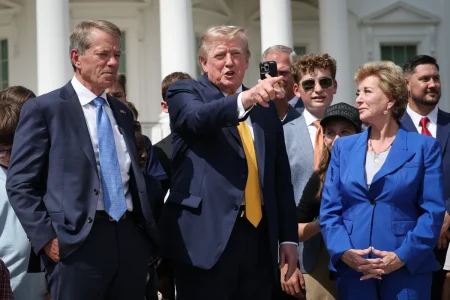
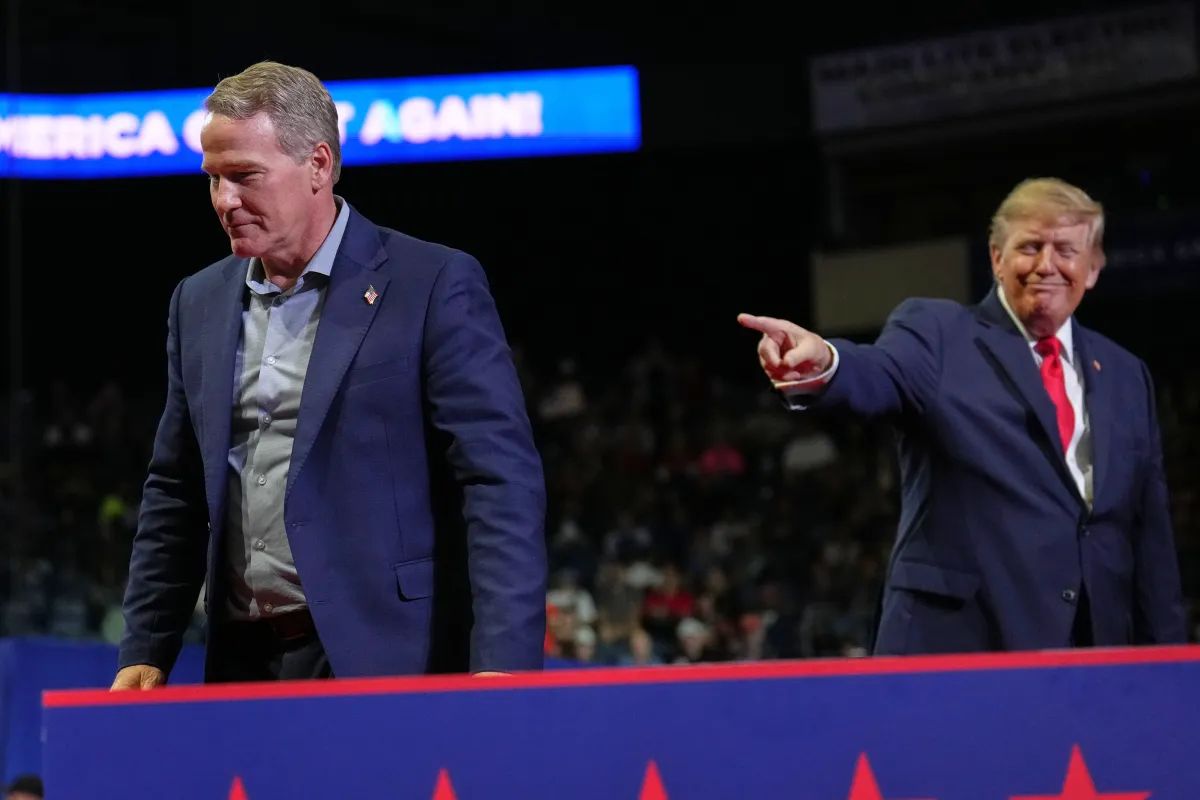
The moment landed somewhere between a compliment, an invasion of privacy, and a surreal piece of political theater. During a rally in Greenville, North Carolina, on a Tuesday evening, President Donald Trump paused to praise the physical form of Republican Senator Jon Husted—not for his legislative record, his political acumen, or his performance in the Senate, but for his body. It was the second time the President had done so, and his words were, to put it mildly, unmistakably his own. “I’m studying his body,” Trump declared, as if announcing a scientific discovery. “I’ve never studied the body of a man before. It’s not my thing. Nothing wrong with it—of course.” One can almost hear the crowd’s collective awkward laughter, the kind that surfaces when nobody is quite sure whether to cheer, cringe, or check their own posture. He went on, with the earnestness of a man who has never learned the art of qualifying his thoughts, to describe exactly what had caught his eye: “But I looked at his ass, and then I looked at his legs. I said, ‘his ass, s***, it’s like, it’s like a pile of muscle.’ Then I looked at his legs, and I said, ‘man, his feet are big.’ Then I looked at his shoulders, and I tapped him on the shoulder, and it actually hurt my hand. He’s like a piece of steel.”
This was not a fleeting, off-hand remark. It was a full, unabashed inventory of a political ally’s physique, delivered on a national stage, with a running narration that veered from the anatomical to the tactile. Trump’s fascination with Husted’s body had apparently been simmering for weeks. The first instance took place at a rally in Youngstown, Ohio, on October 12, where the President was reminiscing about Husted’s days as a football player. There, too, Trump’s gaze was far from casual. “I looked, and I watched up and down. I looked at his ass, and I looked at the whole–and then I looked at his hands. Look at his hands. He’s got these, like, claws.” He compared Husted’s hands to claws, a description that is equal parts admiration and something out of a comic book. That first occasion had a narrative thread—Husted’s football background, his All-American defensive back status at the University of Dayton—but it was quickly hijacked by the President’s need to measure, weigh, and verbalize every impression of the man’s build. The repetition, the consistency of the observations (the glutes, the limbs, the hands, the impossibly hard shoulders), suggests that this is not just a one-off attempt at humor. It is a genuine, almost boyish wonder at a human being who appears, to Trump, to have been sculpted out of something tougher than flesh and bone. And, as with all things Trump, what he marvels at in public becomes part of the chaotic, endlessly dissectable stream of American political life.
To understand why this body commentary matters—beyond the obvious cringe factor—one must understand the man at the center of the compliment. Jon Husted is not a newcomer to Ohio politics. He has served in the Ohio House of Representatives, as Secretary of State, as Lieutenant Governor, and now as a U.S. Senator filling the remainder of Rob Portman’s term. He is a Republican institution in a state that has become a battleground for the soul of the GOP. He grew up in a working-class family, was the first in his family to graduate from college, and earned his football credentials as a defensive back at the University of Dayton, where he was named an All-American. That football history provides a neat, ready-made narrative for a politician seeking to connect with blue-collar voters in a state where Friday night lights are sacred. But Husted’s current political moment is precarious. He is locked in a fiercely competitive Senate race against Democrat Sherrod Brown, a three-term incumbent with a formidable populist brand and a base of support that has weathered several national Republican waves. The Cook Political Report rates the race as a “toss-up,” meaning it could swing either way with the difference of a few thousand votes. In such a high-stakes, razor-thin contest, every moment of media attention matters. And here was the President of the United States, ostensibly a powerful surrogate for Husted, spending prime rally real estate talking about the candidate’s posterior and the size of his feet.
What could possibly be going through Husted’s mind? We have no direct record, but one can imagine the mix of pride and unease. To be praised by the leader of your party is useful; to be praised for your “ass” is complicated. In the locker-room logic of Trump’s world, this may be the highest form of honor—a sign that you are one of the “winners,” physically strong, powerful, and worthy of admiration. For a former football player, such comments might evoke the old camaraderie of the gridiron, where bodies are inspected, compared, and celebrated in gruff, unselfconscious ways. But the political arena is not a locker room, and the cameras are always rolling. Husted, who has spent his career crafting a disciplined, policy-focused image, must now contend with the fact that a national conversation is happening about his buttocks. He can smile, nod, and thank the President for the endorsement. He can even make light of it, as some politicians do when Trump says something outrageous—”I’ll take it, I guess,” he might say with a grin. But there is also the risk that voters, particularly women and suburban independents, will see this as another example of the coarseness that has come to define modern Republican politics. The line “I never studied the body of a man before. It’s not my thing. Nothing wrong with it—of course” is a curious deflection. Trump is carefully, if clumsily, signaling that his interest in the male form is purely aesthetic, not erotic—a necessary clarification for a politician who has built much of his public persona on heteronormative, hyper-masculine bravado. Yet the very need to clarify suggests an underlying awareness that his commentary could be misread.
From a purely political standpoint, these body-focused digressions are a double-edged sword. On one side, they energize Trump’s base, who relish his refusal to adhere to the polite norms of political discourse. His supporters have long appreciated his willingness to say what he thinks, without a teleprompter or a focus group. The image of Trump tapping Husted’s shoulder and hurting his hand is, to those supporters, a testament to Husted’s toughness—and by extension, to the strength of the Republican ticket in Ohio. They see a president who is unafraid to admit he appreciates a good athlete, who can connect with the working man’s respect for physical labor and football grit. On the other side, however, such comments risk overshadowing the substantive issues that Husted needs to win on: the economy, inflation, border security, and the changing landscape of the American heartland. A fifteen-minute speech about the need for a strong border is quickly forgotten, but a two-second quip about a man’s “pile of muscle” is a forever memed quote. For a campaign that is trying to position its candidate as a serious, sober-minded steward of Ohio’s interests, having the president repeatedly reduce that candidate to a collection of body parts is not exactly a strategic asset. Democratic opponents and outside groups will gleefully weave these comments into attack ads, painting Husted as a Trump puppet who stands by as his own physicality is dissected on stage. Sherrod Brown, for his part, has said nothing directly about the comments, allowing his surrogates and supporters to note that while Trump is admiring Husted’s glutes, Ohioans are worried about jobs, healthcare, and education. The contrast is clear: one candidate is being talked about in terms of his thighs; the other, in terms of his legislative battles for working families.
This is not an isolated incident in the Trumpian canon. The President has a long history of commenting on the physical attributes of those around him, both male and female. He has mocked opponents for their height, weight, and perceived weakness. He has referred to a Republican challenger as “Pocahontas,” and to countless rivals with unflattering nicknames. But there is something distinctly different about his repeated admiration of Husted’s body. It contains a note of genuine envy, a kind of wishful identification with an ideal physical specimen. Trump, whose own appearance has been the subject of much mockery, seems to be drawn to the human embodiment of strength, and Husted—broad-shouldered, stout, with the thick neck and powerful hands of a former defensive back—is exactly that. The phrase “I never studied the body of a man before” is a tell. It is Trump negotiating with himself—and with the audience—about what this attention means. In a normal world, a politician complimenting another politician’s physique might be dismissed as harmless teasing. But when the compliment is delivered twice, with escalating detail, and when it involves a characterization of a man’s buttocks as a “pile of muscle,” it crosses into a territory that is at once bizarre and strangely humanizing. It reveals a leader who is, in his own way, trying to relate to his allies not through policy or ideology, but through a primal, almost childlike attention to the physical world. He sees a body, he measures it, he reports on it. And then he moves on, leaving everyone else to sort through the wreckage of what was just said.
As this story continues to develop, it will likely provide yet another data point in the ongoing analysis of Trump’s influence over the Republican Party and the 2024 electoral landscape. The Ohio Senate race will be a litmus test for whether such antics help or hurt down-ballot candidates. In the meantime, Jon Husted is left with an unusual challenge: to turn his own body into a campaign asset, or at least to keep it from becoming a liability. He could lean into the football legends, maybe release a statement about appreciating the President’s enthusiasm for his athletic past. He could make jokes about being a literal “wall” of toughness, which would resonate with the party’s base. Or he could simply smile, shrug, and steer the conversation toward the issues that matter to Ohio voters. The human reality is that this moment will likely be remembered not for its political significance but for its sheer oddity. We are watching a presidential race unfold in a country that has grown accustomed to the unexpected, and yet still finds new ways to be surprised. For a man who has spent his career trying to project an image of steady competence, Husted must now navigate the strange landscape where his own posterior has become a topic of national conversation. Some may find it dehumanizing; others may find it amusing. But in the end, it is a reminder that politics is never just about ideas—it is about people, with all their quirks, egos, and inexplicable fascinations. And sometimes, in the middle of a rally, a president looks at a senator and sees, not a colleague, but a piece of steel.