


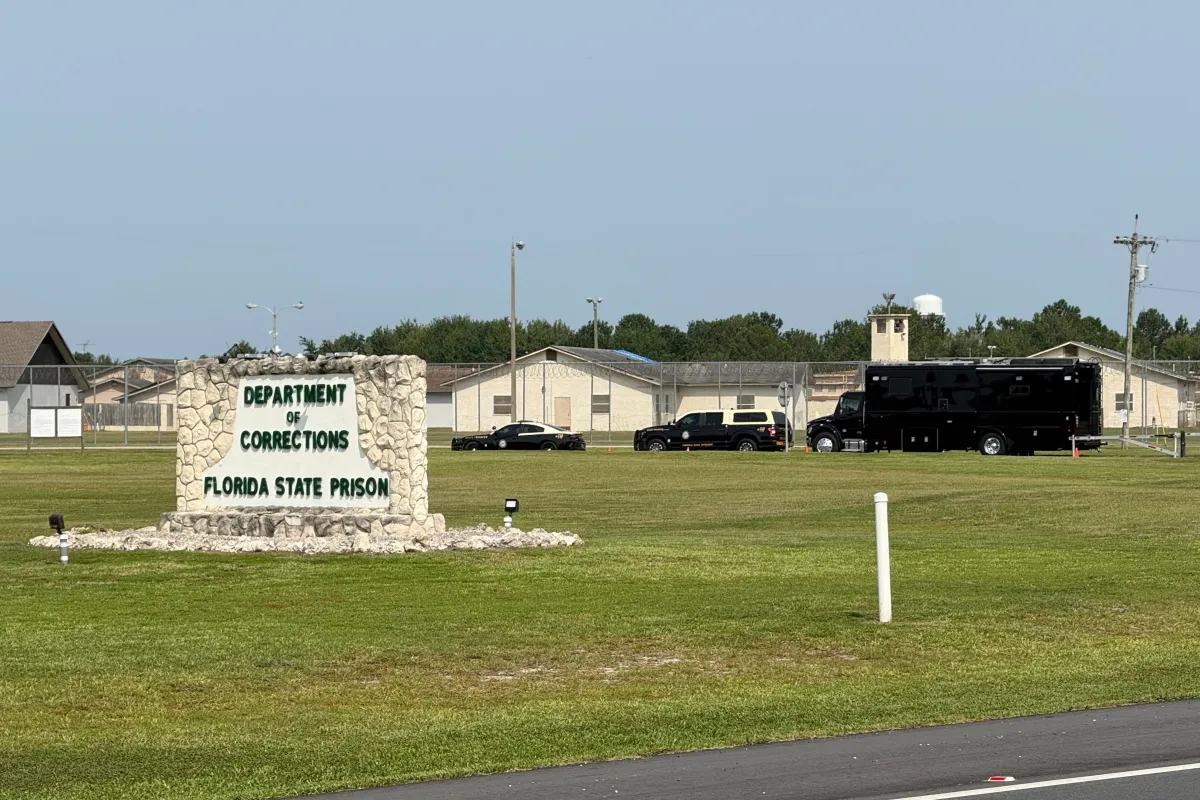
On a Tuesday evening in rural North Florida, inside the walls of Florida State Prison near Starke, a 77-year-old man named William Reaves was pronounced dead at 6:12 p.m., becoming the 18th person executed in Florida in 2026. The room was quiet, clinical, and orderly, but everything around it was heavy with decades of grief, anger, and unresolved questions. Reaves had been sentenced to death for the 1986 shooting death of Indian River County Sheriff’s Deputy Richard Raczkoski, a husband, father, and public servant who answered a 911 call and never came home. For 34 years, Reaves sat on death row while lawyers argued, courts deliberated, and families waited. When the three-drug lethal injection finally ended his life, the sheriff who now wears the badge that Raczkoski once wore did not speak of triumph. “Would we all be so lucky to be 77 years old and to die so peacefully?” Sheriff Eric Flowers said afterward. “That’s not justice in any way, in my opinion.” It was a striking moment—a law enforcement officer looking at an execution and calling it something other than justice. For some, the death of an elderly killer was the long-delayed fulfillment of a verdict; for others, it was a disturbing spectacle of punishment carried out on a frail old man who had spent more than half his life waiting to die.
Florida has become the undisputed center of capital punishment in America under Governor Ron DeSantis, who has signed death warrants with unusual speed during his final term. The execution of Reaves was the state’s 18th of the year, and with another execution already scheduled for November 5, Florida could tie its own record of 19 executions in a single year, a mark set just last year. To put that in perspective, Florida has carried out 18 of the 32 executions performed in the entire United States this year, according to the Death Penalty Information Center. No other state comes close. Texas, long known as the most active death penalty state, has executed far fewer. The pace has transformed Florida into an outlier, not only in the number of executions but in the unmistakable image of what those executions look like. Reaves was the eighth Florida prisoner aged 70 or older put to death this year. That statistic is not an accident. It is the result of decades of appeals, evolving legal standards, and a governor who has shown little patience for further delays. The men being executed are not young offenders caught in the heat of a terrible moment; they are elderly, often infirm, and profoundly changed by the passage of time. They have lived behind bars longer than many of their lawyers have been alive. They have watched the country change, the legal system change, and their own bodies break down. And then, one evening, they are wheeled or walked into a sterile room and put to death by the state. The question that hangs over each of these executions is whether justice is served when the person being punished barely resembles the person who committed the crime.
The aging of death row is a phenomenon that has been building for decades, and Florida has become its starkest example. Reaves was sentenced to death 34 years before his execution, and several other Florida inmates executed this year also spent nearly three decades or more waiting for their cases to run their course. The Death Penalty Information Center has documented that the median age of executed inmates in the United States has steadily increased as appeals have grown longer and more complex. On one hand, supporters of capital punishment insist that lengthy appellate review is essential to protect constitutional rights and to prevent the irreparable mistake of executing an innocent person. They argue that the delay, however agonizing, is a feature of a system that takes life seriously. On the other hand, opponents of the death penalty look at the same delay and see a cruel absurdity. If the purpose of execution is retribution, deterrence, or closure, what does it mean when the condemned person is 77, 80, or even older, suffering from chronic illness and decades removed from the violence that put them there? What does it say about a society that insists on killing people who are already nearing the end of their natural lives? The debate is not new, but the sight of so many elderly men on Florida’s execution gurney has given it new urgency. The state has scheduled executions for multiple inmates in their 70s and even an 80-year-old, prompting questions about whether the punishment has become more about the state’s need to show resolve than about any coherent theory of justice. There is something deeply unsettling about watching a government spend millions of dollars and decades of legal effort to ensure that a man who has been locked away for a third of a century is finally killed, not because he is dangerous, but because a verdict from a different era demanded it.
The life of William Reaves makes the question even more complicated. He was not simply a convicted murderer; he was also a veteran of the Vietnam War, a man the U.S. Department of Veterans Affairs had determined to be 100 percent disabled due to service-related post-traumatic stress disorder. His attorneys argued that the jurors who sentenced him to death were never told about that disability, that the trauma he carried from combat might have shaped the events of that terrible September day in 1986 in ways the court never fully considered. They challenged Florida’s lethal injection protocol, arguing that the drugs and procedures could cause unnecessary pain. They filed appeals with the Florida Supreme Court and the U.S. Supreme Court. More than 100 military veterans, moved by the case, appealed directly to Governor DeSantis to halt the execution, asking him to show mercy to a man who had once served his country in the jungles of Southeast Asia. The governor did not intervene. The courts declined to stop the execution. In the end, the legal system did what it was designed to do: it followed the procedures, considered the arguments, and allowed the sentence to be carried out. But the refusal to pause and consider the full arc of Reaves’s life—the young soldier, the damaged man, the decades of imprisonment—left many with the uncomfortable feeling that the machinery of justice had become too rigid to see the human being in front of it. Reaves was not a symbol. He was a real person with a history, a mind, and a past that included both service and horror. By the time he was executed, he was a frail old man whose life had been consumed by a single act of violence and its endless aftermath.
That act of violence, however, cannot be forgotten. On September 23, 1986, Deputy Richard Raczkoski responded to a 911 call at a Vero Beach convenience store. Reaves was there. During the encounter, a gun fell from his clothing, and the two men struggled. Investigators later said that Raczkoski was trying to flee when Reaves shot him four times. The deputy died from his injuries. He left behind a family, a community, and a legacy of service that Indian River County has never let go. For nearly four decades, Raczkoski’s brother, Marc Raczkoski, carried the weight of that loss. After watching Reaves die on Tuesday, Marc told reporters that his brother had finally received justice. It was a simple, direct statement, the words of a man who had waited 34 years for a moment he believed would bring some kind of peace. Sheriff Flowers, however, chose a different word: closure. He did not describe the execution as justice, but as an ending, a final chapter in a story that had haunted his community for a generation. Perhaps that is the most honest way to describe what happened. There is no way to measure whether the death of a 77-year-old prisoner restores anything to the family of the man he killed. There is no scale that weighs the suffering of one family against the suffering of another. There is only the grim finality of an execution, the cold reality that a life has been taken by the state, and the hope that, for the people who loved Richard Raczkoski, this can finally be over.
Florida’s execution chamber will not be empty for long. Jesse Guardado is scheduled to be executed on November 5, and if that lethal injection proceeds, the state will match its record of 19 executions in a single year. The pace shows no sign of slowing, and the demographics of the condemned show no sign of changing. The men waiting on death row are older, sicker, and more likely to have spent decades in solitary confinement than at any point in American history. As Florida continues to push forward, the country is watching a kind of social experiment unfold: what happens when a society decides that finality matters more than mercy, that old men must be killed to prove that the system works, and that the slow crawl of appeals is not a protection but an obstacle to be overcome. The execution of William Reaves did not answer the questions it raised. It only made them more visible. In the sterile room where he died, there was no peace, no triumph, no obvious justice. There was only an old man, a grieving brother, a sheriff searching for words, and a state that had decided, after 34 years, that the time for waiting was over.