





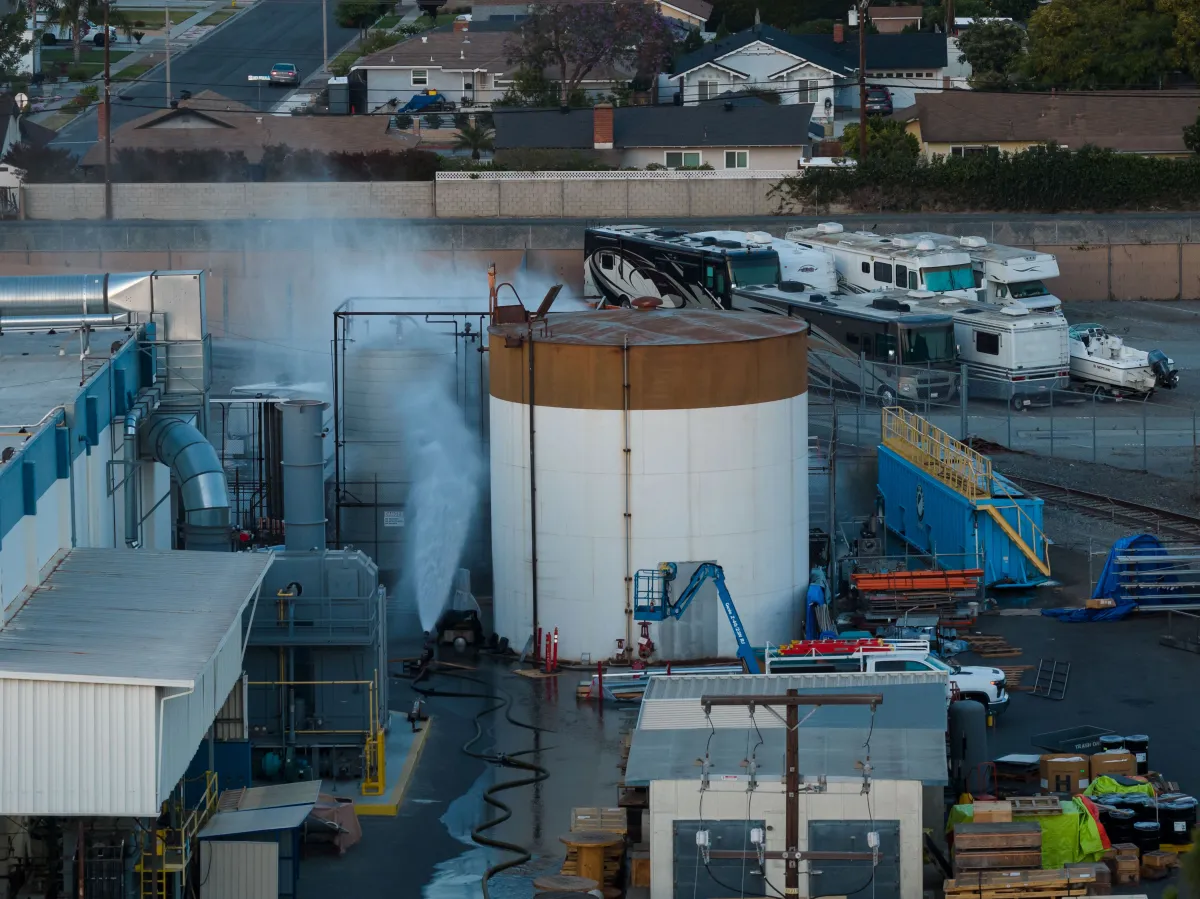
In the quiet suburbs of Garden Grove, California, what was a routine Thursday evening transformed into a scene of sudden panic, turning the lives of tens of thousands of residents upside down. Sirens pierced the night air as emergency officials issued urgent, mandatory evacuation orders, forcing families to hastily gather whatever belongings they could carry, such as treasured photo albums, vital medications, pet supplies, and basic necessities, before fleeing. The source of this widespread disruption was a volatile situation unfolding at the local GKN Aerospace facility, where an industrial storage tank had begun dangerously overheating, casting an invisible shadow of danger over the entire community. For several grueling days, normally bustling residential neighborhoods stood completely deserted, transformed into eerie, silent ghost towns where the only signs of life were the flashing lights of emergency vehicles and the persistent, heavy rumble of fire engines. This was not just a logistical challenge; it was a deeply human crisis of displacement, sudden separation, and profound anxiety. Families huddled in local emergency shelters or crowded into the spare bedrooms of relatives, their eyes glued to their phones as they waited for any scrap of news from incident commanders. The psychological toll of being suddenly cast out of one’s home, suspended in a state of constant worry about whether everything you own might be destroyed in a sudden industrial explosion, weighed heavily on the hearts of the displaced. The GKN facility, typically a quiet symbol of local economic stability, had suddenly become a ticking timebomb, turning a tight-knit community into a collective unit of worried onlookers praying for a peaceful resolution to a silent, chemical siege. Neighbors checked on elderly residents and helped one another navigate the sudden exodus, illustrating a deep-seated humanity amid the looming uncertainty. As the days wore on, this shared trauma bound the community together, transforming their fear into a resilient vigil.
At the heart of this terrifying standoff with disaster lay a highly sophisticated, yet incredibly dangerous, chemical compound known as methyl methacrylate, which was stored inside the distressed aerospace tank. Primarily used in the manufacturing of high-strength plastics, acrylic sheets, and various medical prosthetics, this chemical is incredibly useful in modern manufacturing but becomes a volatile monster when exposed to uncontrolled heat. The technical specialists monitoring the situation feared the onset of a phenomenon known as thermal runaway. In the realm of industrial chemistry, thermal runaway is a worst-case scenario, an accelerating, self-sustaining loop where an increase in temperature triggers chemical reactions that generate even more heat, which in turn drives the temperature up further, causing pressure to build inside a sealed container at an exponential rate. If this runaway reaction is not halted, it inevitably leads to a catastrophic structural failure, culminating in a violent rupture or a devastating, large-scale explosion that would send toxic shrapnel and chemical fireballs tearing through the surrounding neighborhoods. Making this nightmare scenario even more complex and frustrating for responders was a jammed, malfunctioning valve on the tank itself. This mechanical failure completely blocked firefighters from executing their primary plan, which would have been to safely drain the volatile liquid or inject neutralizing agents directly into the vessel to render the chemical inert. Prevented from accessing the interior, emergency crews were left with only one viable, yet highly fragile, line of defense: continuously dousing the massive steel container with millions of gallons of water from the outside in a desperate, around-the-clock bid to cool the metal, lower the internal temperature, and prevent the volatile compound from reaching its point of no return. This delicate cooling operation required absolute precision, massive volume, and tireless dedication, as firefighters worked in constant peril, knowing that the structural integrity of this massive metal tank was degrading with every passing second.
As the stalemate dragged into its third exhausting day, standard defense measures were proving insufficient to guarantee public safety, prompting incident commanders to authorize a high-stakes, extremely risky reconnaissance mission in the middle of the night. A specialized team of subject-matter experts and elite firefighters from the Orange County Fire Authority volunteered to enter the hazardous hot zone under the cover of darkness to secure the first direct visual inspection of the volatile tank. Stepping into the pitch-black, mist-filled perimeter of the GKN Aerospace facility, these brave individuals had to confront not only the intense physical dangers of toxic chemical exposure but also the immense psychological weight of walking directly toward a potential bomb. Dressed in bulky, suffocating hazardous materials suits and relying entirely on self-contained breathing apparatuses, they navigated a labyrinth of emergency hoses, debris, and pooling water, with the constant, intimidating hiss of venting chemical vapors echoing in their ears. Every single step required absolute focus, as a single spark or misstep could have triggered the very explosion they were trying so desperately to prevent. Fire Chief TJ McGovern later lauded the incredible courage of this reconnaissance crew, emphasizing that their willingness to put themselves in harm’s way was driven by a deep, unwavering commitment to protecting the thousands of displaced families. Using specialized, spark-proof thermal imaging cameras and diagnostic equipment, the team successfully breached the immediate area surrounding the tank, capturing high-resolution photos and critical structural data that would prove to be the ultimate turning point in this multi-day battle, demonstrating the profound selflessness and professionalism that define our first responders during moments of absolute crisis. This late-night gamble was a testament to the calculated bravery of modern firefighting, where tactical decisions are carved out of raw courage and scientific discipline, shining a spotlight on the human shield protecting everyday suburban families from catastrophic industrial accidents.
The breakthrough that occurred during this daring midnight operation was both shocking and profoundly hopeful, as firefighters discovered a physical feature on the tank that would fundamentally alter the emergency response strategy. As the specialized team illuminated the towering, moisture-streaked metal surface of the container, they identified what appeared to be a distinct, structural crack running along the side of the tank. In almost any other hazardous materials incident, the discovery of a crack in a highly pressurized vessel containing volatile chemicals would be a cause for absolute panic, signaling an imminent, catastrophic rupture. However, in this highly unique, inverted scenario, the potential fracture presented a bizarre glimmer of hope, acting as an unplanned, natural safety valve for the volatile contents inside. If validated, this crack indicated that the tank’s skin was slowly and steadily venting the dangerous build-up of internal pressure, preventing the container from reaching the critical threshold required for a devastating thermal runaway explosion. Fire Chief TJ McGovern announced this critical development in an early morning video update shared with the public on the social media platform X, providing a wave of cautious optimism to a weary community and exhausted emergency crews alike. This unexpected twist highlighted the unpredictable nature of chemical emergencies, where salvation can present itself in the guise of structural damage. The discovery immediately changed the tone at the incident command post, shifting the atmosphere from one of tense, defensive dread to active, tactical planning, bringing absolute clarity where there was once only chaos. For days, the primary fear had been a sudden, catastrophic shattering of the vessel; now, this micro-venting crack offered a potential exit ramp from the crisis. It was a vivid reminder of the complexity of physical mechanics under pressure, where the rules of normal operations are entirely rewritten, and where a sign of weakness in a steel structure can suddenly become the very lifeline that saves an entire neighborhood from destruction.
Despite the immense relief brought by the midnight discovery, the battle was far from over, shifting from a physical confrontation on the ground to an intense, analytical challenge in the command tents. Before any decisions could be made regarding the lifting of evacuation orders or the repatriation of the thousands of displaced Garden Grove residents, the raw data, infrared imagery, and structural metrics gathered by the brave reconnaissance team had to be rigorously vetted. Technical specialists, including chemical engineers, metallurgists, and structural integrity experts, immediately began working around the clock to validate whether this suspected crack was indeed facilitating a safe, controlled reduction of internal pressure. They had to ensure that the crack was stable and not expanding rapidly toward a catastrophic, complete failure of the container’s walls under the immense stress of the chemical reaction. This scientific process required painstaking calculation, modeling the exact thermodynamics of the methyl methacrylate and calculating the precise rate of pressure decay against the structural threshold of the damaged metal. The heavy burden of responsibility rested squarely on the shoulders of these technical experts, who understood that a single miscalculation could invite disaster, putting the lives of both returning citizens and on-site emergency personnel at grave risk. This phase of the operation highlighted the quiet, intellectual heroism that occurs behind the scenes of major emergencies, where mathematical models, science, and technical precision serve as the vital gatekeepers of human safety, ensuring that hope is never prioritized over hard, empirical evidence. Every thermal scan and structural stress model was run repeatedly to predict behavior under these unprecedented conditions. The incident commanders made it abundantly clear that they would not let their guard down prematurely, refusing to yield to public pressure until the scientific data offered an absolute, ironclad guarantee of safety, demonstrating that true leadership lies in the patience to verify facts first.
As the scientific validation process continues, the resilient residents of Garden Grove remain in a state of suspended animation, holding onto a newfound sense of hope while waiting patiently for the final word that it is safe to return home. The strict evacuation orders remain in place, serving as a buffer between the volatile site and the surrounding human lives. This incredibly intense, high-stakes chemical standoff at the GKN Aerospace facility has profoundly impacted the community, yet it has also revealed the extraordinary strength, compassion, and unity of the people of Southern California. From the tireless, compassionate volunteers managing the emergency shelters to the neighbors opening up their homes to displaced families, this ordeal has highlighted a beautiful tapestry of human kindness in the face of sudden adversity. In local school gymnasiums, community halls, and civic centers, parents worked diligently to keep young children entertained with board games and makeshift movie nights, finding joy in small moments of connection despite their upended routines. Nearby businesses quickly stepped up as well, with local pizzerias and grocery stores donating high volumes of fresh, warm food and bottled water, proving that in times of crisis, no one stands alone. Furthermore, local animal shelters cooperated closely with emergency managers to provide pet-friendly accommodations, ensuring that beloved family dogs, cats, and other pets were not left behind to face the chemical threat alone. This comprehensive care relieved a massive burden of worry for pet owners who refused to leave without their furry companions. Ultimately, this high-stakes standoff showed that while technical challenges of industrial emergencies are vast, the human capacity for mutual aid, compassion, and structural organization is infinitely greater. The impending resolution of this crisis, guided by the heroism of the firefighters who braved the dark and the meticulous calculations of the scientists, will leave behind a legacy of absolute dedication to public safety. As emergency crews continue to monitor the tank, ready to transition from high-risk containment to a controlled, permanent mitigation strategy, the community looks forward to a joyful reclamation of their neighborhoods. When the physical barriers are finally taken down and the families return to their homes, they will do so with a profound appreciation for the invisible network of protectors, first responders and scientists alike, who stood watch in the darkest hours of the night. This dramatic incident will always be remembered as the week their community stood strong, bound by shared anxiety and saved by the ultimate triumph of human courage over volatile chemistry. Their return home will not just be a return to normalcy, but a celebration of resilience, survival, and the enduring power of community spirit.