




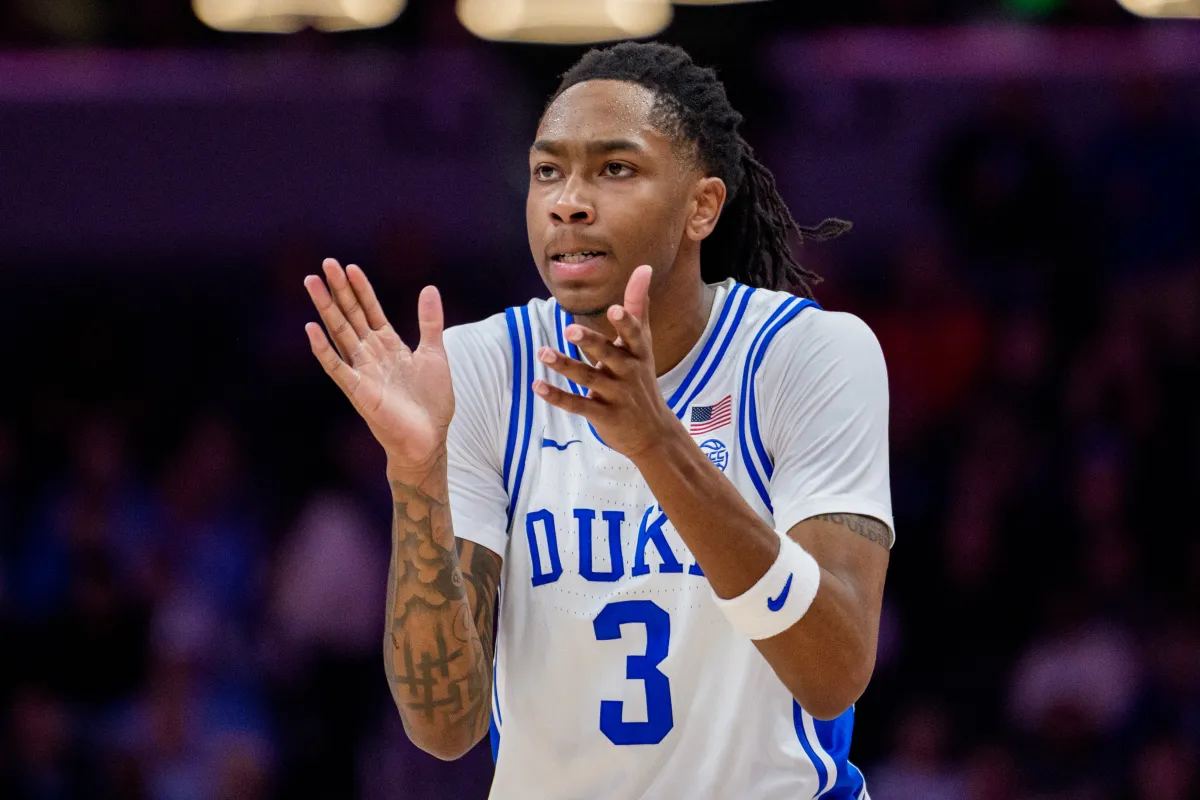
The basketball court inside Cameron Indoor Stadium is more than just a polished wooden floor; it is a sacred, high-pressure crucible where raw youthful potential is systematically forged into the gold standard of professional basketball. For decades, the Duke University men’s basketball program has operated as an elite finishing school, churning out a relentless assembly line of transcendent NBA talent, from the legendary grace of Grant Hill to the unstoppable offensive wizardry of Kyrie Irving, Jayson Tatum, and Zion Williamson. The latest prospect to find himself caught in this dazzling, historical spotlight is Isaiah Evans, a dynamic and fiercely determined young shooting guard who has captured the undivided attention of NBA scouts, front-office executives, and basketball purists around the globe. As draft analysts begin to construct their preliminary mock projections for the 2026 NBA Draft, Evans’ name has steadily climbed into the conversation, carrying with it the immense expectations that naturally accompany anyone who wears the iconic collegiate blue and white. Playing under the microscope in Durham requires a rare blend of mental fortitude, adaptability, and pure basketball instinct, qualities that Evans displays every time he steps onto the floor. He is not merely a statistical anomaly or a highly rated prospect on a scout’s spreadsheet; he is a living, breathing testament to the ongoing legacy of Duke basketball, working tirelessly to refine his craft and prove that he belongs among the elite pantheon of players who have successfully navigated the transition from collegiate stardom to professional excellence.
The process of evaluating young athletes for the NBA Draft is a complex, high-stakes puzzle that extends far beyond athletic testing, standard box scores, and physical measurements. In a highly anticipated and deeply detailed mock draft released on Wednesday, May 20, Isaac Trotter of CBS Sports illuminated this fascinating universe by offering fans and insiders an intimate look at how the league’s decision-makers are viewing the upcoming class following the annual draft Combine. While fans often focus on public measurements like vertical leaps and wingspans, Trotter emphasizes that the true value of the Combine lies within the quiet, whispered conversations that occur in the shadows of the arena. “Beyond the measurements and testing, the conversations behind the scenes provide an illuminating look at where some of the top NBA Draft prospects are trending,” Trotter notes, capturing the deeply human element that ultimately dictates a young player’s professional destiny. It is in these private, high-stakes meetings that scouts exchange notes on a prospect’s maturity, their ultimate work ethic, their capacity to absorb complex scouting reports, and how they handle the intense psychological pressure of the draft process. For Isaiah Evans, these behind-the-scenes conversations have been overwhelmingly positive, highlighting a growing consensus that his skillset, basketball intelligence, and trajectory make him one of the most intriguing and upwardly mobile prospects in the entire 2026 draft class.
One of the most captivating aspects of Trotter’s projection is his decision to slide Evans to the Dallas Mavericks late in the first round, a hypothetical destination that represents an absolute dream scenario for a developing young wing player. The Mavericks, spearheaded by the historic offensive gravity of Luka Dončić and the veteran brilliance of Kyrie Irving, have established a championship-caliber culture that thrives on surrounding their playmakers with elite, versatile floor-spacers. Trotter envisions a masterfully constructed roster where Dallas selects high-flying guard Kingston Flemings at number nine, thereby creating an absolute necessity for rangy, dynamic shooters who can capitalize on the defensive chaos created by their superstars. “If Dallas plucks Kingston Flemings at No. 9, it will need some rangy shooters to complement Flagg, Flemings and Kyrie Irving,” Trotter explains, identifying Evans as the ultimate puzzle piece to maximize the team’s offensive spacing and flow. At 6-foot-6, Evans possesses the prototypical size and elite shooting stroke to step into a highly specialized role, with Trotter suggesting that he could comfortably inherit “some of Klay Thompson’s minutes in the not-so-distant future.” To be mentioned in the same breath as Klay Thompson—one of the greatest off-ball marksmen in the history of the sport—is a massive testament to Evans’ potential, signaling that he possesses the rare, highly coveted ability to alter defensive game plans simply by standing on the perimeter.
To truly appreciate why Evans has become such a hot commodity among NBA talent evaluators, one must look closely at the stunning evolution of his on-court game over the course of his collegiate season. It is one thing to be a stationary catch-and-shoot threat from the corners, but Evans has actively transformed himself into a dynamic, highly sophisticated weapon who thrives while in constant, relentless motion. Trotter highlights this impressive developmental leap by noting that “Evans rounded out the rough edges of his game, showcasing an ability to curl off pindowns, get downhill and finish with authority.” Watching Evans operate off the ball is like watching a masterclass in kinetic energy and spatial awareness; he uses his quickness to run defenders through a brutal maze of screens, catches the ball while curled in mid-air, rapidly squares his shoulders to the basket, and releases a high, feather-soft shot before the defense can even contest. What makes him truly terrifying for opponents, however, is his newfound ability to leverage his shooting gravity into aggressive downhill drives, utilizing soft closeouts to attack the paint and rise above rim protectors to finish plays with a startling amount of force and athletic confidence.
Despite the highly encouraging draft projections and his undeniable offensive ceiling, any honest evaluation of Isaiah Evans must also address the significant physical hurdles he must overcome to survive the grueling, physically punishing reality of the NBA. Weighing in at a slender 180 pounds, Evans’ long, wire-thin frame will immediately make him a target for physical bullying by veteran NBA wings who specialize in using brute strength, power, and low centers of gravity to displace younger opponents. The transition to the professional ranks is a notorious wake-up call for lanky collegiate stars, and Evans will need to devote himself entirely to an intensive strength and conditioning program to build the muscular core necessary to absorb contact on drives and fight through physical screens on defense. Furthermore, skeptics still question his ability to create his own shot off the dribble when forced into late-clock, isolation situations where defensive schemes tighten up. However, what sets Evans apart from typical young prospects is his inspiring willingness to embrace the defensive end of the floor, showcasing a level of grit, lateral mobility, and defensive IQ that has vastly improved this season. He is fighting through screens, utilizing his length to disrupt passing lanes, and playing with a competitive fire that proves his heart and character are already built for the ultimate physical challenges of the big leagues.
When you step back to look at the complete picture of Isaiah Evans’ basketball journey, it becomes abundantly clear that he is a premier talent who absolutely deserves to be selected in the first round of the 2026 NBA Draft. The modern NBA has evolved into a league dominated by positional size, defensive versatility, and elite floor spacing, and franchises are constantly searching for players who can play the highly coveted “three-and-D” role at an exceptional level. While the concerns regarding his physical strength and individual shot creation are completely valid, they should not diminish the enormous value of a 6-foot-6 movement shooter who is actively displaying a profound commitment to playing lockdown defense. Draft night is not about selecting a finished product; it is about investing in a young player’s work ethic, their capacity for coachability, and what they will eventually become after years of professional development. Evans offers an incredibly safe developmental floor due to his pure shooting stroke and gravity, but he also possesses a sky-high ceiling if his physical strength can eventually catch up to his natural basketball intelligence. Ultimately, watching Evans transition from the legendary stage of Duke to the global arena of the NBA will be one of the most exciting storylines to follow, serving as a powerful reminder of the relentless dedication, sacrifice, and passion required to transform a childhood hoop dream into a professional masterpiece.