





The sports landscape in Northeast Ohio has always been defined by a unique mixture of fierce loyalty and a lingering, collective anxiety, a psychological scar tissue built up over decades of near-misses and sudden departures. It is within this fragile emotional echo chamber that the Cleveland Cavaliers find themselves reeling after a postseason campaign that ended not with a valiant fight, but with the suffocating embarrassment of an unceremonious playoff exit at the hands of the New York Knicks. What was supposed to be a triumphant declaration of Cleveland’s return to the elite tier of the Eastern Conference instead devolved into a stark, painful exposure of their deepest structural flaws. The physical bully-ball style of the Knicks, spearheaded by the relentless play of Jalen Brunson, completely overwhelmed the Cavaliers’ dual-big lineup, turning Rocket Mortgage FieldHouse into a theater of quiet frustration as Cleveland’s offense looked stagnant, claustrophobic, and entirely dependent on desperate individual heroics. For fans who survived the bleak, rebuilding post-LeBron years, the realization that this current group might be fundamentally flawed was an incredibly bitter pill to swallow, sparking an intense postseason autopsy regarding the team’s true ceiling. General Manager Koby Altman and the front office now stand at a terrifying existential crossroads, forced to decide whether they should simply polish the edges of their current core or engage in a radical, painful restructuring to avoid the dreaded “treadmill of mediocrity” that claims so many promising mid-market franchises. In an unforgiving Eastern Conference where rivals are constantly improving and retooling, standing still is a slow-motion death sentence. The pressure to act is mounting with each passing day, and the margin for error has officially vanished, leaving the organization with no choice but to confront the reality that major, identity-shifting changes are required to save them from irrelevance.
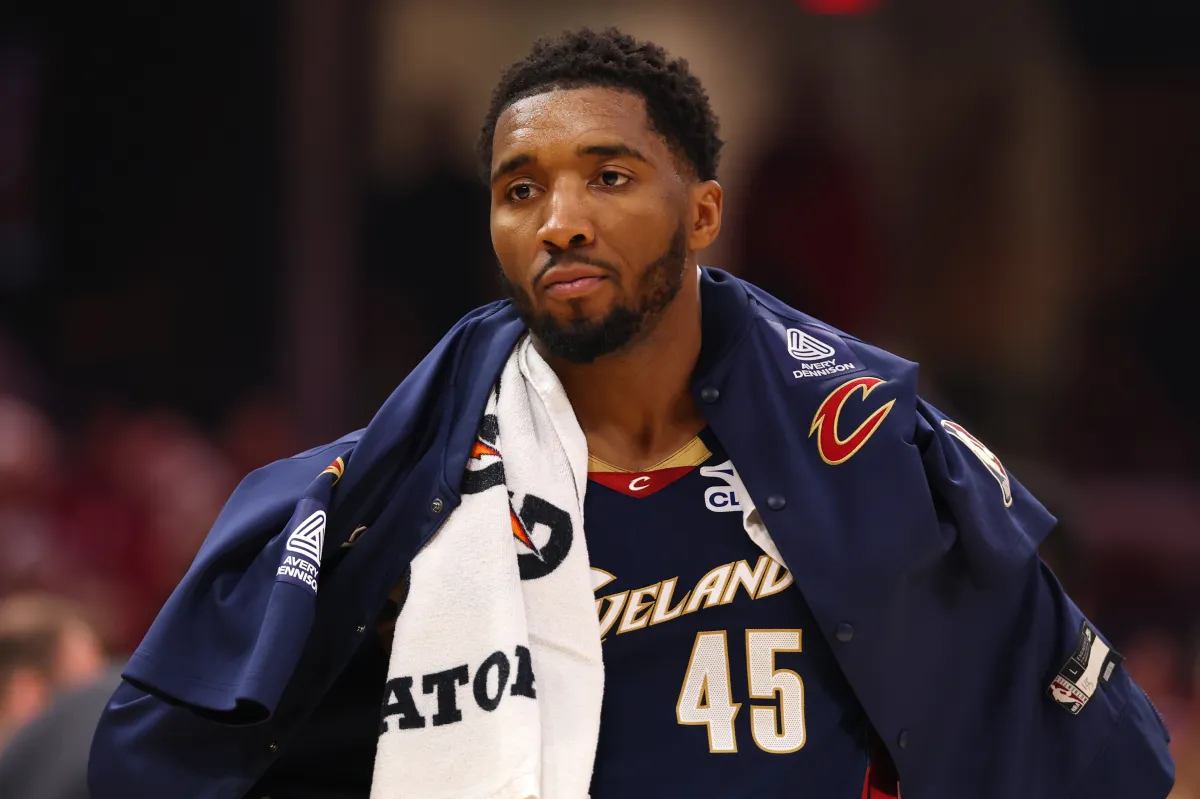
At the absolute center of this unfolding drama is Donovan “Spida” Mitchell, an undeniably electric, gravity-defying guard whose arrival was initially celebrated as the final, glorious piece of Cleveland’s modern championship puzzle. Mitchell is a spectacular human being both on and off the court, a charismatic leader who completely embraces the community, loves the bright lights of the big stage, and possesses a rare scoring gravity that few in basketball can replicate. Yet, as he fast approaches his 30s, his personal timeline of peak athletic prime begins to diverge from the slower development of Cleveland’s younger, less-experienced nucleus of Evan Mobley and Darius Garland. This age gap creates a highly sensitive financial puzzle under the league’s punishing new collective bargaining agreement, which mercilessly penalizes teams that overpay for star-studded rosters that cannot consistently deliver deep postseason runs. Committing a supermax, long-term contract extension to a guard who might ultimately prefer a larger media market risks locking the Cavaliers into an expensive ceiling of first-round exits. Crucially, this specific offseason represents the absolute zenith of Mitchell’s trade value across the league; he remains a dominant, top-15 superstar, healthy, highly productive, and uniquely capable of transforming any standard offense into a postseason juggernaut with his devastating pick-and-roll execution and clutchtime shot-making ability. For a Cavaliers front office that sacrificed a historic cache of draft assets and beloved young prospects to acquire him, the thought of trading him away is a heart-wrenching prospect, but the alternative is far more dangerous. If they hesitate due to sentimentality, Mitchell could simply play out his remaining contract and walk away for absolutely nothing in free agency, leaving Cleveland’s cupboard completely bare. Protecting the franchise’s long-term future requires having the cold, calculated administrative courage to explore blockbuster trade packages right now, before the marketplace shifts and they lose all leverage.
If the Cavaliers do choose to take the plunge and trade Mitchell, the Houston Rockets present an incredibly intriguing, albeit chaotic, destination that is desperately searching for immediate offensive relevance. The Rockets are a franchise starved for star power, historically prone to making massive, impatient swings to accelerate their rebuilding process after years of dwelling in the Western Conference cellar. Their front office is utterly exhausted by grueling, low-scoring contests and the slow, agonizing timeline of player development. Houston previously entertained wild, optimistic dreams of landing transformative, championship-altering veterans to vault them back into the playoff conversation, only to find their real-world roster repeatedly beaten down by Western Conference powerhouses like a Los Angeles Lakers squad that didn’t even have to break a sweat to dismantle them. Adding a player of Mitchell’s caliber to the Rockets’ mix would instantly cure their stagnant half-court offense, providing them with a legitimate, playoff-hardened weapon who can break down elite perimeter defenders and score from literally anywhere on the hardwood. Yet, bringing Mitchell to Space City is a classic double-edged sword that could severely compromise their long-term structural health and financial trajectory. A trade of this magnitude would require Houston to surrender several of their highly prized young core players—such as Jalen Green or Amen Thompson—alongside a mountain of valuable draft capital they secured during their rebuilding years. While Mitchell’s individual brilliance would undoubtedly elevate Houston’s regular-season floor and satisfy an impatient fanbase hungry for playoff basketball, critics rightfully worry it would be a short-sighted panic move. It might make them a trendy, mid-tier playoff team under Ime Udoka’s leadership, but it ultimately threatens to cap their long-term ceiling, leaving them with an incredibly expensive star but without the depth needed to ever mount a genuine championship run.
Alternatively, a blockbuster trade to the Atlanta Hawks presents a highly cinematic basketball partnership that could completely reshape the structural hierarchy of the Eastern Conference. The Hawks have established a distinct reputation as a front office that is entirely unafraid to push all of their chips into the middle of the table, constantly seeking that explosive, paradigm-shifting move to unlock their roster’s true potential. In this hypothetical scenario, the premier attraction would be the creation of a superstar pairing featuring Mitchell alongside Jalen Johnson, the Hawks’ incredibly gifted forward whose rapid, breakout ascent as a dynamic playmaker has captured the imagination of basketball purists around the globe. Johnson’s unique blend of elite court vision, imposing physical size, and explosive transition athleticism makes him the ultimate modern basketball player, and Mitchell is precisely the type of lethal, perimeter threat who could elevate Johnson’s playmaking to a masterclass level. Furthermore, Mitchell possesses a deep, trusting history with Atlanta’s head coach Quin Snyder from their highly successful years together with the Utah Jazz, suggesting an almost seamless tactical integration into Snyder’s complex offensive schemes. For Mitchell, playing in Atlanta would offer a refreshing change of scenery, placing him in a vibrant, culturally rich metropolitan city alongside a young, ascending co-star who can shoulder the physical burdens of a grueling eighty-two game season. However, pulling off a deal of this immense magnitude would require Atlanta to totally dismantle their current backcourt rotation, likely necessitating the departure of other vital core players like Dejounte Murray or Trae Young, alongside several highly coveted future draft picks. It represents a massive gamble on short-term chemistry, but if the puzzle pieces fit, a Mitchell-Johnson tandem under Snyder’s guidance would instantly make Atlanta one of the most watchable, dangerous, and physically dominant dynamic duos in the Eastern Conference landscape.
Of course, no modern superstar sweepstakes would be complete without the inevitable, looming presence of the Miami Heat, a franchise that operates with a legendary, almost predatory focus on acquiring premier talents to sustain their iconic culture of competitive excellence. Under the relentless guidance of team president Pat Riley, the Heat have historically bypassed the slow, traditional route of drafting and developing, choosing instead to target disgruntled, elite stars who can immediately thrive in their highly disciplined environment. Mitchell fits the classic “Heat Culture” archetype perfectly: a physically robust, mentally resilient superstar who consistently raises his level of performance when the physical demands of the postseason are at their absolute peak. Miami’s ultimate grand scheme would center on pairing Mitchell with their elite, multi-positional defensive anchor, Bam Adebayo, establishing a terrifyingly athletic star nucleus that could match up with any heavyweight roster in the league. The genuine off-court connection between Mitchell and Adebayo is well-documented, and their complementary skill sets—Mitchell’s lethal perimeter shot creation combined with Adebayo’s elite screen-setting and defensive IQ—would form a near-perfect basketball foundation. However, prying Mitchell away from Cleveland would force Miami to virtually empty their entire war chest of future draft picks, young players like Jaime Jaquez Jr. or Nikola Jovic, and high-salary assets like Tyler Herro, potentially gutting their roster depth to a microscopic level. This harsh financial reality raises a cynical, yet highly necessary sports question: would a top-heavy Heat team consisting of Mitchell, Adebayo, and an aging Jimmy Butler actually be enough to dethrone the reigning powerhouses of the East? Or would this spectacular trade simply leave them right back at the drawing board in a couple of seasons, desperately searching for another miracle trade to salvage their championship window?
In the final analysis, the Cleveland Cavaliers stand at an incredibly historic and emotionally charged crossroads where the decision to stay the course might actually be the most dangerous gamble of all. The modern NBA is a beautifully merciless landscape that aggressively punishes complacency, and sports history has repeatedly shown that organizations that hesitate to make the hard, unsentimental choices are quickly left behind in the dust of their competitors. For Cleveland’s fiercely loyal fanbase, the thought of trading away a player of Mitchell’s transcendent, spellbinding talent is understandably painful, evoking deep-seated memories of past eras where beloved local icons suddenly departed and left the city in athletic ruin. However, professional basketball is a cold, highly transactional business where regional sentimentality must occasionally be cast aside to pave the path for sustainable, long-term greatness. A carefully executed trade with desperate, asset-rich suitors like Houston, Atlanta, or Miami could provide Cleveland with the flexible draft assets, elite defensive depth, and essential cap relief necessary to build a balanced roster around the timeline of their young core. It requires the front office to look past the immediate public relations headache of trading away their best player and focus on the cold math of championship construction. Whether Cleveland’s leadership decides to double down on Mitchell’s prime or boldly pivot toward a flexible, draft-rich future, their administrative actions over the coming months will fundamentally define the franchise for the next decade. In a sports world where standing still is the ultimate sin, the difference between perpetual mediocrity and genuine championship glory is always defined by the courage of a franchise to make the absolute toughest decisions when the pressure is at its absolute highest, ensuring that the legacy of this era is remembered not for its safe choices, but for its bold, unwavering pursuit of excellence.