





The tranquil afternoon air of Washington, D.C., was violently shattered on a recent Saturday evening when a sudden volley of gunfire erupted near the intersection of 17th Street and Pennsylvania Avenue Northwest, sending shockwaves through the heart of American democracy. Journalists on the White House grounds, accustomed to the fast-paced but highly structured rhythm of political reporting, were abruptly thrust into a state of panic as Secret Service agents rushed them into the press briefing room, locking the doors and ordering an immediate shelter-in-place. Outside, a tragic human drama was unfolding against the backdrop of the presidential complex’s formidable perimeter. Nasire Best, a twenty-one-year-old resident of Maryland, had approached a security checkpoint shortly after six o’clock, carrying a heavy burden of unseen mental distress along with a weapon concealed in his bag. When he pulled out the firearm and began shooting at the posted officers, the response was swift, clinical, and fatal; agents returned fire, striking Best, who later succumbed to his wounds at a local hospital. This violent end was the culmination of a deeply troubled history; just months earlier, in July 2025, Best had been detained at another checkpoint, desperately claiming he was Jesus Christ and practically begging officers to arrest him. His death stands as a grim reminder of how unresolved personal crises and mental health struggles can collide catastrophically with the rigid, zero-tolerance apparatus of elite national security, leaving families to mourn and policy-makers to grapple with the fallout.
This sudden outbreak of violence near the executive mansion was not an isolated tremor, but part of a larger, deeply unsettling seismic wave of threats that have haunted the presidency in recent weeks. Only a month prior, at the end of April, the high-profile White House Correspondents’ Dinner was targeted by another armed individual, Cole Allen, who managed to get terrifyingly close to the venue where President Donald Trump and his inner circle were gathered. Although Allen did not succeed in firing his weapon, his arrest on charges of attempted assassination and various firearms offenses sent a cold shiver through the administration, illustrating that the dangers facing the commander-in-chief are both persistent and pervasive. The Department of Justice has seized upon these two near-misses within a thirty-day window to argue that the threat landscape has fundamentally mutated, shifting the conversation from routine safety protocols to an urgent, existential crisis of national security. For the President, his family, and his senior staff, these incidents are not mere legal data points or statistical anomalies; they are vivid, terrifying reminders of vulnerability. The administration frames these attacks as direct assaults on the presidency itself, arguing that the psychological and physical toll of operating under constant siege demands an unprecedented overhauling of executive defenses, transforming the way the leader of the free world interacts with both his guests and the physical space of the White House.
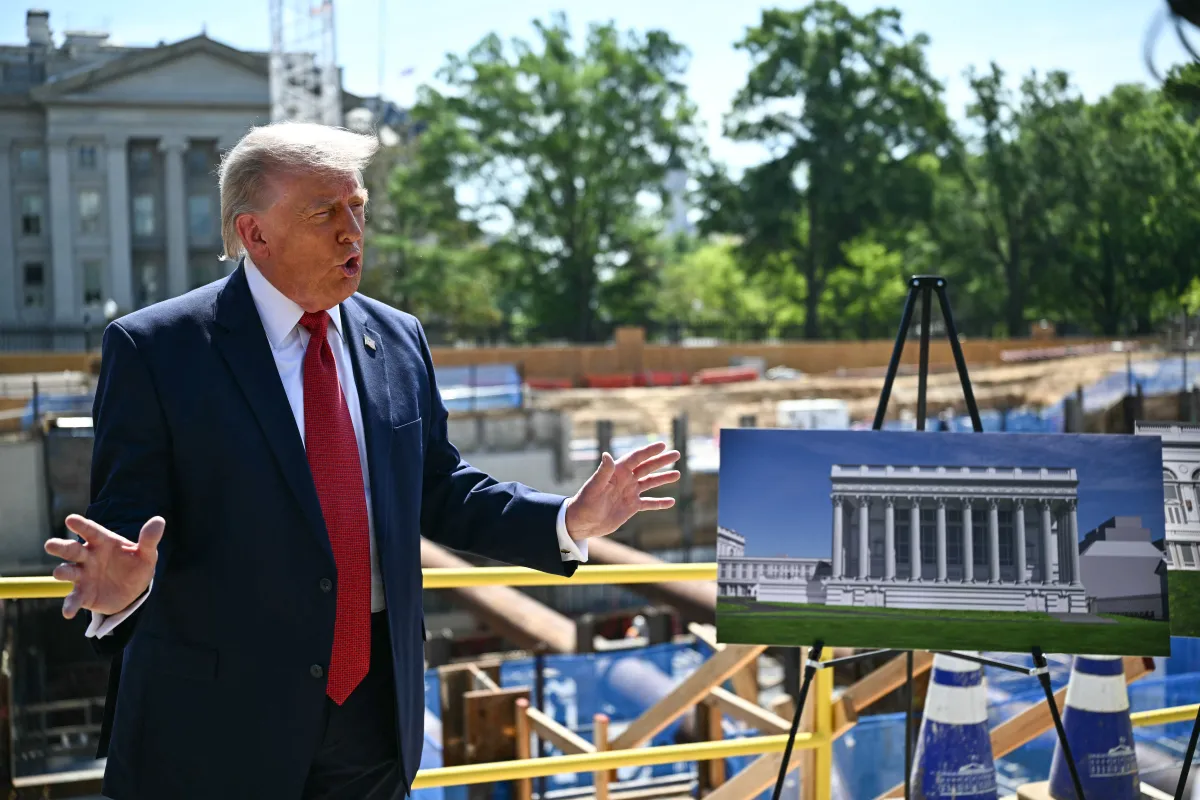
At the center of this gathering storm is a fierce legal and ideological battle over a proposed building project: a massive, four-hundred-million-dollar ballroom intended to expand the East Wing of the White House. The Trump administration has lobbied fiercely for this construction, presenting it as a vital sanctuary designed for the physical preservation of all future presidents, their families, senior staff, and visiting foreign dignitaries. However, this vision of an impenetrable fortress has run headlong into a challenge mounted by the National Trust for Historic Preservation, an organization dedicated to safeguarding the architectural legacy and democratic accessibility of America’s most treasured landmarks. The preservationists argue that a project of this scale, which fundamentally alters the iconic silhouette of the “People’s House,” requires rigorous public scrutiny and adherence to established heritage-protection laws rather than a rushed, bypass-the-rules construction schedule. This clash represents a profound human dilemma: how does a nation balance the preservation of its historical identity—symbolized by an open, transparent, and aesthetically accessible executive mansion—with the visceral, primitive need to protect its leaders from highly sophisticated, modern-day threats? The legal battle is not just about concrete and steel; it is a philosophical argument over whether fear should be allowed to permanently reshape the tangible symbols of democratic freedom.
To understand the scale of the administration’s anxieties, one must look at the astonishingly fortified design of the proposed ballroom, which resembles a science-fiction redoubt more than a traditional venue for state dinners. The Department of Justice’s court filings paint a vivid picture of the vulnerabilities inherent in the White House’s current setup, particularly the temporary canvas tents that have historically been erected on the lawn for major social events—structures that officials dismiss as laughably unsafe and utterly defenseless against modern weaponry. In stark contrast, the proposed ballroom is engineered to withstand a veritable apocalypse: it is designed with missile-resistant and drone-proof columns, bomb shelters, and heavy ballistic- and blast-proof glass. Perhaps most striking is the revelation of a dedicated drone port and government-sniper facilities engineered directly into the structure—details the government laments having to disclose publicly, arguing that the historic preservation lawsuit forced them to compromise operational security. Furthermore, rather than relying on standard rooftop air-conditioning units that could be vulnerable to airborne toxins, the entire facility will be hermetically sealed, protecting the occupants inside from any “malign forces” attempting to contaminate the atmosphere. It is an architecture designed for a dark, uncertain future where even the air we breathe can be weaponized, turning a space historically meant for diplomatic soft power and celebration into an armored command bunker.
The Department of Justice’s latest legal filing has leveraged the tragedy of the Saturday shooting as a powerful rhetorical cudgel to demand the immediate dismissal of the preservationists’ lawsuit, arguing that administrative red tape must not be allowed to stand in the way of vital national security. In a highly unusual twist of public-private cooperation, the DOJ has highlighted that the four-hundred-million-dollar price tag is being heavily offset by hundreds of millions of dollars in donations from “patriotic private donors.” This financial arrangement adds another layer of human complexity to the saga, raising questions about the ethics of wealthy private citizens directly funding the physical infrastructure of federal security, and whether such acts represent selfless patriotism or an unprecedented privatization of democratic spaces. The government’s brief insists that the project is an “invaluable gift” to the nation, built for the enduring safety of all future administrations, and argues that continuing to delay construction past the current June 5 injunction deadline is an unacceptable risk to human life. For the critics and the National Trust, however, the administration’s exploitation of recent security scares is viewed with deep skepticism; they maintain that even in times of heightened danger, the government must remain bound by the rule of law and democratic accountability, refusing to let panic dictate the destruction of historic preservation processes.
As the June 5 deadline quickly approaches, the nation finds itself at a poignant crossroads, watching a literal and metaphorical wall being built around the presidency. The tragic death of Nasire Best and the chilling arrest of Cole Allen are painful reminders of the volatile, fractured society that exists just beyond the heavily guarded gates of the White House. If the court rules in favor of the administration and dismisses the lawsuit, construction on this hermetically sealed, bulletproof palace will proceed apace, setting a precedent where security imperatives can swiftly override historical preservation and regulatory oversight. Yet, as we contemplate a future where the President of the United States hosts world leaders inside an impenetrable, self-contained bunker complete with missile defenses and sniper nests, we are forced to ask a deeper, more troubling question about the trajectory of our civilization. Are we protecting our leaders at the cost of alienating them from the very public they serve, and is a house truly safe if it must be transformed into a fortress to survive? Ultimately, this battle over a ballroom is a stark reflection of the contemporary human condition—a society deeply divided, haunted by the specter of sudden violence, and struggling to find a way to preserve both its safety and its soul in an increasingly hostile world.