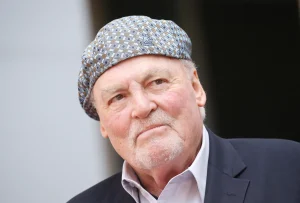


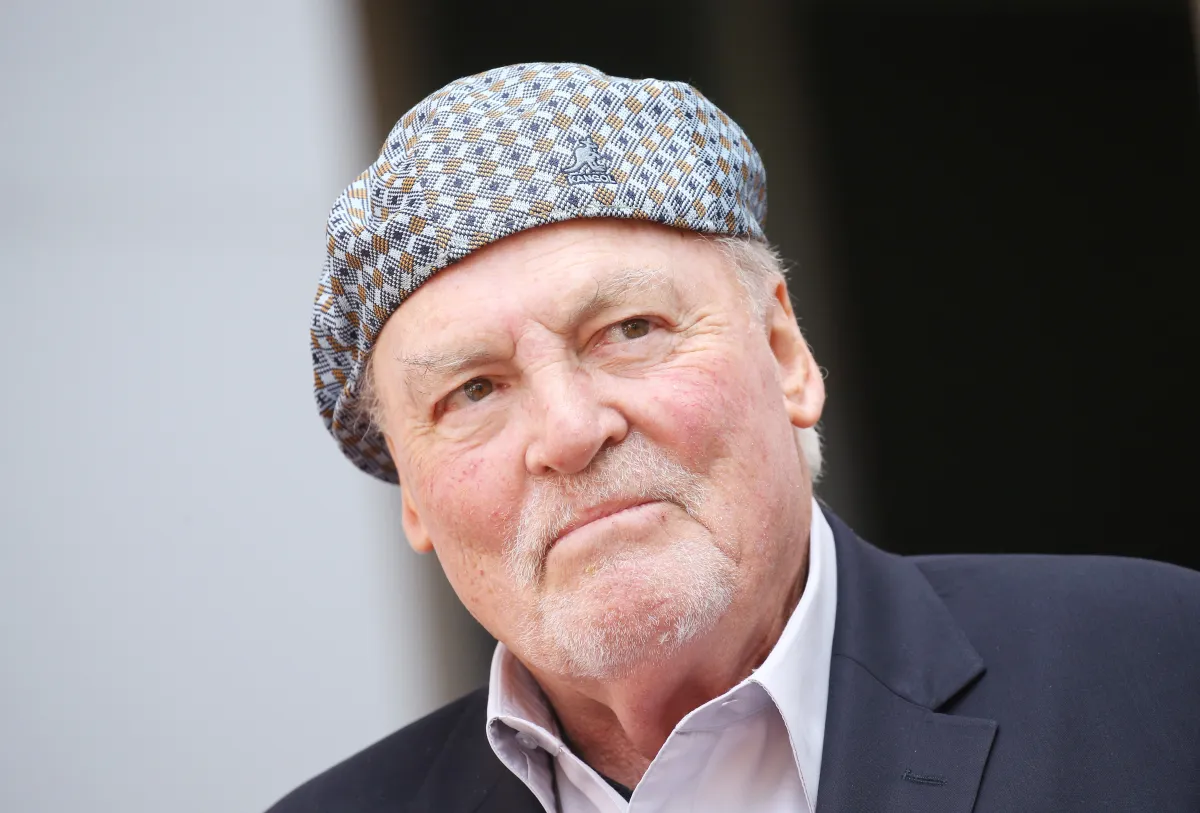
The world of acting has lost one of its most formidable and enduring voices. Stacy Keach, the classically trained American actor whose multifaceted career spanned more than six decades, passed away on Tuesday at his home in Magdalenka, Poland. He was 85 years old. The cause was a serious heart condition that he had fought against with unyielding courage for a long and difficult period. His wife, Malgosia Tomassi Keach, delivered the heartbreaking news, offering a poignant glimpse into the private battle he waged during his final years. “He fought for so long, with extraordinary courage, determination and strength,” she said in a statement. “He was a true warrior, facing his illness with the same remarkable spirit and resilience that defined his life.” Her words painted a vivid picture not just of an actor facing his final curtain call, but of a man who met every hardship—whether on stage, on screen, or in the relentless currents of life—with an unyielding grit that never allowed him to surrender. It was a fitting epitaph for someone who had spent a lifetime plumbing the depths of the human condition, from the tragic heights of Shakespearean kings to the bruised and battered boxers of American cinema. His departure marks the end of an era for those who revere raw, visceral acting rooted in the rigorous traditions of the theater, and for those who simply remember the tough, brooding private eye who graced their television screens in a trench coat and fedora. The loss is profound, yet the legacy he leaves behind is a masterclass in artistic dedication and human resilience, a testament to a man who poured every ounce of his formidable presence into each role he inhabited.
Born on June 2, 1938, in Savannah, Georgia, Keach’s journey to artistic greatness was paved with academic excellence and intensive theatrical training that would shape the very core of his being. He studied at the University of California, Berkeley, before earning a coveted spot at the distinguished Yale School of Drama, where he refined his craft alongside some of the most promising talents of his generation. A Fulbright scholarship then carried him across the Atlantic to the London Academy of Music and Dramatic Art, an experience that would cement his deep and abiding affinity for the works of the Bard. It was in London that he honed the formidable technique and the booming, resonant voice that would become his unmistakable signature—a voice that could command a theater with a whisper or shake the rafters with a bellow of rage. Keach was widely regarded as one of America’s foremost interpreters of Shakespeare, a reputation that placed him on an exalted pedestal among his peers and allowed him to walk in the footsteps of the greatest actors of his age. He tackled the monumental role of King Lear on Broadway, a part that has broken lesser performers under the weight of its sheer emotional and physical demands, yet Keach handled it with a raw, visceral intensity that left audiences breathless. His performances were never mere recitations of dense Elizabethan text; they were live wires of emotion, physicality, and intellect that crackled with contemporary relevance. He brought a modern sensibility to classical roles, making ancient kings and tormented archbishops feel startlingly human and immediately accessible. Whether prowling the boards as Richard III with malevolent cunning or delivering a soliloquy with a knowing, weary sigh, Keach possessed a command of the stage that could hold a packed theater spellbound in absolute silence. He did not simply act; he inhabited a character so completely that the audience forgot the man behind the mask, and in doing so, he elevated the craft of acting to the level of high art.
While he was a titan of the living stage, Keach’s career stretched with equal dexterity into the realms of film and television, showcasing a versatility that few of his contemporaries could match. He earned a Tony Award nomination for his portrayal of Buffalo Bill in the Broadway production of Indians, but his film work was equally potent and far-reaching. He delivered a searing performance in John Huston’s noir-tinged drama Fat City, playing an aging boxer trapped in the gritty, sunbaked underbelly of Stockton, California—a role that demanded profound vulnerability, physical exhaustion, and battered pride. He later added memorable turns in The Ninth Configuration, William Peter Blatty’s surreal exploration of madness and faith, and in the Oscar-winning Nebraska, where he played the gruff, stubborn brother of Bruce Dern’s protagonist. He also appeared in American History X, lending gravitas to the role of the tragic father, and in later years, he graced the small screen with a recurring role as a wise and weathered archbishop on the CBS procedural Blue Bloods. Just this year, he appeared in the film Jay Kelly, playing George Clooney’s father, proving that his raw talent never dimmed with age and that he remained a sought-after presence in Hollywood even into his ninth decade. However, it was his portrayal of the hard-boiled private eye Mike Hammer in the 1980s television series that made him a household name and cemented his status in popular culture. With his trench coat, fedora, and gruff, noir-inflected demeanor, Keach perfectly embodied the literary detective, bringing a classic pulp sensibility to living rooms across America. He was simultaneously a high-brow artist and a populist entertainer, shifting effortlessly from the sublime heights of King Lear to the gritty streets of a detective’s world without missing a beat, proving that his talent was as boundless as his ambition.
The most potent and tragic symbol of Keach’s unyielding warrior spirit came not in a boxing ring or on a battlefield, but on a theatrical stage in Chicago in June 2017. While performing a one-man show about the legendary author Ernest Hemingway, a man renowned for his machismo, his hard living, and his tragic end, Keach suffered a heart attack directly in the middle of his performance. The irony was so profound it almost defied comprehension—an artist playing an icon of masculine endurance collapsing while embodying that very spirit of adventurous resilience. The production was immediately canceled, and Keach was rushed to a hospital, beginning a new, grueling chapter in his personal war against cardiac disease. That moment encapsulated the paradox of his entire career: an artist willing to push himself to the absolute physical and emotional brink for the sake of his art. Keach had always been drawn to complex, tormented characters—Hemingway, King Lear, Buffalo Bill—figures who grapple with mortality, identity, and the fickle nature of legacy. That he should suffer his own physical breakdown while channeling Hemingway, a man who ultimately took his own life, adds a tragic, almost poetic layer to his story that weaves through the fabric of his myth. Unlike Hemingway, however, Keach survived that collapse, refusing to let death claim him on the stage he loved so deeply. He fought back with the same determination he had applied to every role, enduring a long and difficult convalescence, but the heart condition that had so brutally interrupted his craft would eventually prove too formidable an opponent. It finally subdued this true warrior at his home in Poland, yet there is a strange comfort in knowing that his last great public performance was one of immense physical dedication to his art.
Keach’s life was not without its devastating low points, and the most glaring of these occurred in 1984, at the very height of his career and public prominence. At London’s Heathrow Airport, customs officials discovered cocaine hidden in his luggage, leading to his immediate arrest. The subsequent conviction sent shockwaves through Hollywood and the global entertainment industry, and Keach was sentenced to nine months in prison, serving six at Reading Gaol. He was 44 years old, a family man, and an internationally renowned actor, yet he was brought low by the very substance that had insidiously plagued his life and threatened to destroy his legacy. In his 2013 memoir, All in All: An Actor’s Life On and Off the Stage, Keach described this arrest and imprisonment as the “lowest moment” of his life, a period of profound shame and humiliation. He vividly recalled the crushing weight of the verdict, writing, “As my sentence was read — nine months in prison — I felt like someone had kicked me in the groin with lead cleats.” He described his time behind bars as “very lonely, very depressing, very sad,” a period of isolation and introspective darkness that forced him to confront the demons he had tried so hard to outrun. But true to the resilient nature his wife later praised so movingly, Keach did not surrender to that darkness or allow it to define him forever. Following his release, he confronted his addiction head-on with the same courage he brought to his most challenging roles. He spoke publicly and with brutal honesty about his struggles, bravely testifying before Congress about the scourge of substance dependence. He visited college campuses and rehabilitation centers across the country, not to seek pity, but to serve as a living warning and a beacon of hope for others trapped in similar cycles of addiction. He transformed his professional and personal disgrace into a platform for advocacy and redemption, proving that a fall from grace does not have to dictate the entirety of one’s legacy, and that true strength often lies in the ability to rise from the ashes of one’s own mistakes.
As the news of his passing spreads across the globe, the spotlight inevitably turns to the remarkable fullness of Stacy Keach’s life, and the rich tapestry of contradictions that made him so fascinating. He was a classically trained Shakespearean who found superstar fame as a gritty private eye; a deeply private man who publicly exposed his deepest flaws; a survivor who pushed himself to the brink of death for his art and then lived to tell the tale. Beyond the Tony nomination for Indians, the Golden Globe he won for his portrayal of Hemingway in a television miniseries, and the countless films and plays that bear his artistic mark, Keach was a devoted family man who found lasting love and stability with Malgosia. He is survived by his wife, Malgosia, his daughter Shannon, and his son Karolina, who together inherit a legacy of courage, defiance against quiescence, and a relentless pursuit of excellence. His body of work serves as a monumental testament to the power of dedication and the enduring magic of storytelling, while his personal journey serves as a stark reminder that human beings are messy, fallible, and yet capable of extraordinary redemption. Keach’s journey—from the red clay of Savannah, Georgia, through the hallowed halls of Yale and the London stage, to the heights of Hollywood stardom, the depths of prison, and the quiet dignity of his final days in Poland—is a quintessential American story of rise, fall, and triumphant rebirth. While the world mourns the loss of a titan, there is profound comfort in knowing that Keach lived life entirely on his own terms, meeting every obstacle—be it an addiction, a failing heart, or a demanding script—with that same remarkable spirit his wife so lovingly described. He exits the stage not with a quiet whisper, but with the resounding echo of a veteran actor who gave everything he had until the final curtain call, leaving behind an artistic footprint that will continue to inspire actors and audiences for generations to come, a truly magnificent life lived in the full light of the world’s attention.