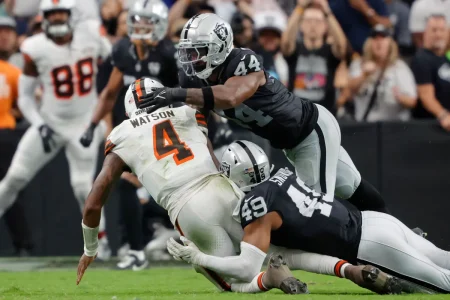


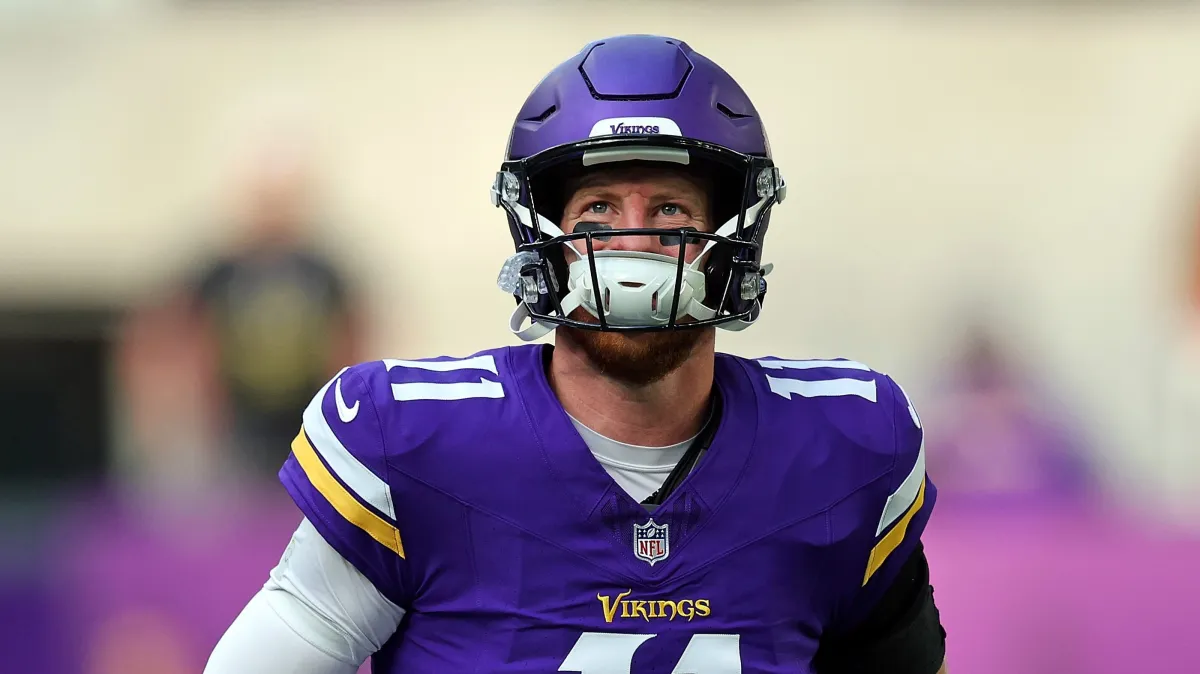
Football has a way of turning ordinary Sundays into mythology, and this was one of those afternoons when the story felt bigger than the scoreboard. The Minnesota Vikings and Green Bay Packers were locked in the kind of NFC North battle that always carries a little extra weight, but no one expected the pivot point to come so early. With about six minutes left in the first quarter, Vikings quarterback Kyler Murray scrambled toward the sideline, trying to extend a play the way he had done a thousand times before. Then came the kind of hit that changes a game—and maybe a season—in an instant. Green Bay defender Javon Bullard arrived with force, and Murray’s head snapped back against the turf. The sideline went quiet. The medical staff sprinted onto the field, and after a brief but tense evaluation, the diagnosis was a concussion. The stadium seemed to exhale all at once, not because everything was fine, but because everyone suddenly understood that the Vikings were going to have to find a way to win without their starter. Carson Wentz, the veteran backup who had won the job in a training camp battle that pushed a first-round rookie to the side, began to unbuckle his helmet and jog onto the field. It was not the moment he had planned for, but it was the moment he had prepared for his entire career.
What followed was not a story about perfect statistics. It was a story about steadiness and nerve. Wentz did not try to be superhero. He did not force throws into impossible windows or try to prove that he should still be a starter somewhere. He simply made the offense functional again, moving the chains, giving his playmakers chances, and reminding everyone that football is ultimately about trust. By the third quarter, though, the Packers had built a 22-10 lead, and the Vikings had every excuse to let the game slip away. That was when Wentz began to take control. He finished the afternoon with 12 completions on 19 attempts, 133 yards, and three touchdown passes—numbers that would look modest on a stat sheet but felt heroic in the context. More importantly, the offense started to believe. When Green Bay’s defense bent, Wentz stayed patient. When the crowd in Minnesota began to feel the momentum shift, he responded with the kind of rhythm that had been missing since the injury. The Vikings scored 29 unanswered points, turning a twelve-point deficit into a 39-22 victory. It was the kind of comeback that fans remember for a long time, not just because of the score, but because it came on a Sunday when the game could have gone completely off the rails.
In the modern NFL, every play is tied to something bigger, and for Wentz, this particular victory came with a financial reward that made the afternoon even sweeter. According to Spotrac, the quarterback earned a $100,000 bonus for playing at least 60 percent of the offensive snaps in a winning game. That kind of clause is written into the contracts of backup quarterbacks for exactly this reason—it rewards them for staying ready even when they are not expected to play. When the final whistle blew, Wentz had met the threshold, and the bonus was triggered. But the contract was designed with even more upside. He is eligible to earn that same $100,000 bonus for each winning game in which he plays at least 60 percent of the snaps, up to six wins. After that, the rewards escalate to $150,000 per victory for the next six wins. For a veteran who has experienced the highest highs and the lowest lows of the NFL, the money is meaningful, but it is not the only reason he was smiling in the locker room. The bonus symbolized something bigger: the recognition that he had been trusted in a critical moment, and he had delivered. It is one thing to practice with the starters all week. It is another thing entirely to walk into a heated rivalry game, shrug off the shock of the injury, and lead a comeback.
Now the question shifts to what happens next. Murray’s day ended with a concussion, and while the Vikings were celebrating the win, there was an unavoidable undertone of uncertainty. Concussion protocol has no timeline, and the only determination that matters will come from doctors, not coaches or fans. If Murray cannot clear the necessary tests before Minnesota travels to Chicago to face the Bears in Week 2, Wentz will get another chance to prove that this was not a one-game wonder. That possibility changes the mood of the week. Instead of a simple film review and a normal practice schedule, the Vikings have to prepare for two quarterbacks. Wentz, meanwhile, has been through enough seasons to know exactly how to handle the situation. He appeared in five games for the Vikings last season, throwing for 1,216 yards, six touchdowns, and five interceptions. He has been a starter in the NFL, he has been benched, he has been traded, and he has been doubted. Those scars have taught him not to panic. He knows that a backup’s job is not to replace a teammate’s personality or skill set, but to run the offense with confidence and clarity. So he will take the same repetitions, study the same film, and walk into the building every morning as if he is one play away—because in his world, he always is.
The most telling words, though, came from head coach Kevin O’Connell after the game. In a season where so much attention is paid to analytics and game plans, O’Connell reached for something human. “That’s why he’s here,” he said. “For him to come in and do what he did and just be part of that calming presence that allowed our team to continue playing, I can’t say enough about him.” Those words carried a weight that no stat sheet can capture. A backup quarterback has to be more than a good arm. He has to be a calm voice in a huddle filled with anxious eyes and racing hearts. Wentz gave the Vikings that. He walked onto the field with the kind of presence that makes players around him believe everything is going to be all right, even when the score says otherwise. O’Connell, a former quarterback himself, understood better than anyone what Wentz accomplished. It was not just about the three touchdown passes or the 133 yards. It was about the way he handled the moment, how he managed the clock, how he communicated in the huddle, and how he kept the offense confident when everything around him was changing.
This is the part of the story that stays with you. The NFL is often described as a league of stars, but the truth is that every season is shaped by the players who are ready when their names are called. Carson Wentz has been a star before, and he has been a backup who wondered if another opportunity would ever come. Sunday was not about proving that he should take Murray’s job. It was about proving that he could help his team win on one of the toughest stages in football. The victory over the Packers was a team effort, but it would not have happened without the quiet resilience of a veteran who refused to let a bad situation become a lost game. The $100,000 bonus is a nice reward, but the real payoff is the trust he earned from his coaches and teammates. As the Vikings turn their attention to the Chicago Bears, they know that there are no guarantees. Murray’s health, Wentz’s readiness, the momentum of the season—all of it remains unknown. But in the aftermath of a comeback like this, one thing feels certain: whatever happens next week, the man standing in the huddle will be ready. That is what makes football more than a game. It is a reminder that preparation, patience, and the courage to step into an unexpected moment can turn a backup into a hero.